California billionaire tax may yield less revenue, study says
Stanford economists caution a proposed wealth tax could lead to significant income tax losses.
AI-assisted coverage comparison, editor-supervised · How this was made
California billionaire tax may yield less revenue, study says
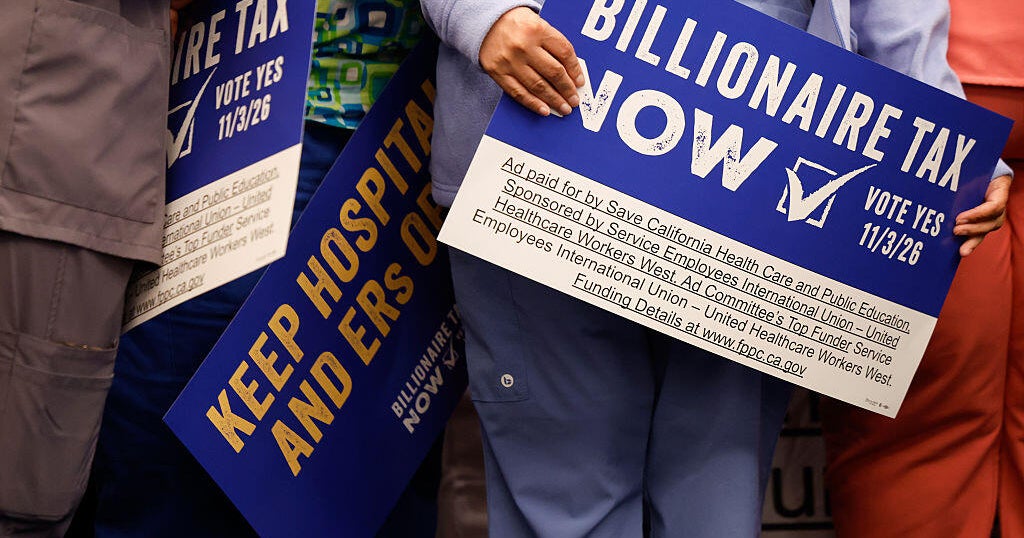
Photograph: CBS News (embedded from source)
What this story says
- Stanford economists Benjamin Jaros and Joshua Rauh estimate California's proposed billionaire tax would generate about $30 billion, significantly less than the $100 billion projected by proponents.
- Seven billionaires, including Peter Thiel, Larry Page, and Sergey Brin, have relocated from California, removing an estimated $540 billion or 30% of the state's billionaire wealth.
- The economists predict California could lose $1 billion to $3.5 billion annually in income tax revenue due to this decrease in its billionaire population.
- A Citrin-Politico poll indicates voter sentiment is divided, with 46% favoring the proposition and 43% opposing it.
Who covered it
Percentages are shares of the 32 outlets carrying a published leaning rating. 4 of the 36 outlets we know ran this story carry no rating and are not counted in them. Coverage measured .
Trust
68/100
Craft
95/100
Hype
15/100
36 sources · methodology
Thin on the left so far
Only 3 of the 32 outlets with a published leaning rating that ran this story are rated left.
This story is still being watched, so it is a count and not yet a finding. Coverage keeps arriving for hours after an event, and a side that has published nothing this morning may publish by tonight. If it is still true when we stop checking, we will say so plainly.
Stanford economists Benjamin Jaros and Joshua Rauh have estimated that California's proposed billionaire tax, Proposition 40, may generate approximately $30 billion in revenue. This figure is considerably lower than the $100 billion projected by supporters of the measure. The economists' working paper, published by the National Bureau of Economic Research, suggests that the tax, which would impose a one-time 5% state tax on billionaire wealth, could be offset by future income tax losses.
The study highlights that seven billionaires, including Peter Thiel, Larry Page, and Sergey Brin, have moved out of California. This exodus represents an estimated $540 billion, or 30%, of the state's total billionaire wealth, removing it from potential taxation. Jaros and Rauh calculated that California could lose between $1 billion and $3.5 billion annually in income tax revenue as a result of its shrinking billionaire population. They concluded that these persistent losses, when valued in today's dollars, could exceed the wealth tax proceeds by about $39 billion.
Disagreement on tax purpose and impact
The Service Employees International Union-United Healthcare Workers West (SEIU-UHW), which introduced the ballot measure, disputed the Stanford study's findings. Union vice president Debru Carthan stated that the tax's sole purpose is to ensure billionaires pay their fair share to prevent a healthcare system collapse and allow millions of Californians to keep their healthcare without premium increases. In contrast, the Stanford economists Jaros and Rauh wrote that their findings suggest the Billionaire Tax Act will not fulfill its intended functions, as behavioral responses prior to voting have already eroded much of the projected tax base. Other economists, including Nobel laureates Daron Acemoglu and Joseph Stiglitz, have supported the measure, noting California's increased venture funding since the tax was announced and arguing for public spending on essential services funded by the ultra-wealthy.
What the coverage left out
No left- or right-rated reports were available for this story. The centre-rated report did not include the views of economists who support the measure, such as Daron Acemoglu and Joseph Stiglitz, beyond a brief mention that they have signed their support.
Still developing. We have re-checked which outlets are covering this 6 times, most recently on 22 Oct 2026, 01:45, and will add the sides that appear.
How each side covered it
Our own reading of the reporting listed below, written from the outlets’ articles rather than quoted from them. The reasoning is set out on our methodology page.
Left
3 rated outlets
We have not written our reading of the left coverage of this story. The left-rated outlets that ran it are listed below.
Centre
13 rated outlets
- The centre-rated report from CBS News led with the caution from Stanford economists that California's proposed billionaire tax could result in less state revenue. It detailed the economists' estimate of $30 billion in potential revenue, contrasting it with the $100 billion projected by proponents. The report highlighted the departure of seven billionaires from California, representing $540 billion in wealth, and the projected annual income tax losses of $1 billion to $3.5 billion. It also included the union's refutation of the study and a poll showing divided voter sentiment, with 46% in favour and 43% opposed to Proposition 40.
Right
16 rated outlets
We have not written our reading of the right coverage of this story. The right-rated outlets that ran it are listed below.
Questions about this coverage
- How did the left and right cover California billionaire tax may yield less revenue, study says?
- Of the 32 outlets on this story carrying a published leaning rating, 9% are rated left, 41% are rated centre, 50% are rated right. Those percentages are shares of the rated outlets, not of every outlet that ran it, which was 36. The sections above set out what each side emphasised, in its own terms.
- Is California billionaire tax may yield less revenue, study says left or right?
- Neither side dominates it. Of the 32 rated outlets on this story, 9% are rated left, 41% are rated centre, 50% are rated right, and no side holds the 70% this site would want before calling a field one-sided. A story is not left or right in any case; the outlets that carried it are what carry ratings.
- Is the coverage of California billionaire tax may yield less revenue, study says biased?
- California billionaire tax may yield less revenue, study says is one event reported by 36 outlets, and this page does not rate the story as biased or unbiased. What it publishes is the spread: which outlets ran it, where named rating organisations place each of them on the spectrum, and what each side chose to lead with. A leaning rating describes an outlet's record over time, not this article, and the two should not be run together.
- Which side is not reporting California billionaire tax may yield less revenue, study says?
- When we first saw this story, outlets rated left had barely covered it. Coverage accretes for hours after an event, so that is where to look rather than a verdict — the split above is the current count, and it is the one to read.
- Which outlets covered California billionaire tax may yield less revenue, study says?
- 36 that we know of, every one of them listed further up this page with a link to its own report and to what we hold on the publisher. Nothing here is a summary of somebody else's summary: the outlets are named so the original reporting can be read.
- How much revenue could California's proposed billionaire tax generate?
- Stanford economists Benjamin Jaros and Joshua Rauh estimate the tax could generate about $30 billion. This is significantly less than the $100 billion projected by proponents of the measure, Proposition 40.
- Why might the tax generate less revenue than expected?
- The Stanford study suggests that billionaires may move out of California in response to the tax, thereby removing wealth from potential taxation. This wealth migration could lead to substantial losses in state income tax revenue, potentially offsetting the revenue gained from the wealth tax itself.
- What is the projected impact on California's income tax revenue?
- Economists predict that California could lose between $1 billion and $3.5 billion annually in income tax revenue due to a shrinking billionaire population. If these losses are permanent, their value could exceed the wealth tax proceeds by approximately $39 billion.
- How do voters feel about the proposed billionaire tax?
- A Citrin-Politico poll indicates that voter sentiment is divided. According to the poll, 46% of likely voters favor Proposition 40, while 43% oppose it, suggesting a close contest ahead of the vote.
Read it at the source
36 outlets, grouped by the leaning a published rating gives them. Every headline links to the original; an underlined outlet name opens our profile of that publisher.
Left
3- Economists: Billionaire tax would hurt, not help, California (opens News-Herald in a new tab)
News-Herald — is News-Herald biased? Our profile of this outletOpinion
- Economists: Billionaire tax would hurt, not help, California (opens Fairfield Sun Times in a new tab)
Fairfield Sun Times — is Fairfield Sun Times biased? Our profile of this outletOpinion
- Economists: Billionaire tax would hurt, not help, California (opens Daily Post-Athenian in a new tab)
Daily Post-Athenian — is Daily Post-Athenian biased? Our profile of this outletOpinion
Centre
13- Billionaires fleeing California could turn a $30 billion tax windfall into a $39 billion loss, Stanford economists warn (opens Fortune in a new tab)
- Economists: Billionaire tax would hurt, not help, California (opens romesentinel.com in a new tab)
romesentinel.com — is romesentinel.com biased? Our profile of this outletOpinion
- Economists: Billionaire tax would hurt, not help, California (opens Your Alaska Link in a new tab)
Your Alaska Link — is Your Alaska Link biased? Our profile of this outletOpinion
- Economists: Billionaire tax would hurt, not help, California (opens The Penn in a new tab)
The Penn — is The Penn biased? Our profile of this outletOpinion
- Economists: Billionaire tax would hurt, not help, California (opens The Guam Daily Post in a new tab)
The Guam Daily Post — is The Guam Daily Post biased? Our profile of this outletOpinion
- Economists: Billionaire tax would hurt, not help, California (opens Star Local in a new tab)
Star Local — is Star Local biased? Our profile of this outletOpinion
- Economists: Billionaire tax would hurt, not help, California (opens Purdue Exponent in a new tab)
Purdue Exponent — is Purdue Exponent biased? Our profile of this outletOpinion
- Economists: Billionaire tax would hurt, not help, California (opens News-Graphic.com in a new tab)
News-Graphic.com — is News-Graphic.com biased? Our profile of this outletOpinion
Show 5 more
- Economists: Billionaire tax would hurt, not help, California (opens KTEN in a new tab)
- Economists: Billionaire tax would hurt, not help, California (opens KPVI in a new tab)
- Economists: Billionaire tax would hurt, not help, California (opens KAKE News in a new tab)
KAKE News — is KAKE News biased? Our profile of this outletOpinion
- Economists: Billionaire tax would hurt, not help, California (opens Columbia Gorge News in a new tab)
Columbia Gorge News — is Columbia Gorge News biased? Our profile of this outletOpinion
- California billionaire tax could leave state with less revenue, Stanford study cautions (opens CBS News in a new tab)
Right
16- Economists: Billionaire tax would hurt, not help, California - The Daily Bo Snerdley (opens thedailybs.com in a new tab)
thedailybs.com — is thedailybs.com biased? Our profile of this outletOpinion
- Economists: Billionaire tax would hurt, not help, California (opens Webster County Citizen in a new tab)
Webster County Citizen — is Webster County Citizen biased? Our profile of this outletOpinion
- Economists: Billionaire tax would hurt, not help, California (opens WVII / Fox Bangor in a new tab)
WVII / Fox Bangor — is WVII / Fox Bangor biased? Our profile of this outletOpinion
- Economists: Billionaire tax would hurt, not help, California (opens The Mountain Press in a new tab)
The Mountain Press — is The Mountain Press biased? Our profile of this outletOpinion
- Economists: Billionaire tax would hurt, not help, California (opens The Herald Palladium in a new tab)
The Herald Palladium — is The Herald Palladium biased? Our profile of this outletOpinion
- Economists: Billionaire tax would hurt, not help, California (opens The Elkhart Truth in a new tab)
The Elkhart Truth — is The Elkhart Truth biased? Our profile of this outletOpinion
- Economists: Billionaire tax would hurt, not help, California (opens The Daily Herald in a new tab)
The Daily Herald — is The Daily Herald biased? Our profile of this outletOpinion
- Economists: Billionaire tax would hurt, not help, California (opens The Center Square in a new tab)
The Center Square — is The Center Square biased? Our profile of this outletOpinion
Show 8 more
- Economists: Billionaire tax would hurt, not help, California (opens News-Topic in a new tab)
News-Topic — is News-Topic biased? Our profile of this outletOpinion
- Economists: Billionaire tax would hurt, not help, California (opens Mountain Democrat in a new tab)
Mountain Democrat — is Mountain Democrat biased? Our profile of this outletOpinion
- Economists: Billionaire tax would hurt, not help, California (opens Chronicle-Tribune in a new tab)
Chronicle-Tribune — is Chronicle-Tribune biased? Our profile of this outletOpinion
- Billionaire tax would hurt California, not help, according to some economists (opens Just the News in a new tab)
Just the News — is Just the News biased? Our profile of this outlet
- Economists: Billionaire tax would hurt, not help, California (opens Owensboro Messenger-Inquirer in a new tab)
Owensboro Messenger-Inquirer — is Owensboro Messenger-Inquirer biased? Our profile of this outletOpinion
- Stanford Researchers Just Gave California’s Billionaire Tax a Cold Dose of Reality (opens Townhall in a new tab)
- Worst-Case California Wealth Tax Scenario? It 'Succeeds' (opens RealClearMarkets in a new tab)
RealClearMarkets — is RealClearMarkets biased? Our profile of this outletOpinion
- The California billionaire tax is very likely a net revenue loser (opens Marginal REVOLUTION in a new tab)
Marginal REVOLUTION — is Marginal REVOLUTION biased? Our profile of this outletOpinion
Not rated
4- California’s billionaire tax could leave the state $39 billion poorer, Stanford economists warn (opens MSNBCTV NEWS in a new tab)
MSNBCTV NEWS — is MSNBCTV NEWS biased? Our profile of this outlet
- Economists: billionaire tax would hurt, not help, California (opens The San Joaquin Valley Sun in a new tab)
The San Joaquin Valley Sun — is The San Joaquin Valley Sun biased? Our profile of this outletOpinion
- Economists: Billionaire tax would hurt, not help, California (opens Fort Wayne Business Weekly in a new tab)
Fort Wayne Business Weekly — is Fort Wayne Business Weekly biased? Our profile of this outletOpinion
- California billionaire tax could backfire, Stanford study says (opens BizToc in a new tab)
How did this read?
About the coverage, not about the story. We do not ask whether you agree with what happened — we have no honest use for that answer.