Global student performance hits lowest point in 25 years
OECD PISA 2025 results show sharp declines in reading, maths, and science, with AI use a contributing factor.
AI-assisted coverage comparison, editor-supervised · How this was made
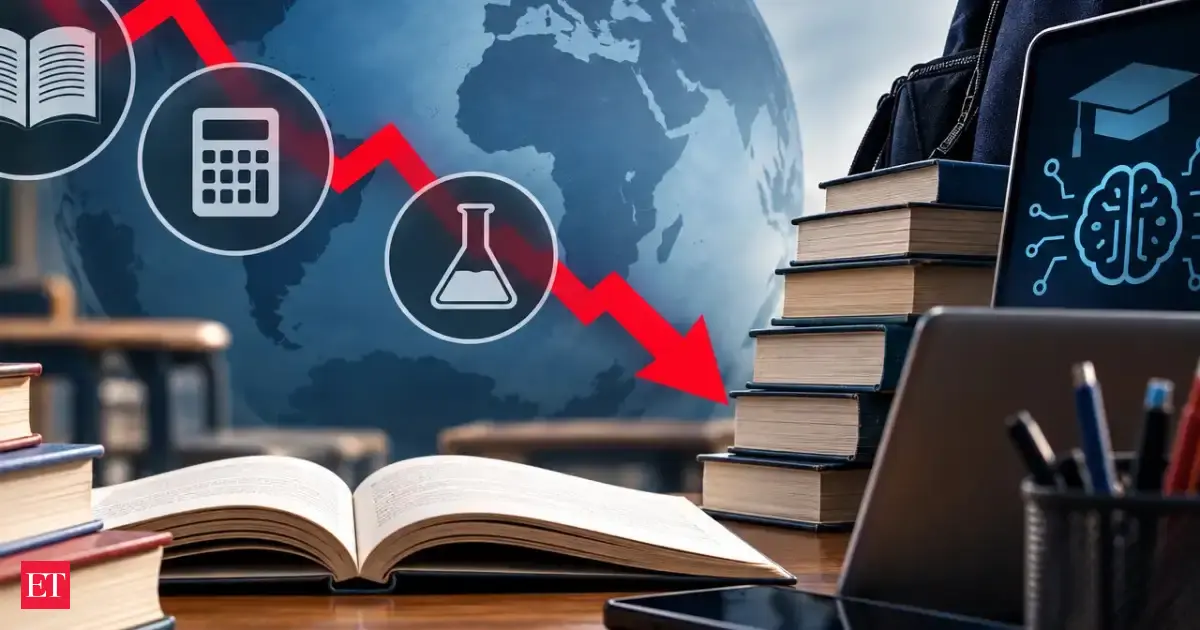
15-year-olds are reading, calculating and reasoning worse than ever, thanks to AI: OECD finds
Photograph: The Economic Times (embedded from source)
What this story says
- Global 15-year-old students' performance in reading, mathematics, and science is at its lowest point in 25 years, based on OECD's PISA 2025 results.
- Average scores across OECD countries have declined significantly in all three subjects, with reading scores showing the steepest drop.
- The share of 'hasty readers,' students who rush through texts, has nearly doubled since 2018, contributing to the decline in reading ability.
- While AI use is widespread, students who do not use AI chatbots for schoolwork generally outperform those who do, though the relationship is complex.
Who covered it
Percentages are shares of the 8 outlets carrying a published leaning rating. 4 of the 12 outlets we know ran this story carry no rating and are not counted in them. Coverage measured .
Trust
60/100
Craft
65/100
Hype
45/100
12 sources · methodology
Global 15-year-old students are performing at their weakest levels in reading, mathematics, and science since global testing began 25 years ago, according to the OECD's PISA 2025 results. The assessment covered over 760,000 students across 91 countries and economies. Average performance across OECD countries has reached the lowest recorded scores in all three core subjects.
Reading scores across OECD countries fell 28 points between 2015 and 2025, with a 25-point drop occurring between 2018 and 2025 alone. Mathematics scores declined by 22 points over the decade, with a particularly sharp fall after 2018. Science scores slipped 7 points over ten years and remained broadly stable between 2022 and 2025.
The share of 'hasty readers,' students who rush through texts and provide quick, incorrect answers, nearly doubled between 2018 and 2025, rising from about 7% to 11%. Performance dropped most sharply on tasks requiring evaluation of information and connecting material across multiple sources. Students reported spending less effort on the test than in previous years.
Disagreement on AI's impact
The Economic Times and Hindustan Times report that the widespread use of AI tools and social media platforms has contributed to a sharp deterioration in reading skills. However, Startup Fortune and TechNode Global note that the relationship between AI use and performance is not straightforward. Startup Fortune states that students taught to critically assess AI output outperformed those who weren't, complicating a simple narrative. TechNode Global reports that students avoiding AI for schoolwork outscored peers in science, except when AI was used as a general study aid.
What the coverage left out
None of the centre or right-rated reports printed below mention the OECD's finding that socio-economic gaps in performance narrowed between 2022 and 2025, attributed to declining scores among advantaged students rather than gains among disadvantaged ones. None of the reports mention the specific figures for non-OECD participants' scores falling by 16 points in reading and 8 points in mathematics between 2015 and 2025. No reports mention the share of students below the basic bar across OECD countries, which rose from 16% in 2022 to 20% in 2025.
Still developing. We have re-checked which outlets are covering this 3 times, most recently on 8 Sept 2026, 15:45, and will add the sides that appear.
How each side covered it
Our own reading of the reporting listed below, written from the outlets’ articles rather than quoted from them. The reasoning is set out on our methodology page.
Left
0 rated outlets
No outlet rated left has run this story so far. We are still checking, and will say plainly if that does not change.
Centre
6 rated outlets
- Centre-rated reports led on the overall decline in student performance across reading, mathematics, and science. The Economic Times and Hindustan Times highlighted the role of AI and digital distractions in this decline, with Hindustan Times quoting Andreas Schleicher, the OECD's director for education and skills, who called reading 'the mother of all skills'. Bloomberg and Wall Street Journal also focused on AI's negative impact on learning. Euronews noted the decline in all three subjects and the changing traditional divide between advantaged and disadvantaged students. OECD.org's digest stated that student performance had reached the lowest average ever recorded by PISA in mathematics and reading.
Right
2 rated outlets
- Right-rated reports from Times of India and Kronen Zeitung focused on the overall decline in student performance. The Times of India digest mentioned that 15-year-olds show the weakest performance globally in reading, math, and science, and that digital distractions and AI use present complex challenges. Kronen Zeitung stated that domestic pupils' performance is significantly higher than the OECD cut, but this is only because successes in other OECD countries have fallen even more.
Questions about this coverage
- How did the left and right cover Global student performance hits lowest point in 25 years?
- Of the 8 outlets on this story carrying a published leaning rating, 0% are rated left, 75% are rated centre, 25% are rated right. Those percentages are shares of the rated outlets, not of every outlet that ran it, which was 12. The sections above set out what each side emphasised, in its own terms.
- Is Global student performance hits lowest point in 25 years left or right?
- Too few of the outlets on this story carry a published leaning rating to say. 8 of them do, and this site does not characterise a field under 12: at that size one newsroom filing moves the share by ten points. The percentages above are the count as it stands.
- Is the coverage of Global student performance hits lowest point in 25 years biased?
- Global student performance hits lowest point in 25 years is one event reported by 12 outlets, and this page does not rate the story as biased or unbiased. What it publishes is the spread: which outlets ran it, where named rating organisations place each of them on the spectrum, and what each side chose to lead with. A leaning rating describes an outlet's record over time, not this article, and the two should not be run together.
- Which outlets covered Global student performance hits lowest point in 25 years?
- 12 that we know of, every one of them listed further up this page with a link to its own report and to what we hold on the publisher. Nothing here is a summary of somebody else's summary: the outlets are named so the original reporting can be read.
- What are the PISA 2025 results for global student performance?
- The OECD's PISA 2025 results show that 15-year-old students worldwide are performing at their weakest levels in reading, mathematics, and science since global testing began 25 years ago. Average scores across OECD countries have hit record lows in all three subjects.
- How have reading scores changed?
- Reading scores across OECD countries have declined significantly, falling 28 points between 2015 and 2025. The report notes that this drop is equivalent to losing approximately one year of schooling, with students now reading at a level previously expected of younger students.
- What is the impact of AI on student performance?
- The PISA 2025 results suggest a complex relationship between AI use and student performance. Generally, students who do not use AI chatbots for schoolwork are outperforming those who do. However, the impact can vary, and students taught to critically assess AI output showed better results.
- Which students experienced the largest score declines?
- The OECD report indicates that socio-economic gaps in performance narrowed, but this was due to declining scores among advantaged students rather than gains among disadvantaged ones. In science, advantaged students' scores fell while disadvantaged students' performance held steady.
Read it at the source
12 outlets, grouped by the leaning a published rating gives them. Every headline links to the original; an underlined outlet name opens our profile of that publisher.
Left
0No outlet in this group ran the story.
Centre
6- PISA 2025: Students’ reading and mathematics performance declined sharply across the OECD (opens oecd.org in a new tab)
- 15-year-olds are reading, calculating and reasoning worse than ever, thanks to AI, OECD finds (opens The Economic Times in a new tab)
The Economic Times — is The Economic Times biased? Our profile of this outlet
- School Students Who Use AI Get Worse Test Scores, OECD Warns (opens Bloomberg in a new tab)
- AI Use Contributes to Global Decline in Student Reading Skills, OECD Says (opens Wall Street Journal in a new tab)
Wall Street Journal — is Wall Street Journal biased? Our profile of this outlet
- Pupils getting worse at reading, maths and science, PISA study shows (opens Euronews in a new tab)
- AI Use Contributes to Global Decline in Student Reading Skills, OECD Says (opens Hindustan Times in a new tab)
Hindustan Times — is Hindustan Times biased? Our profile of this outlet
Right
2- 15-year-olds are reading, calculating and reasoning worse than ever, thanks to AI, OECD finds (opens Times of India in a new tab)
Times of India — is Times of India biased? Our profile of this outlet
- Pupils Perform (Almost) Worse Everywhere (opens Kronen Zeitung in a new tab)
Kronen Zeitung — is Kronen Zeitung biased? Our profile of this outlet
Not rated
4- OECD Warns that Using AI on a Daily Basis Can Worsen School Outcomes (opens DiarioBitcoin in a new tab)
DiarioBitcoin — is DiarioBitcoin biased? Our profile of this outlet
- OECD Finds Students Who Use AI Chatbots Daily Score Far Worse on Tests (opens Startup Fortune in a new tab)
Startup Fortune — is Startup Fortune biased? Our profile of this outlet
- Students avoiding AI for schoolwork outscore peers in science: OECD (opens TechNode Global in a new tab)
TechNode Global
- PISA 2025: Students Who Frequently Use AI to Do Assignments Perform Worse in Science. (opens Publico in a new tab)
How did this read?
About the coverage, not about the story. We do not ask whether you agree with what happened — we have no honest use for that answer.

