Four crew members complete year-long simulated Mars mission
Participants in NASA's CHAPEA experiment lived in isolation for 378 days to prepare for future space travel.
AI-assisted coverage comparison, editor-supervised · How this was made
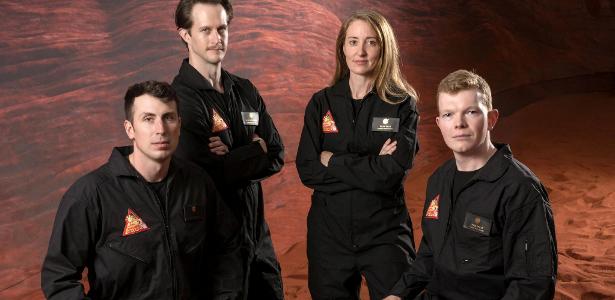
Os tripulantes Ross Elder, Matthew Montgomery, Ellen Ellis e James Spicer antes de passarem mais de um ano em isolamento
Photograph: UOL (embedded from source)
What this story says
- Four crew members have finished a 378-day simulated mission to Mars.
- The experiment took place in a 160-square-meter habitat at NASA's Johnson Space Center in Houston.
- Participants experienced isolation and performed tasks including growing crops.
- The simulation was designed to prepare for future human missions to Mars.
Who covered it
Percentages are shares of the 41 outlets carrying a published leaning rating. 46 of the 87 outlets we know ran this story carry no rating and are not counted in them. Coverage measured .
Trust
42/100
Craft
60/100
Hype
45/100
87 sources · methodology
Four crew members have completed a 378-day simulated mission to Mars. The experiment, known as the Crew Health and Performance Exploration Analog (CHAPEA), took place in a habitat at NASA's Johnson Space Center in Houston. The mission aimed to prepare for future human expeditions to the Red Planet by studying the effects of isolation and the challenges of living in a confined space.
During the 378 days, the participants lived in a 3D-printed habitat that was approximately 160 square meters. They experienced isolation from the outside world and performed various tasks necessary for survival and mission success. These included growing crops and managing the habitat's systems. Some reports also mentioned simulated communication delays to mimic the conditions of a mission to Mars.
Habitat size disagreement
Reports differ on the size of the habitat used for the simulation. Some sources state the habitat was approximately 160 square meters, as reported by interia.pl and Tagesschau. Others specify it was 1,700 square feet, which is approximately 158 square meters, according to The Independent and The Independent (US).
What the coverage left out
None of the left-rated digests mention the specific start date of the mission. None of the centre-rated digests mention the specific start date of the mission. None of the right-rated digests mention the specific start date of the mission.
Still developing. We have re-checked which outlets are covering this 6 times, most recently on 2 Nov 2026, 12:15, and will add the sides that appear.
How other outlets pictured it
Which photograph to run is each newsroom’s own choice. The leaning beside a name is that outlet’s published rating, not a claim that the pictures divide along it. Every picture is shown from the outlet’s own server and links to the article it ran in.

How each side covered it
Our own reading of the reporting listed below, written from the outlets’ articles rather than quoted from them. The reasoning is set out on our methodology page.
Left
17 rated outlets
- Left-rated reports highlighted the duration of the isolation, with headlines such as 'Prisoners "on Mars" Free Again After 378 Days' from delo.si. Several reports from this side mentioned the 3D-printed nature of the habitat, as seen in The Independent's headline: 'NASA crew emerges after 378 days in isolation in 3D-printed habitat'. The Independent (US) also used this phrasing. The Independent and The Independent (US) specified the habitat size as 1,700 square feet. Philstar Global noted that the mission aimed to prepare astronauts for Mars and that the habitat was at Johnson Space Center. De Morgen quoted a participant saying, 'Even if It Rains Later, We Will Be Happy,' and noted the volunteers saw sunlight again after a year. Dawn mentioned tasks such as growing crops and interfacing with officials with recreated delays.
Centre
11 rated outlets
- Centre-rated reports focused on the completion of the mission and the emergence of the crew. Headlines included 'NASA crew emerges after 378 days in isolation' from the Star Advertiser and 'Crew from NASA's simulated Mars mission emerges after 378 days in isolation' from The Express Tribune. Tagesschau reported that four people spent a year together in the USA on 160 square meters for science, and that the NASA experiment was over. KHOU 11 stated that four volunteers finished a year in isolation in Houston for space exploration and that they were in a 3D-printed habitat. WTVB and The Express Tribune mentioned that the crew entered a simulated Mars habitat in 2025, growing crops and testing delayed communications. VRT quoted a participant saying, 'Living There Is Becoming an Inevitable Reality'.
Right
13 rated outlets
- Right-rated reports often used strong language to describe the experience, such as 'Been a hell of a year: Crew from NASAs simulated Mars mission emerges after 378 days in isolation' from Tribune India and 'It Was a Hellish Year' from Telegraf, Najnovije vesti. The Hindu Business Line reported that the NASA crew completed the 378-day simulated Mars mission in Houston. Kronen Zeitung stated that four volunteers lived isolated on a NASA test site in Texas for a year to simulate life on Mars, and that the site was created with the help of a 3D printer and had no windows. N-tv reported that an extreme NASA experiment came to a successful end after 378 days of isolation, and that a third crew is to follow in 2027. NOS mentioned that the volunteers were locked up in a tiny NASA building of just 160 square meters at the Johnson Space Center in Houston.
Questions about this coverage
- How did the left and right cover Four crew members complete year-long simulated Mars mission?
- Of the 41 outlets on this story carrying a published leaning rating, 42% are rated left, 26% are rated centre, 32% are rated right. Those percentages are shares of the rated outlets, not of every outlet that ran it, which was 87. The sections above set out what each side emphasised, in its own terms.
- Is Four crew members complete year-long simulated Mars mission left or right?
- Neither side dominates it. Of the 41 rated outlets on this story, 42% are rated left, 26% are rated centre, 32% are rated right, and no side holds the 70% this site would want before calling a field one-sided. A story is not left or right in any case; the outlets that carried it are what carry ratings.
- Is the coverage of Four crew members complete year-long simulated Mars mission biased?
- Four crew members complete year-long simulated Mars mission is one event reported by 87 outlets, and this page does not rate the story as biased or unbiased. What it publishes is the spread: which outlets ran it, where named rating organisations place each of them on the spectrum, and what each side chose to lead with. A leaning rating describes an outlet's record over time, not this article, and the two should not be run together.
- Which outlets covered Four crew members complete year-long simulated Mars mission?
- 87 that we know of, every one of them listed further up this page with a link to its own report and to what we hold on the publisher. Nothing here is a summary of somebody else's summary: the outlets are named so the original reporting can be read.
- How long did the simulated Mars mission last?
- The simulated mission to Mars lasted for 378 days. This duration was chosen to study the effects of long-term isolation and the challenges of living in a confined environment, preparing participants for potential future human expeditions to the Red Planet.
- Where did the simulated Mars mission take place?
- The simulation took place in a habitat at NASA's Johnson Space Center in Houston, Texas. The habitat was described as a 3D-printed structure, approximately 160 square meters in size, designed to replicate conditions on Mars.
- What did the participants do during the simulation?
- During the 378-day mission, the four crew members experienced isolation and performed various tasks. These included growing crops, managing the habitat's systems, and dealing with simulated communication delays to mimic the experience of a real Mars mission.
Read it at the source
87 outlets, grouped by the leaning a published rating gives them. Every headline links to the original; an underlined outlet name opens our profile of that publisher.
Left
17- Prisoners "on Mars" Free Again After 378 Days (opens delo.si in a new tab)
- 4 NASA Astronauts Isolated Themselves for an Experiment that Simulated Life on Mars. After 378 Days They Returned to Reality (opens antena3.ro in a new tab)
antena3.ro — is antena3.ro biased? Our profile of this outlet
- Crew from NASA's simulated Mars mission emerges after 378 days in isolation (opens Philstar Global in a new tab)
Philstar Global — is Philstar Global biased? Our profile of this outlet
- NASA crew emerges after 378 days in isolation in 3D-printed habitat (opens The Independent (US) in a new tab)
The Independent (US) — is The Independent (US) biased? Our profile of this outlet
- NASA crew emerges after 378 days in isolation in 3D-printed habitat (opens The Independent in a new tab)
The Independent — is The Independent biased? Our profile of this outlet
- NASA Volunteers See Sunlight Again After a Year in a Simulated Mars Base: ‘Even if It Rains Later, We Will Be Happy’ (opens De Morgen in a new tab)
- Crew from Nasa's simulated Mars mission emerges after 378 days in isolation (opens Dawn in a new tab)
- 'In Captivity of Your Own Will': Simulation to Mars Ends After 378 Days (opens UOL in a new tab)
Show 9 more
- NASA's Simulated Mars Mission Crew Comes Out of Isolation After 378 Days: "It's Been a Crazy Year" (opens La Vanguardia in a new tab)
La Vanguardia — is La Vanguardia biased? Our profile of this outlet
- The NASA Team that Simulated a Mission on Mars Came Out of Isolation After 378 Days. "It's Inevitable to Get People There," Says Commander HotNews.ro. (opens Hot News in a new tab)
- A Year on Mars – Volunteers End Extreme Nasa Experiment (opens Spiegel in a new tab)
- 4 volunteers who lived in a Mars simulation for a year are back to the real world (opens NPR in a new tab)
- Life in the Closest Space: One Year Mars: Volunteers End Extreme Nasa Experiment (opens Zeit Online in a new tab)
Zeit Online — is Zeit Online biased? Our profile of this outlet
- They spent more than a year inside a NASA hangar in Houston simulating life on Mars. Now, they’re finally out (opens Houston Public Media in a new tab)
Houston Public Media — is Houston Public Media biased? Our profile of this outlet
- ‘Mars Mission’ Back on Earth, Just Through an Interior Door (opens Volkskrant in a new tab)
Volkskrant — is Volkskrant biased? Our profile of this outlet
- NASA's second year-long Mars simulation mission ends today (opens Engadget in a new tab)
- Simulated Mars crew to emerge after year confined (opens The Canberra Times in a new tab)
The Canberra Times — is The Canberra Times biased? Our profile of this outlet
Centre
11- NASA crew emerges after 378 days in isolation | Honolulu Star-Advertiser (opens Star Advertiser in a new tab)
Star Advertiser — is Star Advertiser biased? Our profile of this outlet
- NASA Experiment: Mars Simulation Completed After One Year (opens Tagesschau in a new tab)
Tagesschau — is Tagesschau biased? Our profile of this outlet
- Crew from NASA's simulated Mars mission emerges after 378 days in isolation (opens The Express Tribune in a new tab)
The Express Tribune — is The Express Tribune biased? Our profile of this outlet
- Crew from NASA's simulated Mars mission emerges after 378 days in isolation (opens Reuters in a new tab)
- NASA's Simulated Mars Mission Crew Returns From Isolation After 378 Days (opens yle in a new tab)
- Crew from NASA’s simulated Mars mission emerges after 378 days in isolation (opens WTVB in a new tab)
- Four People From Isolation Who Lived for a Year as if on Mars: "Living There Is Becoming an Inevitable Reality" (opens vrt in a new tab)
- Four volunteers just finished a year in isolation in Houston, all in the name of space exploration (opens KHOU 11 in a new tab)
Show 3 more
- One Year Mars: Volunteers End Extreme Nasa Experiment (opens wz.de in a new tab)
- NASA crew prepares to exit Mars simulation after nearly 380 days (opens ABC 13 Houston in a new tab)
ABC 13 Houston — is ABC 13 Houston biased? Our profile of this outlet
- Simulated Mars crew to emerge after year confined (opens PerthNow in a new tab)
Right
13- Been a hell of a year: Crew from NASAs simulated Mars mission emerges after 378 days in isolation - The Tribune (opens Tribune India in a new tab)
Tribune India — is Tribune India biased? Our profile of this outlet
- NASA crew completes 378-day simulated Mars mission in Houston (opens The Hindu Business Line in a new tab)
The Hindu Business Line — is The Hindu Business Line biased? Our profile of this outlet
- Crew from NASA's simulated Mars mission emerges after 378 days in isolation (opens The Straits Times in a new tab)
The Straits Times — is The Straits Times biased? Our profile of this outlet
- Crew from NASA's simulated Mars mission emerges after 378 days in isolation (opens Times of India in a new tab)
Times of India — is Times of India biased? Our profile of this outlet
- Volunteer Simulated Life on Mars (opens Kronen Zeitung in a new tab)
Kronen Zeitung — is Kronen Zeitung biased? Our profile of this outlet
- Second Mars Simulation: Extreme Nasa Experiment Comes to a Successful End (opens n-tv in a new tab)
- NASA Volunteers Back Home After a Year on Simulated Mars Mission (opens NOS in a new tab)
- One Year Mars: Volunteers End Extreme Nasa Experiment (opens focus.de in a new tab)
Show 5 more
- NASA's Simulated Mission Members Claim that Reaching Mars Is "Inevitable" (opens Clarin in a new tab)
- NASA Crew Ends 378-Day Simulated Mars Mission After More Than a Year in Isolation (opens [your]NEWS in a new tab)
[your]NEWS — is [your]NEWS biased? Our profile of this outlet
- LIVE NOW: NASA Crew Completes 378-Day Simulated Mars Mission (opens The Epoch Times in a new tab)
The Epoch Times — is The Epoch Times biased? Our profile of this outlet
- A Year on Mars without Leaving Houston: the Four 'Tripulents' of the CHAPEA 2 Mission 'Return' to Earth (opens ABC in a new tab)
- Simulated Mars crew to emerge after year confined (opens The West Australian in a new tab)
The West Australian — is The West Australian biased? Our profile of this outlet
Not rated
46- Four NASA Pilots Came Out of Isolation After 378 Days. (opens Life.ru in a new tab)
- NASA Is Completing a Year-Long Simulation of a Mission to Mars. Spent 378 Days in Lockdown (opens interia.pl in a new tab)
interia.pl — is interia.pl biased? Our profile of this outlet
- "It Was a Hellish Year": Four Astronauts Came Out of Isolation After 378 Days, They Lived Like They Were on Mars (opens Telegraf in a new tab)
- They Spent 378 Isolated Days (opens spotmedia.ro in a new tab)
spotmedia.ro — is spotmedia.ro biased? Our profile of this outlet
- A Whole Year in Martian Conditions: the Four Volunteers Walked Out of the Room - and This Is What They Went Through (opens kikar.co.il in a new tab)
kikar.co.il — is kikar.co.il biased? Our profile of this outlet
- NASA: Four Volunteers Leave a 378-Day Mars Simulation (opens economiematin.fr in a new tab)
economiematin.fr — is economiematin.fr biased? Our profile of this outlet
- Crew from NASA’s simulated Mars mission emerges after 378 days (opens military-stuff.org in a new tab)
military-stuff.org — is military-stuff.org biased? Our profile of this outlet
- Crew from NASA’s simulated Mars mission emerges after 378 days (opens theirishchannel.com in a new tab)
theirishchannel.com — is theirishchannel.com biased? Our profile of this outlet
Show 38 more
- The Crew of the Simulated Mars Mission "Returned" to Earth (opens Naftemporiki in a new tab)
Naftemporiki — is Naftemporiki biased? Our profile of this outlet
- NASA's Team that Simulated a Mission on Mars Came Out of Isolation After 378 Days. "It's Inevitable to Get People There," the Commander Says. (opens unimedia.info in a new tab)
unimedia.info — is unimedia.info biased? Our profile of this outlet
- NASA's Mission Simulation Experiment on Mars Is over, Four People Spent 378 Days in Solitary Confinement. (opens Mediafax in a new tab)
- NASA Completes 378-Day Simulated Mars Life Experiment. (opens vietnamplus.vn in a new tab)
vietnamplus.vn — is vietnamplus.vn biased? Our profile of this outlet
- With Isolation for More than a Year, NASA Tests Life on Mars (opens nvinoticias.com in a new tab)
nvinoticias.com — is nvinoticias.com biased? Our profile of this outlet
- The Group of Volunteers Completed 378 Days of Isolation Simulating Martian Conditions. (opens Thanh Niên in a new tab)
Thanh Niên — is Thanh Niên biased? Our profile of this outlet
- After 378 Days of Isolation, the Crew Appeared to Simulate Mars's Journey. (opens IMLebanon in a new tab)
- CHAPEA 2 Ends After 378 Days of Isolation: NASA Studies How to Live on Mars (opens CRIPTO TENDENCIA in a new tab)
CRIPTO TENDENCIA — is CRIPTO TENDENCIA biased? Our profile of this outlet
- Mars simulation crew emerges after 378 days in isolation (opens sharjah24.ae in a new tab)
sharjah24.ae — is sharjah24.ae biased? Our profile of this outlet
- NASA’s CHAPEA Mars mission crew completes 378 days of isolation (opens Udaipur News in a new tab)
Udaipur News — is Udaipur News biased? Our profile of this outlet
- NASA Completed a Simulated Mars Mission: Four People Lived Isolated 378 Days (opens BAE Negocios in a new tab)
BAE Negocios — is BAE Negocios biased? Our profile of this outlet
- Crew of the Simulated Mission to Mars of the Nasa Leaves the Isolation After 378 Days (opens La República in a new tab)
La República — is La República biased? Our profile of this outlet
- Volunteers Who Simulated the Mars Mission Come Out After 378 Days. (opens NU in a new tab)
- Nasa Closes 378-Day Simulation Isolation to Mars (opens SpaceMoney in a new tab)
SpaceMoney — is SpaceMoney biased? Our profile of this outlet
- Simulated Mission Crew to Nasa Mars Leaves Isolation After 378 Days (opens infomoney.com.br in a new tab)
infomoney.com.br — is infomoney.com.br biased? Our profile of this outlet
- Crew from NASA’s simulated Mars mission emerges after 378 days in isolation (opens PressNewsAgency in a new tab)
PressNewsAgency — is PressNewsAgency biased? Our profile of this outlet
- Extreme Nasa Experiment Comes to a Successful End (opens Moneycab in a new tab)
- After a Year on “Mars,” These NASA Employees Are Back with Their Families. (opens Bright in a new tab)
- NASA Concludes Simulated Mission to Mars: Four Crew Members Leave After 378 Days of Isolation (opens El Economista in a new tab)
El Economista — is El Economista biased? Our profile of this outlet
- NASA Mars Simulation: Crew Back Outside After 378 Days (opens tpo.nl in a new tab)
- One Year Mars: Volunteers End Extreme NASA Experiment (opens der Standard DE in a new tab)
der Standard DE — is der Standard DE biased? Our profile of this outlet
- Volunteers End NASA Experiment After 378 Days (opens vienna.at in a new tab)
- One Year Mars: Volunteers End Extreme NASA Experiment (opens epochtimes.de in a new tab)
epochtimes.de — is epochtimes.de biased? Our profile of this outlet
- One Year Mars: Volunteers End Extreme Nasa Experiment (opens mainwelle.de in a new tab)
mainwelle.de — is mainwelle.de biased? Our profile of this outlet
- One Year Mars: Volunteers End Extreme Nasa Experiment (opens bbv-net.de in a new tab)
bbv-net.de — is bbv-net.de biased? Our profile of this outlet
- One Year Mars: Volunteers End Extreme Nasa Experiment (opens RN in a new tab)
- One Year Mars: Volunteers End Extreme Nasa Experiment (opens Badische Neueste Nachrichten in a new tab)
Badische Neueste Nachrichten — is Badische Neueste Nachrichten biased? Our profile of this outlet
- One Year Mars: Volunteers End Extreme Nasa Experiment (opens onetz.de in a new tab)
- One Year Mars: Volunteers End Extreme Nasa Experiment (opens noz.de in a new tab)
- One Year Mars: Volunteers End Extreme Nasa Experiment (opens inFranken.de in a new tab)
inFranken.de — is inFranken.de biased? Our profile of this outlet
- One Year Mars: Volunteers End Extreme Nasa Experiment (opens nordbayern.de in a new tab)
nordbayern.de — is nordbayern.de biased? Our profile of this outlet
- NASA Announces Mars Simulation Results; Four Astronauts Exit the Plane (opens 大纪元 Epoch Times in a new tab)
大纪元 Epoch Times — is 大纪元 Epoch Times biased? Our profile of this outlet
- NASA Mars Mission Simulation Ends (opens 24 HU in a new tab)
- NASA Mars Crew Set to Exit Houston Habitat After 378 Days (opens Hoodline in a new tab)
- NASA’s CHAPEA Crew Prepares to Complete a 378-Day Mars Simulation (opens New Space Economy in a new tab)
New Space Economy — is New Space Economy biased? Our profile of this outlet
- NASA Closes Simulation Mars CHAPEA 2 After 378 Days: the Health of the Crew Will Guide the Real Journey (opens Merca2.es in a new tab)
- They Live Exactly as on Mars for Now a Year: the Lessons of the Nasa Simulation Mission (opens Science-et-vie.com in a new tab)
Science-et-vie.com — is Science-et-vie.com biased? Our profile of this outlet
- Four NASA Volunteers Are Completing a 378-Day Simulation of the Mars Expedition. (opens NEWSru.co.il in a new tab)
NEWSru.co.il — is NEWSru.co.il biased? Our profile of this outlet
How did this read?
About the coverage, not about the story. We do not ask whether you agree with what happened — we have no honest use for that answer.