Germany’s trade deficit with China reaches €55 billion in first half of 2026
Exports to China fell 12% year-on-year while imports rose nearly 9%, making China only the ninth-largest market for German goods
AI-assisted coverage comparison, editor-supervised · How this was made
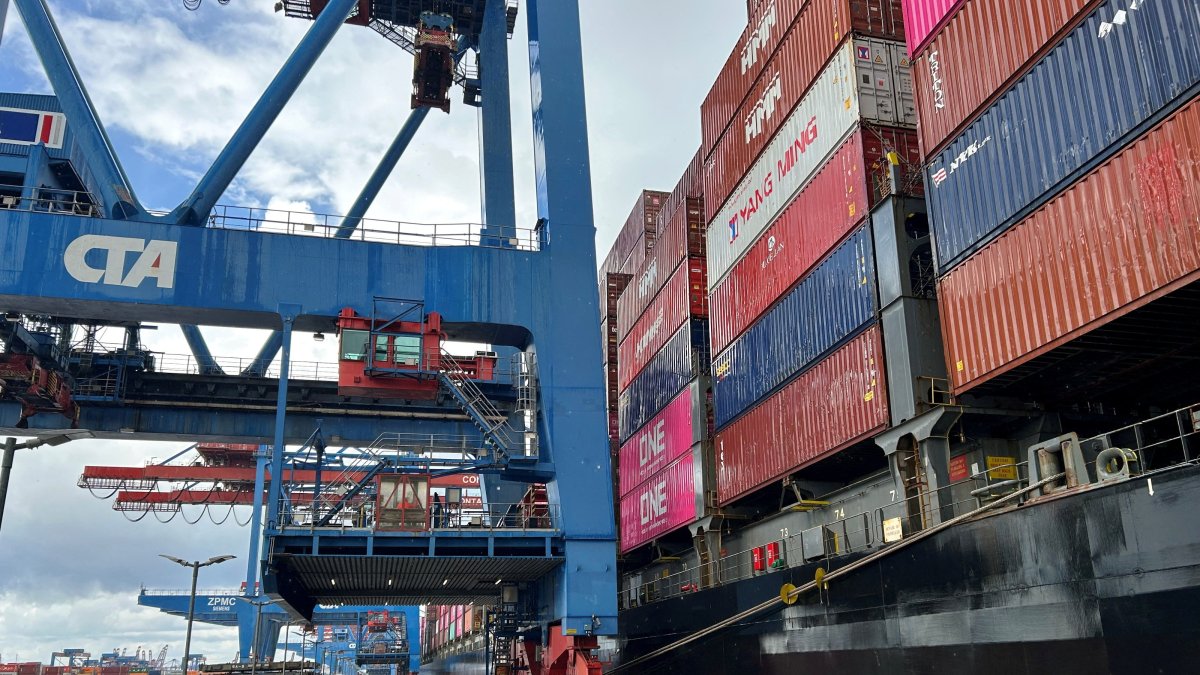
A general view shows the containers at the port, Hamburg, Germany, July 29, 2025. (Reuters Photo)
Photograph: Daily Sabah (embedded from source)
What this story says
- Germany’s trade deficit with China grew to €55 billion in the first half of 2026, the largest on record for that period.
- German exports to China fell 12% year-on-year to €37 billion, while imports from China rose 8.9% to €91.8 billion.
- China dropped to the ninth-largest market for German goods in 2026, down from second place in 2021.
- The shift reflects China’s reduced reliance on European imports and its focus on domestic value chains, according to Germany Trade & Invest.
Who covered it
Percentages are shares of the 6 outlets carrying a published leaning rating. 3 of the 9 outlets we know ran this story carry no rating and are not counted in them. Coverage measured .
Trust
86/100
Craft
87/100
Hype
15/100
9 sources · methodology
Thin on the left so far
None of the 6 outlets with a published leaning rating that ran this story are rated left.
This story is still being watched, so it is a count and not yet a finding. Coverage keeps arriving for hours after an event, and a side that has published nothing this morning may publish by tonight. If it is still true when we stop checking, we will say so plainly.
Germany’s trade deficit with China reached €55 billion in the first half of 2026, up from €40 billion in the same period last year. The gap widened as German exports to China fell 12% year-on-year to €37 billion, while imports from China rose 8.9% to €91.8 billion. Total bilateral trade between the two countries amounted to €128 billion, exceeding trade with the United States by €3 billion.
China was Germany’s ninth-largest export market in 2026, down from second place in 2021. Smaller economies such as Austria and Switzerland now buy more German goods than China does. Germany Trade & Invest, a state-run agency, attributed the decline in exports to China’s weak domestic economy and its increasing focus on domestic production. The agency also noted that China’s property crisis and cash-strapped regional governments have reduced investment.
German manufacturing has faced additional pressure from U.S. tariffs and competition from Chinese firms. Volkswagen and other major companies have announced job cuts in response. Meanwhile, German exports overall rose 3.7% to €817 billion in the first half of 2026, driven by global demand.
What the coverage left out
No left-rated outlet ran this story at all. None of the right-rated digests or the full report in Daily Sabah mentioned that German exports overall rose 3.7% to €817 billion in the first half of 2026. The full report in Devdiscourse was the only one to note that France and the Netherlands were Germany’s next biggest export markets after the U.S.
Still developing. We have re-checked which outlets are covering this 4 times, most recently on 9 Aug 2026, 12:00, and will add the sides that appear.
How each side covered it
Our own reading of the reporting listed below, written from the outlets’ articles rather than quoted from them. The reasoning is set out on our methodology page.
Left
0 rated outlets
No outlet rated left has run this story so far. We are still checking, and will say plainly if that does not change.
Centre
4 rated outlets
- The four centre-rated digests and reports led on the widening trade deficit and the 12% drop in German exports to China. Devdiscourse and Reuters both highlighted China’s growing independence and technological advancement as key factors behind the shift. Devdiscourse’s full report described the deficit as a sign of China’s reduced reliance on Western economies, while IndexBox’s digest noted that China’s weak domestic economy and self-sufficiency were reshaping the trade relationship.
- All centre-rated reports included the €55 billion deficit figure and the 12% year-on-year decline in exports. Devdiscourse and IndexBox also mentioned the 8.9% rise in imports from China. The full report in Devdiscourse quoted Germany Trade & Invest’s explanation that Chinese firms were cutting reliance on European imports, while IndexBox’s digest cited U.S. tariff pressures as an additional factor.
Right
2 rated outlets
- The two right-rated digests and the full report in Daily Sabah led on the widening trade gap and China’s reduced dependence on European imports. Daily Sabah’s full report framed the deficit as evidence of China’s growing independence from Western powers, quoting Commerzbank economist Vincent Stamer: “China’s diminishing reliance on Germany showed it is becoming more independent of Western powers and catching up technologically.”
- Both right-rated digests and the full report included the €55 billion deficit and the 12% drop in exports. Daily Sabah’s report also noted that China overtook the U.S. as Germany’s top trading partner in 2025 after U.S. tariffs under President Donald Trump reduced German exports to America. The report quoted Germany Trade & Invest’s Corinne Abele, who said German firms were producing more inside China itself, and Commerzbank’s Stamer, who warned that the “Made in Germany” brand needed to reinvent itself.
Read it at the source
9 outlets, grouped by the leaning a published rating gives them. Every headline links to the original; an underlined outlet name opens our profile of that publisher.
Left
0No outlet in this group ran the story.
Centre
4- Germany vs. China: Trade Deficit and Economic Shifts in 2026 (opens Devdiscourse in a new tab)
Devdiscourse — is Devdiscourse biased? Our profile of this outlet
- German trade deficit with China grows as Beijing relies less on European industry (opens WTVB in a new tab)
- German trade deficit with China grows as Beijing relies less on European industry (opens Reuters in a new tab)
- German trade deficit with China grows as Beijing relies less on European industry (opens Market Screener in a new tab)
Market Screener — is Market Screener biased? Our profile of this outlet
Right
2Not rated
3- Germany Exports More to Austria than to China (opens suedtirolnews.it in a new tab)
suedtirolnews.it — is suedtirolnews.it biased? Our profile of this outlet
- German Exports to China Drop 12% in H1 2026, Deficit Grows to €55B - News and Statistics (opens indexbox.io in a new tab)
indexbox.io
- German trade deficit with China grows as Beijing relies less on European industry (opens Blue Water Healthy Living in a new tab)
Blue Water Healthy Living — is Blue Water Healthy Living biased? Our profile of this outlet
How did this read?
About the coverage, not about the story. We do not ask whether you agree with what happened — we have no honest use for that answer.