India and Belgium set five-year target to double bilateral trade
Modi and De Wever announce expanded cooperation in defence, clean energy and semiconductors during first Belgian PM visit in 20 years
AI-assisted coverage comparison, editor-supervised · How this was made
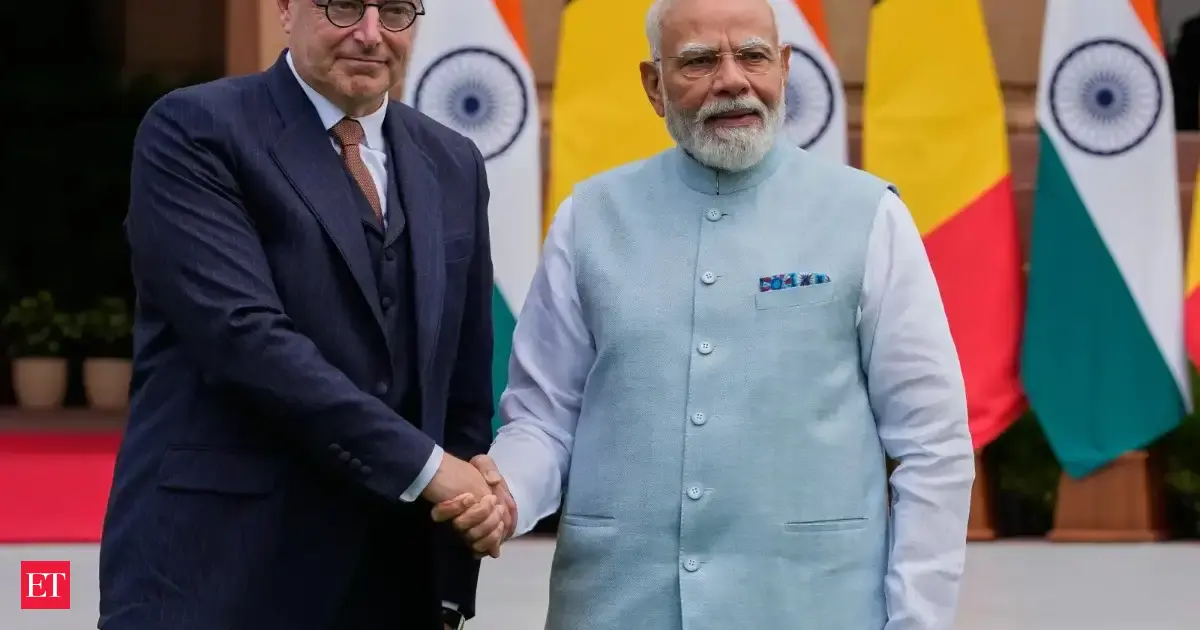
Indian Prime Minister Narendra Modi, right, shakes hand with his Belgium counterpart Bart De Wever in New Delhi, India, Thursday, Sept. 3,
Photograph: The Economic Times (embedded from source)
What this story says
- India and Belgium set a five-year target to double bilateral trade, as announced by Prime Minister Narendra Modi and Belgian Prime Minister Bart De Wever on 3 September 2026.
- The leaders agreed to expand cooperation in defence, including military exchanges and joint work on the Zorawar tank, and in clean energy, with a major green ammonia project in Andhra Pradesh.
- De Wever described India as the world’s largest democracy and fastest-growing major economy during his first visit to India as Belgian PM in 20 years.
- No left-rated outlet carried the story, according to the reports below.
Who covered it
Percentages are shares of the 23 outlets carrying a published leaning rating. 39 of the 62 outlets we know ran this story carry no rating and are not counted in them. Coverage measured .
Trust
65/100
Craft
75/100
Hype
15/100
62 sources · methodology
Prime Minister Narendra Modi and Belgian Prime Minister Bart De Wever announced on 3 September 2026 that India and Belgium would work to double bilateral trade within five years. The announcement came during a joint press conference in New Delhi, the first visit by a Belgian prime minister to India in two decades.
Modi highlighted expanded cooperation in defence and clean energy, including collaboration on the Zorawar tank and a green ammonia project in Andhra Pradesh. De Wever described India as the world’s largest democracy and fastest-growing major economy, calling it a "major geopolitical factor" and an important ally for Belgium.
The leaders agreed to enhance military exchanges, training cooperation, and defence ties. Modi also recalled Belgium’s support for India-Belgium diamond trade and the Indian community during De Wever’s tenure as Mayor of Antwerp.
What the coverage left out
No left-rated outlet ran the story, according to the reports printed below. None of the right-rated digests mentioned the green ammonia project in Andhra Pradesh or De Wever’s remarks on India’s economic growth and its role as the world’s largest democracy.
Coverage settled. We checked this 9 times and stopped on 8 Sept 2026, 21:15. The figures above are what it finished at.
How each side covered it
Our own reading of the reporting listed below, written from the outlets’ articles rather than quoted from them. The reasoning is set out on our methodology page.
Left
1 rated outlet
We have not written our reading of the left coverage of this story. The left-rated outlets that ran it are listed below.
Centre
9 rated outlets
- The three centre-rated reports led on the trade target and the expansion of cooperation into strategic sectors. Live Mint quoted Modi’s remarks on the Zorawar tank and the green ammonia project in Andhra Pradesh, and carried De Wever’s description of India as a "powerhouse". The Economic Times framed the story around the trade target and the shift from traditional trade to defence and clean energy.
- Live Mint’s report included Modi’s statement that the two countries were collaborating on "modern defence equipment, such as the Zorawar tank" and developing "one of the world’s largest green ammonia projects in Kakinada, Andhra Pradesh". The outlet also quoted De Wever’s remarks on India’s economic growth and its role as a global power.
Right
13 rated outlets
- The five right-rated digests led on the defence and military aspects of the announcement. ABP News and Social News XYZ both reported that Modi had described defence and security cooperation as a "key pillar" of India-Belgium ties. Latestly and Tribune India highlighted Modi’s remarks on the expansion of cooperation into strategic sectors, including the Zorawar tank and clean energy partnerships.
- Rediff.com’s digest led with Modi’s statement that India’s economic growth was a "source of confidence for the world". None of the right-rated digests mentioned the five-year trade target or De Wever’s description of India as the fastest-growing major economy.
Questions about this coverage
- How did the left and right cover India and Belgium set five-year target to double bilateral trade?
- Of the 23 outlets on this story carrying a published leaning rating, 4% are rated left, 40% are rated centre, 56% are rated right. Those percentages are shares of the rated outlets, not of every outlet that ran it, which was 62. The sections above set out what each side emphasised, in its own terms.
- Is India and Belgium set five-year target to double bilateral trade left or right?
- Neither side dominates it. Of the 23 rated outlets on this story, 4% are rated left, 40% are rated centre, 56% are rated right, and no side holds the 70% this site would want before calling a field one-sided. A story is not left or right in any case; the outlets that carried it are what carry ratings.
- Is the coverage of India and Belgium set five-year target to double bilateral trade biased?
- India and Belgium set five-year target to double bilateral trade is one event reported by 62 outlets, and this page does not rate the story as biased or unbiased. What it publishes is the spread: which outlets ran it, where named rating organisations place each of them on the spectrum, and what each side chose to lead with. A leaning rating describes an outlet's record over time, not this article, and the two should not be run together.
- Which outlets covered India and Belgium set five-year target to double bilateral trade?
- 62 that we know of, every one of them listed further up this page with a link to its own report and to what we hold on the publisher. Nothing here is a summary of somebody else's summary: the outlets are named so the original reporting can be read.
- What did India and Belgium agree to during De Wever’s visit?
- India and Belgium set a target to double bilateral trade within five years and agreed to expand cooperation in defence, clean energy, and military exchanges. The leaders announced joint work on the Zorawar tank and a green ammonia project in Andhra Pradesh during a press conference in New Delhi on 3 September 2026.
- Which sectors did Modi and De Wever highlight for cooperation?
- Modi and De Wever highlighted defence, clean energy, and semiconductors as key areas for expanded cooperation. They mentioned collaboration on the Zorawar tank and a major green ammonia project in Andhra Pradesh, as well as military exchanges and training cooperation between the two countries.
- How did the right-rated outlets cover the story?
- The right-rated digests led on the defence and military aspects of the announcement, with several quoting Modi’s description of defence cooperation as a "key pillar" of India-Belgium ties. None mentioned the five-year trade target or De Wever’s remarks on India’s economic growth.
- Which outlets did not carry the story?
- No left-rated outlet ran the story, according to the reports printed below. The coverage was limited to centre-rated and right-rated outlets, with no reports from outlets classified as left in the material provided.
Read it at the source
68 outlets, grouped by the leaning a published rating gives them. Every headline links to the original; an underlined outlet name opens our profile of that publisher.
Left
1Centre
10- India and Belgium agree to strengthen trade, defence ties (opens Reuters in a new tab)
- Bart De Wever and Belgian Armament Groups Get Big Contracts in India (opens La Libre in a new tab)
- PM Modi Meets Belgian Prime Minister Bart De Wever in Delhi (opens Hindustan Times in a new tab)
Hindustan Times — is Hindustan Times biased? Our profile of this outlet
- Modi meets Belgium PM in Delhi, lauds bilateral cooperation in key sectors; Wever calls India a ‘powerhouse’ (opens Live Mint in a new tab)
- India and Belgium Want to Double Trade in the Coming Years: "We Are 100 Times Smaller, but Have a Lot to offer." (opens vrt in a new tab)
- India and Belgium to enhance military exchanges, training cooperation: PM Modi (opens The Statesman in a new tab)
The Statesman — is The Statesman biased? Our profile of this outlet
- From diamonds to defence: India, Belgium target 2x trade in 5 years (opens The Economic Times in a new tab)
The Economic Times — is The Economic Times biased? Our profile of this outlet
- Belgian PM Bart De Wever arrives in India for three-day official visit, to hold talks with PM Modi (opens The Economic Times in a new tab)
The Economic Times
Show 2 more
- Belgium Prime Minister to arrive in India on first official visit (opens Devdiscourse in a new tab)
Devdiscourse — is Devdiscourse biased? Our profile of this outlet
- Belgium Prime Minister to arrive in India on first official visit this week (opens Greater Kashmir in a new tab)
Greater Kashmir — is Greater Kashmir biased? Our profile of this outlet
Right
16- India, Belgium aim to double $13 billion trade in five years, expand defence ties (opens CNBC-TV18 in a new tab)
- India, Belgium agree to double trade; Modi says nation's growth inspires global confidence (opens The Print in a new tab)
- PM Modi-PM De Wever Bilateral Talks: India-Belgium deepen defence, trade, critical minerals & clean energy partnership (opens organiser.org in a new tab)
organiser.org — is organiser.org biased? Our profile of this outlet
- India, Belgium sign agreement to enhance military exchanges, training cooperation: PM Modi (opens India TV News in a new tab)
India TV News — is India TV News biased? Our profile of this outlet
- India's economic growth source of confidence for world: PM (opens rediff.com in a new tab)
rediff.com — is rediff.com biased? Our profile of this outlet
- PM Modi, Belgium PM Agree To Step Up Defence Ties, Military Exchanges And Training (opens ABP News in a new tab)
- From Zorawar Tank to Clean Energy Partnerships: PM Modi Hails Expansion of India-Belgium Ties into Strategic Sectors (opens Latestly in a new tab)
- PM Modi calls for early end to West Asia, Ukraine conflicts, says India-Belgium back dialogue (opens Moneycontrol in a new tab)
Moneycontrol — is Moneycontrol biased? Our profile of this outlet
Show 8 more
- From diamonds to defence: India, Belgium target 2x trade in 5 years (opens Times of India in a new tab)
Times of India — is Times of India biased? Our profile of this outlet
- From Zorawar Tank to clean energy partnerships: PM Modi hails expansion of India-Belgium ties into strategic sectors - The Tribune (opens Tribune India in a new tab)
Tribune India — is Tribune India biased? Our profile of this outlet
- Belgian PM Bart De Wever arrives in India for three-day official visit, to hold talks with PM Modi (opens Times of India in a new tab)
Times of India
- Belgian PM Bart De Wever Arrives in India for Three-day Official Visit, to Hold Talks with PM Modi (opens Latestly in a new tab)
Latestly
- Belgian PM Bart De Wever arrives in India for three-day official visit, to hold talks with PM Modi - The Tribune (opens Tribune India in a new tab)
Tribune India
- Belgian PM Bart De Wever arrives in India for three-day official visit, to hold talks with PM Modi (opens aninews.in in a new tab)
aninews.in — is aninews.in biased? Our profile of this outlet
- India-Belgium Relations Take a New Flight, Prime Minister Wever Will Meet PM Modi today... These Issues Will Be Discussed (opens आज तक in a new tab)
आज तक
- Belgian PM De Wever arrives in India to deepen trade, defence and technology ties (opens The Hindu Business Line in a new tab)
The Hindu Business Line — is The Hindu Business Line biased? Our profile of this outlet
Not rated
41- Belgian PM Bart De Wever Arrives In Mumbai To Boost Diamond, Ports & Logistics Ties With India (opens The Free Press Journal in a new tab)
The Free Press Journal — is The Free Press Journal biased? Our profile of this outlet
- India, Belgium aim to double bilateral trade in five years as Modi meets De Wever in New Delhi - The Canadian Media (opens thecanadianmedia.com in a new tab)
thecanadianmedia.com — is thecanadianmedia.com biased? Our profile of this outlet
- From Trade To Tanks: India-Belgium Ties Shift (opens stratnewsglobal.com in a new tab)
stratnewsglobal.com — is stratnewsglobal.com biased? Our profile of this outlet
- India, Belgium Agree to Deepen Trade and Defence Ties, Target Doubling Bilateral Trade in Five Years (opens Maritime Gateway in a new tab)
Maritime Gateway — is Maritime Gateway biased? Our profile of this outlet
- India, Belgium agree to deepen defence, trade and maritime cooperation; target to double bilateral trade - India Seatrade News (opens indiaseatradenews.com in a new tab)
indiaseatradenews.com — is indiaseatradenews.com biased? Our profile of this outlet
- India, Belgium deepen defence, clean-energy ties; to double trade (opens PressNewsAgency in a new tab)
PressNewsAgency — is PressNewsAgency biased? Our profile of this outlet
- Bart De Wever Is Visiting India to Intensify Trade Relations (opens RTL Info in a new tab)
- From Diamonds To Zorawar Tanks: Modi Hails India–Belgium Leap Into Strategic Sectors (opens indiandefensenews.in in a new tab)
indiandefensenews.in — is indiandefensenews.in biased? Our profile of this outlet
Show 33 more
- India, Belgium target to double trade after India-EU FTA (opens MSNBCTV NEWS in a new tab)
MSNBCTV NEWS — is MSNBCTV NEWS biased? Our profile of this outlet
- Little Belgium Talks Big: Prime Minister Bart De Wever’s Speech to the Press Today on his state visit to India (opens Gilbert Doctorow in a new tab)
Gilbert Doctorow — is Gilbert Doctorow biased? Our profile of this outlet
- Belgium PM’s visit provides new momentum to bilateral ties and India-EU partnership: MEA (opens bhaskarlive.in in a new tab)
bhaskarlive.in — is bhaskarlive.in biased? Our profile of this outlet
- A New Chapter in India-Belgium Relations, a Flurry of Agreements (opens The CSR Journal in a new tab)
The CSR Journal — is The CSR Journal biased? Our profile of this outlet
- Read After meeting PM De Wever, Prime Minister Modi stated, "We will double bilateral trade between India and Belgium within five years." - Gallinews India (opens gallinews.com in a new tab)
gallinews.com — is gallinews.com biased? Our profile of this outlet
- India, Belgium Deepen Ties Across Defence, Counterterrorism, Green Energy and Mobility in New Joint Statement (opens TFIPOST in a new tab)
- India and Belgium Strengthen Strategic Ties Through Zorawar Tank Project and MoUs (opens Zoom News in a new tab)
- "Zoravar Tank Will Enhance India-Belgium Ties," PM Modi Said After Signing the MoU - India TV Hindi (opens India TV Hindi Hindi in a new tab)
India TV Hindi Hindi — is India TV Hindi Hindi biased? Our profile of this outlet
- India and Belgium Have Set a Target of Doubling Trade over Five Years. (opens 1prime.ru in a new tab)
- Why India Is so Important to Belgium (opens levif.be in a new tab)
- India, Belgium to strengthen cooperation in semiconductors, defence (opens communicationstoday.co.in in a new tab)
communicationstoday.co.in — is communicationstoday.co.in biased? Our profile of this outlet
- India, Belgium To Double Bilateral Trade In Next 5 Years, Says PM Modi (opens ODISHA BYTES in a new tab)
ODISHA BYTES — is ODISHA BYTES biased? Our profile of this outlet
- PM Modi and Belgian counterpart review ties, reaffirm commitment to deepen partnership (opens India News Australia in a new tab)
India News Australia — is India News Australia biased? Our profile of this outlet
- PM Modi says India, Belgium to enhance military exchanges, training cooperation (opens madhyamamonline.com in a new tab)
madhyamamonline.com — is madhyamamonline.com biased? Our profile of this outlet
- ‘Bilateral trade to be doubled in 5 years’: PM Modi on India-Belgium partnership (opens NEWS9 LIVE in a new tab)
NEWS9 LIVE — is NEWS9 LIVE biased? Our profile of this outlet
- India, Belgium to enhance military exchanges, training cooperation: PM Modi (opens The Hans India in a new tab)
The Hans India — is The Hans India biased? Our profile of this outlet
- Belgian Prime Minister Bart De Wever Meets PM Modi at Hyderabad House (opens chitralekha in a new tab)
chitralekha — is chitralekha biased? Our profile of this outlet
- PM Modi, Belgian counterpart Wever hold bilateral talks at Hyderabad House (opens The Munsif Daily in a new tab)
The Munsif Daily — is The Munsif Daily biased? Our profile of this outlet
- India, Belgium to enhance military exchanges, training cooperation: PM Modi (opens Social News XYZ in a new tab)
Social News XYZ — is Social News XYZ biased? Our profile of this outlet
- Belgian PM Bart De Wever arrives in New Delhi for three-day India visit - OrissaPOST (opens Orissa POST in a new tab)
Orissa POST — is Orissa POST biased? Our profile of this outlet
- Belgian PM Bart De Wever Arrives in India, Will Meet PM Modi, Several Important Deals May Be Signed (opens navbharatlive.com in a new tab)
navbharatlive.com — is navbharatlive.com biased? Our profile of this outlet
- Belgian Prime Minister Bart De Wever Arrives in India, Will Meet PM Modi Today (opens News Nation in a new tab)
News Nation — is News Nation biased? Our profile of this outlet
- Belgian PM's India Visit: What Will Be the Full Itinerary? Focus on Bilateral Trade and Defense. (opens Amar Ujala in a new tab)
Amar Ujala — is Amar Ujala biased? Our profile of this outlet
- Belgian PM Wever arrives in India for first official visit, to hold talks with PM Modi (opens Mangalorean.com in a new tab)
Mangalorean.com — is Mangalorean.com biased? Our profile of this outlet
- Belgian PM Wever arrives in India for first official visit, to hold talks with PM Modi (opens Indian Abroad News in a new tab)
Indian Abroad News — is Indian Abroad News biased? Our profile of this outlet
- Belgian PM Wever arrives in India for first official visit, to hold talks with PM Modi (opens India News Australia in a new tab)
India News Australia
- Belgian PM Wever arrives in India for first official visit, to hold talks with PM Modi (opens Social News XYZ in a new tab)
Social News XYZ
- Today's Latest News LIVE: PM Modi Will Hold Bilateral Talks with the Belgian PM Today (opens TV9 Hindi in a new tab)
- Belgian PM Bart De Wever on 3-Day historic Visit to India – The Indian Awaaz (opens theindianawaaz.com in a new tab)
theindianawaaz.com — is theindianawaaz.com biased? Our profile of this outlet
- De Wever in India Seeking Greater Economic Resilience (opens De Tijd in a new tab)
- Belgian PM Wever To Arrive In India Today On First Official Visit (opens Ommcom News in a new tab)
Ommcom News — is Ommcom News biased? Our profile of this outlet
- Prime Minister of Belgium to visit India from 02 - 04 September 2026 (opens New Delhi Times in a new tab)
New Delhi Times — is New Delhi Times biased? Our profile of this outlet
- Belgium PM to Visit India for Bilateral Talks and Business Engagements (opens thechenabtimes.com in a new tab)
thechenabtimes.com — is thechenabtimes.com biased? Our profile of this outlet
How did this read?
About the coverage, not about the story. We do not ask whether you agree with what happened — we have no honest use for that answer.