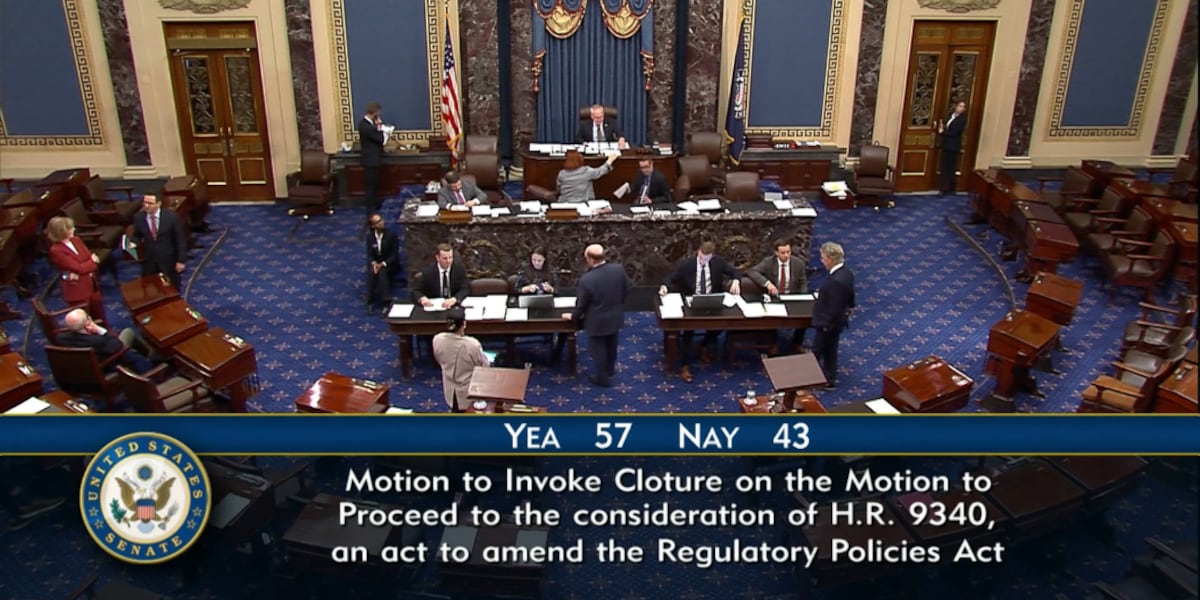
Senate reaches bipartisan permitting bill, Capito calls it major step
The measure would curb NEPA and historic‑preservation lawsuits, make data centres pay transmission costs and faces a vote only after the November midterms.
AI-assisted coverage comparison, editor-supervised · How this was made

Senate reaches bipartisan permitting bill, Capito calls it major step
Photograph: Washington Top News (embedded from source)
What this story says
- Senators from both parties announced a bipartisan deal to accelerate permitting for new energy and infrastructure projects.
- The legislation would limit lawsuits under NEPA and the National Historic Preservation Act.
- Data centres would be required to pay all associated transmission costs.
- A vote is not expected until after the November 2026 midterm elections.
Who covered it
Percentages are shares of the 32 outlets carrying a published leaning rating. 5 of the 37 outlets we know ran this story carry no rating and are not counted in them. Coverage measured .
Trust
68/100
Craft
95/100
Hype
15/100
37 sources · methodology
Thin on the right so far
Only 3 of the 32 outlets with a published leaning rating that ran this story are rated right.
This story is still being watched, so it is a count and not yet a finding. Coverage keeps arriving for hours after an event, and a side that has published nothing this morning may publish by tonight. If it is still true when we stop checking, we will say so plainly.
On 30 September 2026, senators from the Democratic and Republican caucuses said they had reached a bipartisan agreement to reform the federal permitting process for large energy and infrastructure projects. The deal aims to shorten the years‑long review periods that have slowed the construction of new power generation, transmission lines and related facilities.
Key provisions would restrict legal challenges under the National Environmental Policy Act and the National Historic Preservation Act, two statutes that currently allow extensive court reviews of project impacts. The bill also would streamline siting of interstate transmission lines and give the Federal Energy Regulatory Commission greater authority to coordinate state and federal reviews.
Another central element requires data centres, whose growing electricity demand is driving much of the new capacity need, to cover all transmission upgrades needed for their operations, preventing those costs from being passed to households or businesses.
Republican Senator Shelley Moore Capito, chair of the Environment and Public Works Committee, described the legislation as "a major step toward making it faster and more efficient and easier to build infrastructure projects" while preserving essential environmental safeguards.
“a major step toward making it faster and more efficient and easier to build infrastructure projects”
What the coverage left out
None of the left‑rated digests and none of the right‑rated digests include Senator Capito’s statement describing the bill as a "major step toward making it faster and more efficient and easier to build infrastructure projects," a detail that appears only in the centre‑rated full WTOP report.
Still developing. We have re-checked which outlets are covering this 3 times, most recently on 1 Oct 2026, 01:45, and will add the sides that appear.
How each side covered it
Our own reading of the reporting listed below, written from the outlets’ articles rather than quoted from them. The reasoning is set out on our methodology page.
Left
15 rated outlets
- The nine left‑rated digests all led on the bipartisan nature of the deal and the urgency created by rising electricity demand from data centres. They reported that the bill would limit NEPA and historic‑preservation lawsuits and shift transmission costs to data centres. None of the left‑rated digests quoted Senator Capito’s description of the bill as a "major step" or included her direct remarks.
Centre
14 rated outlets
- The eleven centre‑rated reports, including the full WTOP article, highlighted the same core provisions and added Senator Capito’s quote about the bill being a "major step toward making it faster and more efficient and easier to build infrastructure projects." They also noted that the vote is expected only after the November midterms and that the legislation enjoys support from both energy and environmental groups.
Right
3 rated outlets
- All three right‑rated digests focused on the bipartisan agreement and the bill’s potential to reduce permitting delays and costs. They mentioned the requirement that data centres pay transmission expenses and the postponement of a vote until after the midterms. None of the right‑rated digests included Senator Capito’s specific quote about the legislation being a major step.
Questions about this coverage
- How did the left and right cover Senate reaches bipartisan permitting bill, Capito calls it major step?
- Of the 32 outlets on this story carrying a published leaning rating, 47% are rated left, 44% are rated centre, 9% are rated right. Those percentages are shares of the rated outlets, not of every outlet that ran it, which was 37. The sections above set out what each side emphasised, in its own terms.
- Is Senate reaches bipartisan permitting bill, Capito calls it major step left or right?
- Neither side dominates it. Of the 32 rated outlets on this story, 47% are rated left, 44% are rated centre, 9% are rated right, and no side holds the 70% this site would want before calling a field one-sided. A story is not left or right in any case; the outlets that carried it are what carry ratings.
- Is the coverage of Senate reaches bipartisan permitting bill, Capito calls it major step biased?
- Senate reaches bipartisan permitting bill, Capito calls it major step is one event reported by 37 outlets, and this page does not rate the story as biased or unbiased. What it publishes is the spread: which outlets ran it, where named rating organisations place each of them on the spectrum, and what each side chose to lead with. A leaning rating describes an outlet's record over time, not this article, and the two should not be run together.
- Which side is not reporting Senate reaches bipartisan permitting bill, Capito calls it major step?
- When we first saw this story, outlets rated right had barely covered it. Coverage accretes for hours after an event, so that is where to look rather than a verdict — the split above is the current count, and it is the one to read.
- Which outlets covered Senate reaches bipartisan permitting bill, Capito calls it major step?
- 37 that we know of, every one of them listed further up this page with a link to its own report and to what we hold on the publisher. Nothing here is a summary of somebody else's summary: the outlets are named so the original reporting can be read.
- What does the permitting bill change about legal challenges?
- The legislation would limit lawsuits filed under the National Environmental Policy Act and the National Historic Preservation Act, two statutes that currently allow extensive court reviews of energy and infrastructure projects, thereby shortening the permitting timeline.
- Who will pay for transmission upgrades under the new bill?
- Data centres would be required to cover all costs associated with transmission upgrades needed for their electricity consumption, preventing those expenses from being shifted onto households or other businesses.
- When is a vote on the bill expected?
- A vote on the permitting reform is not anticipated until after the November 2026 midterm elections, reflecting the political uncertainty surrounding the upcoming congressional elections.
- Which senator described the bill as a major step forward?
- Republican Senator Shelley Moore Capito, chair of the Environment and Public Works Committee, called the legislation a major step toward faster, more efficient, and easier infrastructure approvals while maintaining environmental protections.
Read it at the source
37 outlets, grouped by the leaning a published rating gives them. Every headline links to the original; an underlined outlet name opens our profile of that publisher.
Left
15- US Senate Achieves Bipartisan Agreement on Permits to Accelerate New Energy Projects (opens Los Angeles Times in a new tab)
Los Angeles Times — is Los Angeles Times biased? Our profile of this outlet
- Senate reaches bipartisan deal on permitting bill to speed approvals of new energy projects (opens PBS NewsHour in a new tab)
PBS NewsHour — is PBS NewsHour biased? Our profile of this outlet
- Heinrich introduces long-sought permitting reforms with key Republicans to expedite energy projects, and he wants a Senate vote right after Election Day - The Paper. (opens abq.news in a new tab)
abq.news
- Senators Have a Bipartisan Permitting Reform Deal but Little Time to Pass It (opens washingtonsun.com in a new tab)
washingtonsun.com — is washingtonsun.com biased? Our profile of this outlet
- Senate reaches bipartisan deal on permitting bill to speed approvals of new energy projects (opens Oskaloosa Herald in a new tab)
Oskaloosa Herald — is Oskaloosa Herald biased? Our profile of this outlet
- Senators clinch construction permitting deal before election jet-set (opens CNBC in a new tab)
- Senate reaches bipartisan deal on permitting bill to speed approvals of new energy projects (opens The Seattle Times in a new tab)
The Seattle Times — is The Seattle Times biased? Our profile of this outlet
- Senate reaches bipartisan deal on permitting bill to speed approvals of new energy projects (opens The Sun Chronicle in a new tab)
The Sun Chronicle — is The Sun Chronicle biased? Our profile of this outlet
Show 7 more
- Senate reaches bipartisan deal on permitting bill to speed approvals of new energy projects (opens Bangor Daily News in a new tab)
Bangor Daily News — is Bangor Daily News biased? Our profile of this outlet
- Senate reaches bipartisan deal on permitting bill to speed approvals of new energy projects (opens ABC News in a new tab)
- Senate reaches bipartisan deal on permitting bill to speed approvals of new energy projects (opens Associated Press News in a new tab)
Associated Press News — is Associated Press News biased? Our profile of this outlet
- Democrats Abandon Environmental Laws to Advance Pro-Fossil Fuel ‘Permitting Reform’ (opens Common Dreams in a new tab)
Common Dreams — is Common Dreams biased? Our profile of this outletOpinion
- Democrats Abandon Environmental Laws to Advance Pro-Fossil Fuel ‘Permitting Reform’ (opens biologicaldiversity.org in a new tab)
biologicaldiversity.org — is biologicaldiversity.org biased? Our profile of this outletOpinion
- Senate Negotiators Strike Bipartisan Permitting Deal To Fast-Track Energy Project Approvals (opens foreignpolicyjournal.com in a new tab)
foreignpolicyjournal.com — is foreignpolicyjournal.com biased? Our profile of this outlet
- The Senate wants to pass a permitting reform bill. So what’s the… (opens Canary Media in a new tab)
Canary Media — is Canary Media biased? Our profile of this outlet
Centre
14- Senate reaches bipartisan deal on permitting bill to speed approvals of new energy projects (opens The New York Ledger in a new tab)
The New York Ledger — is The New York Ledger biased? Our profile of this outlet
- Senate reaches bipartisan deal on permitting bill to speed approvals of new energy projects - WXXV News 25 (opens WXXV 25 in a new tab)
- Senate reaches bipartisan deal on permitting bill to speed approvals of new energy projects (opens My Mother Lode in a new tab)
My Mother Lode — is My Mother Lode biased? Our profile of this outlet
- US senators hit deal on energy project permitting bill, vote after midterm elections (opens Reuters in a new tab)
- Senate reaches bipartisan deal on permitting bill to speed approvals of new energy projects (opens The Record in a new tab)
The Record — is The Record biased? Our profile of this outlet
- Senate reaches bipartisan deal on permitting bill to speed approvals of new energy projects – WTOP News (opens Washington Top News in a new tab)
Washington Top News — is Washington Top News biased? Our profile of this outlet
- Senate reaches bipartisan deal on permitting bill to speed approvals o (opens WBAL in a new tab)
- Senate reaches bipartisan deal on permitting bill to speed approvals of new energy projects (opens Newsday in a new tab)
Show 6 more
- Senate reaches bipartisan deal on permitting bill to speed approvals of new energy projects (opens Bozeman Daily Chronicle in a new tab)
Bozeman Daily Chronicle — is Bozeman Daily Chronicle biased? Our profile of this outlet
- Senate reaches bipartisan deal on permitting bill to speed approvals of new energy projects (opens WBOC 16 in a new tab)
- Senate reaches bipartisan deal on permitting bill to speed approvals of new energy projects (opens WKMG in a new tab)
- Senate reaches bipartisan deal on permitting bill to speed approvals of new energy projects (opens The Northern Virginia Daily in a new tab)
The Northern Virginia Daily — is The Northern Virginia Daily biased? Our profile of this outlet
- Senate reaches bipartisan deal on permitting bill to speed approvals of new energy projects (opens Winnipeg Free Press in a new tab)
Winnipeg Free Press — is Winnipeg Free Press biased? Our profile of this outlet
- Capito says deal is at hand on long-sought permitting reform (opens WV MetroNews in a new tab)
WV MetroNews — is WV MetroNews biased? Our profile of this outlet
Right
3- US senators hit deal on energy project permitting bill, vote seen after November (opens regionalmedianews.com in a new tab)
regionalmedianews.com — is regionalmedianews.com biased? Our profile of this outlet
- US Senate Achieves Bipartisan Agreement on Permits to Accelerate New Energy Projects (opens Clarin in a new tab)
- Congress' backroom permitting reform risks making things worse (opens Washington Times in a new tab)
Washington Times — is Washington Times biased? Our profile of this outletOpinion
Not rated
5- Heinrich introduces long-sought permitting reforms with key Republicans to expedite energy projects, and he wants a Senate vote right after Election Day - New Mexico Political Report (opens The NM Political Report in a new tab)
The NM Political Report — is The NM Political Report biased? Our profile of this outlet
- US Senate Achieves Bipartisan Agreement on Permits to Accelerate New Energy Projects (opens Independent Español in a new tab)
Independent Español — is Independent Español biased? Our profile of this outlet
- Senate reaches bipartisan deal on permitting bill to speed approvals of new energy projects (opens KXL in a new tab)
- Statement from CEBA CEO Rich Powell on the Bipartisan American Affordability and Jobs Act - CEBA - Corporate Energy Buyers Association (opens ceba.org in a new tab)
ceba.orgOpinion
- Senate negotiators reach deal on permitting text (opens BizToc in a new tab)
How did this read?
About the coverage, not about the story. We do not ask whether you agree with what happened — we have no honest use for that answer.