Archaeologists find 7th-century trade hub beneath Ramat Gan stadium site
Excavations ahead of bus terminal construction reveal streets, kilns and coins from Umayyad and Abbasid periods
AI-assisted coverage comparison, editor-supervised · How this was made

Archaeologists find 7th-century trade hub beneath Ramat Gan stadium site
Photograph: Jerusalem Post (embedded from source)
What this story says
- The Israel Antiquities Authority uncovered a 1,300-year-old industrial and commercial complex beneath a parking lot in Ramat Gan during excavations for a bus terminal.
- The site dates to the 7th or 8th century CE, spanning the Umayyad and Abbasid periods, and was operational for about 150 years before being abandoned and later resettled.
- Archaeologists found streets, pottery kilns, bronze tableware, coins and intact oil lamps, suggesting a major trade or industrial hub near a historic road linking Jaffa, Ramla and Jerusalem.
- The complex will be opened to the public for one day on 19 August before being covered to preserve it.
Who covered it
Percentages are shares of the 10 outlets carrying a published leaning rating. 3 of the 13 outlets we know ran this story carry no rating and are not counted in them. Coverage measured .
Trust
62/100
Craft
59/100
Hype
15/100
13 sources · methodology
Missing from the left
Only 3 of the 10 outlets with a published leaning rating that ran this story are rated left.
A reader who follows the left would not have seen this. We report the absence rather than explain it: outlets choose what to cover for many reasons, and we have no evidence about which one applies here.
Archaeologists in Ramat Gan, Israel, have uncovered a 1,300-year-old industrial and commercial complex beneath the Winter Stadium parking lot. The site, which dates to the 7th or 8th century CE, includes intersecting streets, pottery kilns and industrial buildings. It was discovered during excavations ahead of the construction of a bus terminal by Netivei Ayalon.
The complex was operational for about 150 years before being abandoned, then resettled in the 10th century CE. Residents built new structures and installed clay baking ovens. The site was abandoned again in the late 11th century CE, before the Crusader conquest, and has not been resettled since. The Israel Antiquities Authority (IAA) reported finding dozens of pottery vessels, intact oil lamps, bronze tableware, iron tools, coins and fragments of local and imported glass.
The IAA excavation directors, Dr. Yoav Arbel and Lior Rauchberger, said the complex was planned in advance by engineers and likely built with the knowledge of regional authorities. They suggested it may have served as a major trade and industrial station or part of an undiscovered nearby settlement. The site is near a historic road connecting Jaffa, Ramla and Jerusalem, and offers fertile land and water sources.
Heritage Minister Amichai Eliyahu said the discovery demonstrates Israel’s archaeological wealth. The IAA will hold a public viewing day on 19 August before covering the site to preserve it.
What the coverage left out
None of the right-rated digests mentioned the public viewing day on 19 August. The left-rated digest did not report the planned streets, the later Fatimid period resettlement, the specific artefacts found, or the public viewing day.
Coverage settled. We checked this 27 times and stopped on 21 Aug 2026, 21:02. The figures above are what it finished at.
How other outlets pictured it
Which photograph to run is each newsroom’s own choice. The leaning beside a name is that outlet’s published rating, not a claim that the pictures divide along it. Every picture is shown from the outlet’s own server and links to the article it ran in.
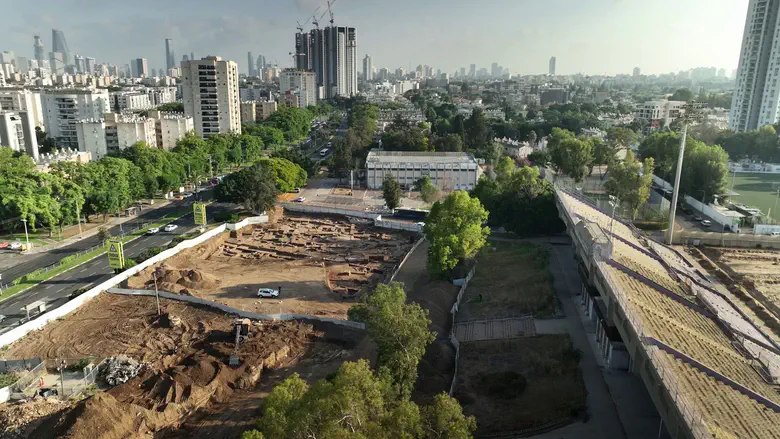
Israel National News
Arutz Sheva — embedded from source
How each side covered it
Our own reading of the reporting listed below, written from the outlets’ articles rather than quoted from them. The reasoning is set out on our methodology page.
Left
3 rated outlets
- The single left-rated digest, from Zeit Online, led on the discovery of an industrial area in Ramat Gan. It noted the site likely dates to the 7th or 8th century CE but did not mention the planned streets, the later Fatimid period resettlement, the specific artefacts found, or the public viewing day.
Centre
2 rated outlets
- The Jerusalem Post, the centre-rated report, led on the site as an "ancient shopping center" and detailed the planned streets, pottery kilns and industrial buildings. It quoted the IAA excavation directors on the complex’s advanced planning and possible funding by regional authorities. The report included the full timeline of abandonment and resettlement, the artefacts found, and the upcoming public viewing day.
Right
5 rated outlets
- All five right-rated digests led on the discovery of a 1,300-year-old industrial and commercial complex in Ramat Gan. The digests from WIN, Jewish News Syndicate and Cleveland Jewish News noted the planned streets, pottery kilns, shops and warehouses. WIN and Cleveland Jewish News specified the Umayyad and Abbasid periods and the 150-year operational span. None of the digests mentioned the later Fatimid period resettlement, the specific artefacts found, or the public viewing day.
- Arutz Sheva, the only right-rated full report, led with the question of whether the streets were the oldest in Ramat Gan. It quoted the IAA excavation directors at length on the complex’s planning and location near the historic road. The report included the full timeline of abandonment and resettlement, the artefacts found, and the ethnic diversity of the region’s population during the period. It did not mention the public viewing day.
Questions about this coverage
- How did the left and right cover Archaeologists find 7th-century trade hub beneath Ramat Gan stadium site?
- Of the 10 outlets on this story carrying a published leaning rating, 30% are rated left, 20% are rated centre, 50% are rated right. Those percentages are shares of the rated outlets, not of every outlet that ran it, which was 13. The sections above set out what each side emphasised, in its own terms.
- Is Archaeologists find 7th-century trade hub beneath Ramat Gan stadium site left or right?
- Too few of the outlets on this story carry a published leaning rating to say. 10 of them do, and this site does not characterise a field under 12: at that size one newsroom filing moves the share by ten points. The percentages above are the count as it stands.
- Is the coverage of Archaeologists find 7th-century trade hub beneath Ramat Gan stadium site biased?
- Archaeologists find 7th-century trade hub beneath Ramat Gan stadium site is one event reported by 13 outlets, and this page does not rate the story as biased or unbiased. What it publishes is the spread: which outlets ran it, where named rating organisations place each of them on the spectrum, and what each side chose to lead with. A leaning rating describes an outlet's record over time, not this article, and the two should not be run together.
- Which side is not reporting Archaeologists find 7th-century trade hub beneath Ramat Gan stadium site?
- When we first saw this story, outlets rated left had barely covered it. Coverage accretes for hours after an event, so that is where to look rather than a verdict — the split above is the current count, and it is the one to read.
- Which outlets covered Archaeologists find 7th-century trade hub beneath Ramat Gan stadium site?
- 13 that we know of, every one of them listed further up this page with a link to its own report and to what we hold on the publisher. Nothing here is a summary of somebody else's summary: the outlets are named so the original reporting can be read.
- What was discovered in Ramat Gan?
- Archaeologists uncovered a 1,300-year-old industrial and commercial complex beneath a parking lot in Ramat Gan, Israel. The site includes intersecting streets, pottery kilns and industrial buildings dating to the 7th or 8th century CE. It was operational for about 150 years before being abandoned and later resettled.
- When was the Ramat Gan complex built and abandoned?
- The complex was built in the 7th or 8th century CE during the Umayyad and Abbasid periods. It was operational for about 150 years before being abandoned, then resettled in the 10th century CE. It was abandoned again in the late 11th century CE, before the Crusader conquest.
- What did archaeologists find at the site?
- Archaeologists found intersecting streets, pottery kilns, industrial buildings, dozens of pottery vessels, intact oil lamps, bronze tableware, iron tools, coins and fragments of local and imported glass. The site suggests a major trade or industrial hub near a historic road linking Jaffa, Ramla and Jerusalem.
- Will the public be able to see the Ramat Gan site?
- The Israel Antiquities Authority will hold a public viewing day on 19 August. Afterward, the site will be covered to preserve it. The Jerusalem Post and Arutz Sheva reported this, but none of the right-rated digests mentioned it.
Read it at the source
13 outlets, grouped by the leaning a published rating gives them. Every headline links to the original; an underlined outlet name opens our profile of that publisher.
Left
3- 1,300-year-old industrial complex uncovered by central Israel soccer stadium (opens Ynet News in a new tab)
- Tel Aviv: 1,300 Years Old Industrial Area Discovered in Israel (opens Zeit Online in a new tab)
Zeit Online — is Zeit Online biased? Our profile of this outlet
- Islamic-era industrial complex in central Israel puzzles archaeologists (opens Haaretz in a new tab)
Centre
2- Archaeology - Researchers in Israel Discover 1,300 Years Old "Industrial Area" Next to Football Stadium (opens Deutschlandfunk in a new tab)
Deutschlandfunk — is Deutschlandfunk biased? Our profile of this outlet
- Ancient shopping center unearthed during excavations prior to construction in central Israel (opens Jerusalem Post in a new tab)
Jerusalem Post — is Jerusalem Post biased? Our profile of this outlet
Right
5- History: "Planned Carefully by Engineers" – Archaeologists Find 1300-Year-Old "Industrial Area" in Israel (opens Welt in a new tab)
- 1,300-year-old industrial, commercial complex uncovered in Ramat Gan (opens WIN in a new tab)
- 1,300-year-old industrial, commercial complex uncovered in Ramat Gan (opens Jewish News Syndicate in a new tab)
Jewish News Syndicate — is Jewish News Syndicate biased? Our profile of this outlet
- 1,300-year-old industrial, commercial complex uncovered in Ramat Gan (opens Cleveland Jewish News in a new tab)
Cleveland Jewish News — is Cleveland Jewish News biased? Our profile of this outlet
- Have the oldest streets in Ramat Gan been uncovered? (opens Arutz Sheva in a new tab)
Arutz Sheva — is Arutz Sheva biased? Our profile of this outlet
Not rated
3- After 1,300 Years: An Entire City Is Resurrected Under the Asphalt (opens kikar.co.il in a new tab)
kikar.co.il — is kikar.co.il biased? Our profile of this outlet
- A 1,300-Year-Old Industrial-Commercial Complex Was Discovered Near the Winter Stadium in Ramat Gan (opens haaretz.co.il in a new tab)
haaretz.co.il — is haaretz.co.il biased? Our profile of this outlet
- Under the Parking Lot of Winter Stadium: A 1,300-Year-Old City Was Discovered in Ramat Gan - Walla Tourism (opens Unknown in a new tab)
Unknown
How did this read?
About the coverage, not about the story. We do not ask whether you agree with what happened — we have no honest use for that answer.
More in Science & Tech
All Science & Tech →
Elsewhere on the site
 Conflict & Security•3 min readIDF Chief of Staff Eyal Zamir Cancels US Visit Amid Security Alert
 Conflict & Security•2 min readTrump unsure if Iran will surrender, says country doing 'very badly'
 Conflict & Security•3 min readPakistan Pledges Military Support for Saudi Arabia Against Houthis
 Conflict & Security•3 min readItaly completes 12-year military withdrawal from Iraq