Astronomers Discover Second-Generation Planet Orbiting White Dwarf
The gas giant appears to have formed from material expelled by its dying star.
AI-assisted coverage comparison, editor-supervised · How this was made
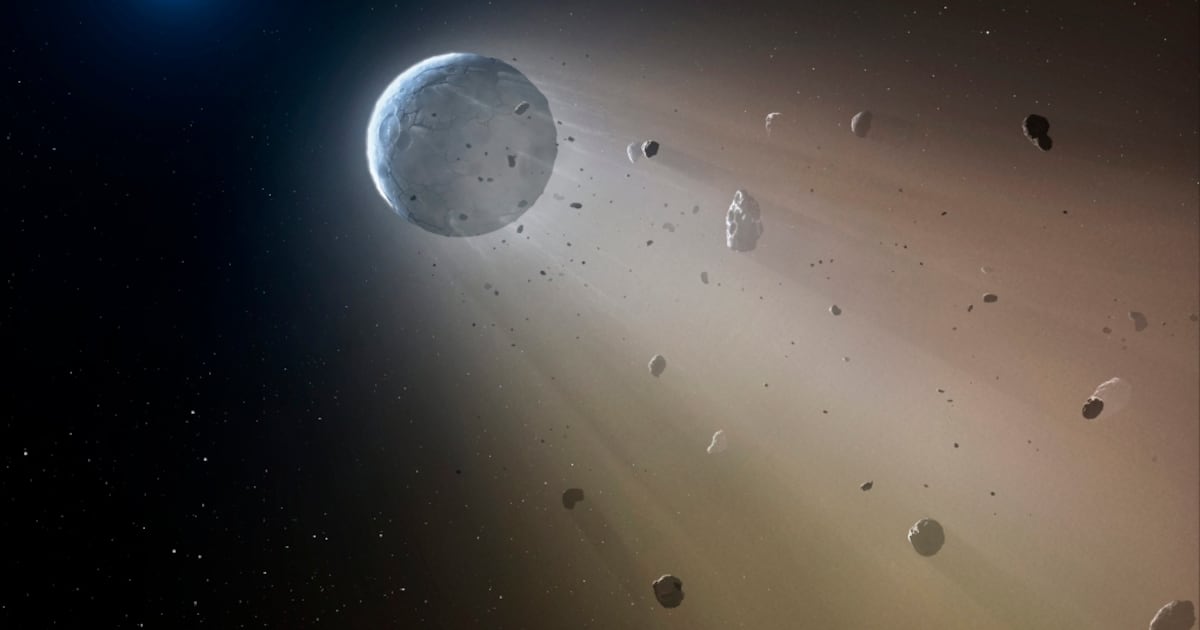
This artist's rendering provided by the Harvard-Smithsonian Center for Astrophysics shows an asteroid slowly disintegrating as it orbits a white dwarf star. (Mark A. Garlick / Harvard-Smithsonian Center for Astrophysics via AP)
Photograph: CTV News (embedded from source)
What this story says
- Astronomers have identified a gas giant exoplanet orbiting a white dwarf star 250 light-years from Earth.
- This planet is classified as 'second-generation', meaning it formed from the remnants of its star after its death, rather than from a primordial disk.
- The planet's composition, rich in niobium, copper, and zinc, supports its second-generation origin.
- Researchers used data from the Hubble, TESS, and FUSE telescopes, with future observations planned using the James Webb Space Telescope.
Who covered it
Percentages are shares of the 97 outlets carrying a published leaning rating. 3 of the 100 outlets we know ran this story carry no rating and are not counted in them. Coverage measured .
Trust
60/100
Craft
60/100
Hype
20/100
100 sources · methodology
A gas giant exoplanet, described as a second-generation planet, has been discovered orbiting a white dwarf star about 250 light-years from Earth. This classification indicates the planet did not form from the initial disk of material around a newborn star, but rather from the debris of a star's later stages. The planet orbits its white dwarf every 4.4 days at a distance equivalent to 4 per cent of the Earth-Sun distance. Researchers used data from the Hubble, TESS, and FUSE telescopes to make the discovery, and plan to use the James Webb Space Telescope for confirmation.
The planet's chemical composition, which includes significant amounts of niobium, copper, and zinc, suggests it formed from material expelled by its dying star. These elements are indicative of the stellar material ejected during a star's death throes. The discovery suggests that planet formation can occur around white dwarfs, which are common stellar remnants, potentially leading to the formation of many more such planets than around rarer pulsars.
Disagreement on planet's proximity
One report states the planet orbits the white dwarf at only 4 per cent of the distance between Earth and the sun. Another report states the planet is located approximately 270 light-years away from Earth.
What the coverage left out
None of the left-rated digests mention the potential for habitable second-generation rocky planets forming around white dwarfs, a detail included in the full report from CTV News. None of the right-rated digests mention the potential for habitable second-generation rocky planets forming around white dwarfs.
Still developing. We have re-checked which outlets are covering this 4 times, most recently on 12 Oct 2026, 23:00, and will add the sides that appear.
How each side covered it
Our own reading of the reporting listed below, written from the outlets’ articles rather than quoted from them. The reasoning is set out on our methodology page.
Left
14 rated outlets
- Eight of the ten left-rated reports led with the 'phoenix planet' analogy, describing it as a world born from the ashes of a dying star. These reports highlighted that this discovery proves planet formation is not a one-time event occurring only when a star is young. Several digests also noted that most known planets are first-generation planets formed when a star is born.
Centre
75 rated outlets
- Nine of the centre-rated reports also used the 'phoenix planet' analogy, focusing on the idea of a world rising from the ashes of a dying star. These digests frequently stated that most known planets are first-generation planets formed when a star is born. Some digests mentioned the planet's composition, noting it was rich in elements like niobium, copper, and zinc.
Right
8 rated outlets
- All eight right-rated reports used the 'phoenix planet' metaphor, describing the exoplanet as being born from the ashes of a dying star. These digests stated that the discovery proves planet formation is not limited to a star's youth. Some digests mentioned the planet's composition, including heavy elements such as zinc, copper, and niobium, and its formation from material shed by its dying star.
Questions about this coverage
- How did the left and right cover Astronomers Discover Second-Generation Planet Orbiting White Dwarf?
- Of the 97 outlets on this story carrying a published leaning rating, 14% are rated left, 78% are rated centre, 8% are rated right. Those percentages are shares of the rated outlets, not of every outlet that ran it, which was 100. The sections above set out what each side emphasised, in its own terms.
- Is Astronomers Discover Second-Generation Planet Orbiting White Dwarf left or right?
- The story itself is neither. What can be counted is who has covered it, and 78% of the 97 rated outlets on it are rated centre — so far this is a story carried mostly by the centre. Coverage is still arriving and that can change, which is why the figure is dated rather than fixed.
- Is the coverage of Astronomers Discover Second-Generation Planet Orbiting White Dwarf biased?
- Astronomers Discover Second-Generation Planet Orbiting White Dwarf is one event reported by 100 outlets, and this page does not rate the story as biased or unbiased. What it publishes is the spread: which outlets ran it, where named rating organisations place each of them on the spectrum, and what each side chose to lead with. A leaning rating describes an outlet's record over time, not this article, and the two should not be run together.
- Which outlets covered Astronomers Discover Second-Generation Planet Orbiting White Dwarf?
- 100 that we know of, every one of them listed further up this page with a link to its own report and to what we hold on the publisher. Nothing here is a summary of somebody else's summary: the outlets are named so the original reporting can be read.
- What is a second-generation planet?
- A second-generation planet is one that forms after its host star has died and become a stellar remnant, such as a white dwarf. This is in contrast to first-generation planets, which form from the initial disk of material surrounding a newborn star.
- How far away is this newly discovered planet?
- The exoplanet is located approximately 250 light-years from Earth. A light-year is the distance light travels in one year, which is about 5.9 trillion miles or 9.5 trillion kilometres.
- What elements is the planet rich in?
- The planet is rich in niobium, copper, and zinc. These elements are indicative of its second-generation origin, suggesting it formed from material expelled by its dying star.
Read it at the source
100 outlets, grouped by the leaning a published rating gives them. Every headline links to the original; an underlined outlet name opens our profile of that publisher.
Left
14- Alien 'phoenix planet' was born from the ashes of a dying star (opens Record and Landmark in a new tab)
Record and Landmark — is Record and Landmark biased? Our profile of this outlet
- Alien 'phoenix planet' was born from the ashes of a dying star (opens Dothan Eagle in a new tab)
Dothan Eagle — is Dothan Eagle biased? Our profile of this outlet
- Alien 'phoenix planet' was born from the ashes of a dying star (opens Sioux City Journal in a new tab)
Sioux City Journal — is Sioux City Journal biased? Our profile of this outlet
- Alien 'phoenix planet' was born from the ashes of a dying star (opens Winston-Salem Journal in a new tab)
Winston-Salem Journal — is Winston-Salem Journal biased? Our profile of this outlet
- Alien 'phoenix planet' was born from the ashes of a dying star (opens St Louis Post-Dispatch in a new tab)
St Louis Post-Dispatch — is St Louis Post-Dispatch biased? Our profile of this outlet
- Alien 'phoenix planet' was born from the ashes of a dying star (opens News & Record in a new tab)
News & Record — is News & Record biased? Our profile of this outlet
- Rising from the ashes: Scientists have found a phoenix planet (opens The Week in a new tab)
- This May Be First Unknown 'Second- Generation' Planet (opens Newser in a new tab)
Show 6 more
- Astronomers spot signs of a planet born from a dying star's remains (opens Mashable in a new tab)
- A New Planet May Have Been Born From the Ashes of the Dead Star (opens Cumhuriyet in a new tab)
Cumhuriyet — is Cumhuriyet biased? Our profile of this outlet
- First Ever Detection Of A Phoenix Planet Around A White Dwarf – Born After Its Star Had Died (opens IFLScience in a new tab)
IFLScience — is IFLScience biased? Our profile of this outlet
- Astronomers find a ‘phoenix’ planet born from a dead star's ashes (opens Metro News in a new tab)
Metro News — is Metro News biased? Our profile of this outlet
- Scientists find planet unlike anything seen before (opens The Independent (US) in a new tab)
The Independent (US) — is The Independent (US) biased? Our profile of this outlet
- Scientists find planet unlike anything seen before (opens The Independent in a new tab)
The Independent — is The Independent biased? Our profile of this outlet
Centre
75- Astronomers discover second-generation planet made by dying star (opens NewsNation in a new tab)
NewsNation — is NewsNation biased? Our profile of this outlet
- Astronomers discover second-generation planet made by dying star (opens KXAN in a new tab)
- Alien 'phoenix planet' was born from the ashes of a dying star (opens Muscatine Journal in a new tab)
Muscatine Journal — is Muscatine Journal biased? Our profile of this outlet
- Alien 'phoenix planet' was born from the ashes of a dying star (opens Beatrice Daily Sun in a new tab)
Beatrice Daily Sun — is Beatrice Daily Sun biased? Our profile of this outlet
- Alien 'phoenix planet' was born from the ashes of a dying star (opens Columbus Telegram in a new tab)
Columbus Telegram — is Columbus Telegram biased? Our profile of this outlet
- Alien 'phoenix planet' was born from the ashes of a dying star (opens Mason City Globe Gazette in a new tab)
Mason City Globe Gazette — is Mason City Globe Gazette biased? Our profile of this outlet
- Alien 'phoenix planet' was born from the ashes of a dying star (opens fredericksburg.com in a new tab)
fredericksburg.com — is fredericksburg.com biased? Our profile of this outlet
- Alien 'phoenix planet' was born from the ashes of a dying star (opens Mooresville Tribune in a new tab)
Mooresville Tribune — is Mooresville Tribune biased? Our profile of this outlet
Show 67 more
- Alien 'phoenix planet' was born from the ashes of a dying star (opens Lake Geneva News in a new tab)
Lake Geneva News — is Lake Geneva News biased? Our profile of this outlet
- Alien 'phoenix planet' was born from the ashes of a dying star (opens Winona Daily News in a new tab)
Winona Daily News — is Winona Daily News biased? Our profile of this outlet
- Alien 'phoenix planet' was born from the ashes of a dying star (opens The Times and Democrat in a new tab)
The Times and Democrat — is The Times and Democrat biased? Our profile of this outlet
- Alien 'phoenix planet' was born from the ashes of a dying star (opens Martinsville Bulletin in a new tab)
Martinsville Bulletin — is Martinsville Bulletin biased? Our profile of this outlet
- Alien 'phoenix planet' was born from the ashes of a dying star (opens Dispatch Argus in a new tab)
Dispatch Argus — is Dispatch Argus biased? Our profile of this outlet
- Alien 'phoenix planet' was born from the ashes of a dying star (opens The News Virginian in a new tab)
The News Virginian — is The News Virginian biased? Our profile of this outlet
- Alien 'phoenix planet' was born from the ashes of a dying star (opens Wahoo Newspaper in a new tab)
Wahoo Newspaper — is Wahoo Newspaper biased? Our profile of this outlet
- Alien 'phoenix planet' was born from the ashes of a dying star (opens Chippewa Herald in a new tab)
Chippewa Herald — is Chippewa Herald biased? Our profile of this outlet
- Alien 'phoenix planet' was born from the ashes of a dying star (opens OANow.com in a new tab)
- Alien 'phoenix planet' was born from the ashes of a dying star (opens Herald & Review in a new tab)
Herald & Review — is Herald & Review biased? Our profile of this outlet
- Alien 'phoenix planet' was born from the ashes of a dying star (opens Corvallis Gazette Times in a new tab)
Corvallis Gazette Times — is Corvallis Gazette Times biased? Our profile of this outlet
- Alien 'phoenix planet' was born from the ashes of a dying star (opens Star-Herald in a new tab)
Star-Herald — is Star-Herald biased? Our profile of this outlet
- Alien 'phoenix planet' was born from the ashes of a dying star (opens Roanoke Times in a new tab)
Roanoke Times — is Roanoke Times biased? Our profile of this outlet
- Alien 'phoenix planet' was born from the ashes of a dying star (opens Bristol Herald Courier in a new tab)
Bristol Herald Courier — is Bristol Herald Courier biased? Our profile of this outlet
- Alien 'phoenix planet' was born from the ashes of a dying star (opens The Valley News Today in a new tab)
The Valley News Today — is The Valley News Today biased? Our profile of this outlet
- Alien 'phoenix planet' was born from the ashes of a dying star (opens Waterloo Cedar Falls Courier in a new tab)
Waterloo Cedar Falls Courier — is Waterloo Cedar Falls Courier biased? Our profile of this outlet
- Alien 'phoenix planet' was born from the ashes of a dying star (opens The Daily Progress in a new tab)
The Daily Progress — is The Daily Progress biased? Our profile of this outlet
- Alien 'phoenix planet' was born from the ashes of a dying star (opens Bulletin-Review in a new tab)
Bulletin-Review — is Bulletin-Review biased? Our profile of this outlet
- Alien 'phoenix planet' was born from the ashes of a dying star (opens Danville Register & Bee in a new tab)
Danville Register & Bee — is Danville Register & Bee biased? Our profile of this outlet
- Alien 'phoenix planet' was born from the ashes of a dying star (opens The Daily Nonpareil in a new tab)
The Daily Nonpareil — is The Daily Nonpareil biased? Our profile of this outlet
- Alien 'phoenix planet' was born from the ashes of a dying star (opens Hickory Daily Record in a new tab)
Hickory Daily Record — is Hickory Daily Record biased? Our profile of this outlet
- Alien 'phoenix planet' was born from the ashes of a dying star (opens Tucson in a new tab)
- Alien 'phoenix planet' was born from the ashes of a dying star (opens Channel 3000 in a new tab)
Channel 3000 — is Channel 3000 biased? Our profile of this outlet
- Alien 'phoenix planet' was born from the ashes of a dying star (opens Omaha World-Herald in a new tab)
Omaha World-Herald — is Omaha World-Herald biased? Our profile of this outlet
- Alien 'phoenix planet' was born from the ashes of a dying star (opens Lincoln Journal Star in a new tab)
Lincoln Journal Star — is Lincoln Journal Star biased? Our profile of this outlet
- Alien 'phoenix planet' was born from the ashes of a dying star (opens Montana Standard in a new tab)
Montana Standard — is Montana Standard biased? Our profile of this outlet
- Alien 'phoenix planet' was born from the ashes of a dying star (opens Missoulian in a new tab)
Missoulian — is Missoulian biased? Our profile of this outlet
- Alien 'phoenix planet' was born from the ashes of a dying star (opens Helena Independent Record in a new tab)
Helena Independent Record — is Helena Independent Record biased? Our profile of this outlet
- Alien 'phoenix planet' was born from the ashes of a dying star (opens The Billings Gazette in a new tab)
The Billings Gazette — is The Billings Gazette biased? Our profile of this outlet
- Astronomers discover second-generation planet made by dying star (opens KTAL NBC 6 News in a new tab)
KTAL NBC 6 News — is KTAL NBC 6 News biased? Our profile of this outlet
- Astronomers discover second-generation planet made by dying star (opens KHON2 in a new tab)
- Astronomers discover second-generation planet made by dying star (opens KXRM in a new tab)
- Astronomers discover second-generation planet made by dying star (opens KTSM in a new tab)
- Astronomers discover second-generation planet made by dying star (opens Fox8 in a new tab)
- Astronomers discover second-generation planet made by dying star (opens Fox8 in a new tab)
Fox8
- Astronomers discover second-generation planet made by dying star (opens WGN 9 in a new tab)
- Astronomers Detect Potential ‘Second Generation’ Planet Around Dying Stellar White Dwarf (opens Universe Today in a new tab)
Universe Today — is Universe Today biased? Our profile of this outlet
- NASA Hubble Cold Case: A Dead Star May Have Given Birth to a New Planet (opens Sci Tech Daily in a new tab)
Sci Tech Daily — is Sci Tech Daily biased? Our profile of this outlet
- 'More Might Be Out There': A Scorching Phoenix Planet May Solve a 3-Decade-Old Astronomical Cold Case (opens Science Alert in a new tab)
Science Alert — is Science Alert biased? Our profile of this outlet
- 'Completely unexpected': Astronomers spy never-before-seen 'phoenix planet' rising from the ashes of a dead star (opens Live Science in a new tab)
Live Science — is Live Science biased? Our profile of this outlet
- Astronomers Spot Possible Second-Generation Planet around Young White Dwarf (opens sci.news in a new tab)
- Astronomers Find Evidence of a “Phoenix Planet” Born From the Remains of Its Dead Star (opens The Debrief in a new tab)
The Debrief — is The Debrief biased? Our profile of this outlet
- Like a Mythical Phoenix, This Planet May Have Risen From the Ashes of a Dead Star (opens Smithsonian Mag in a new tab)
Smithsonian Mag — is Smithsonian Mag biased? Our profile of this outlet
- Alien ‘phoenix planet’ was born from the ashes of a dying star (opens The Japan Times in a new tab)
The Japan Times — is The Japan Times biased? Our profile of this outlet
- Alien ‘phoenix planet’ was born from the ashes of a dying star (opens CTV News in a new tab)
- Alien 'phoenix planet' was born from the ashes of a dying star (opens The Express Tribune in a new tab)
The Express Tribune — is The Express Tribune biased? Our profile of this outlet
- Alien ‘phoenix planet’ was born from the ashes of a dying star (opens WTVB in a new tab)
- Researchers Discover Possible Planets Around Dead Star – It Could Have Emerged From Its Debris (opens mannheim24.de in a new tab)
mannheim24.de — is mannheim24.de biased? Our profile of this outlet
- Discovered a Phoenix Planet, It Is Reborn From the Ashes of Its Star - Space and Astronomy (opens ANSA in a new tab)
- Scientists find planet made on new matter recipe, and it formed after a Red Giant ate a solar system (opens The Register in a new tab)
The Register — is The Register biased? Our profile of this outlet
- Scientists discover planet that may have formed from ashes of dead star (opens UPI in a new tab)
- Detect for the First Time Tests of a Second-Generation Planet Around a Dead Star (opens KEZI 9 News in a new tab)
KEZI 9 News — is KEZI 9 News biased? Our profile of this outlet
- Dead star likely birthed a new planet, in astronomical first (opens Popular Science in a new tab)
Popular Science — is Popular Science biased? Our profile of this outlet
- Phoenix Planet: the World that Rose From the Ashes of Its Dead Star (opens INTELLINEWS in a new tab)
INTELLINEWS — is INTELLINEWS biased? Our profile of this outlet
- They Discover a Planet that Would Have Been Born From the Ashes of Their Own Star (opens 20minutos in a new tab)
- Astronomers discover possible planet born from a dead star’s ashes (opens kioncentralcoast.com in a new tab)
kioncentralcoast.com — is kioncentralcoast.com biased? Our profile of this outlet
- Astronomers discover possible planet born from a dead star’s ashes (opens KVIA in a new tab)
- Astronomers discover possible planet born from a dead star’s ashes (opens KRDO in a new tab)
- Astronomers discover possible planet born from a dead star’s ashes (opens KMIZ in a new tab)
- Astronomers discover possible planet born from a dead star’s ashes (opens KEYT in a new tab)
- Astronomers discover possible planet born from a dead star’s ashes (opens KESQ in a new tab)
- First-ever evidence of a second-generation planet detected around dead star (opens KAKE News in a new tab)
- Astronomers discover possible planet born from a dead star’s ashes (opens KIFI in a new tab)
- First-ever evidence of a second-generation planet detected around dead star (opens Action News Now in a new tab)
Action News Now — is Action News Now biased? Our profile of this outlet
- They Discover a Planet Devoured by Its Star, the Origin of a Second Generation World (opens Hola News in a new tab)
- Suspected Second-generation Planet Solves NASA Hubble Cold Case - NASA Science (opens NASA (Source) in a new tab)
NASA (Source) — is NASA (Source) biased? Our profile of this outlet
- A ‘phoenix’ planet was born from the ashes of its dead star (opens Science News in a new tab)
Science News — is Science News biased? Our profile of this outlet
Right
8- Astronomers discover possible second-generation planet formed from dying star junk (opens New York Post in a new tab)
New York Post — is New York Post biased? Our profile of this outlet
- Alien ‘phoenix planet’ was born from the ashes of a dying star (opens Cyprus Mail in a new tab)
Cyprus Mail — is Cyprus Mail biased? Our profile of this outlet
- A "Phoenix" World: Scientists Spot Planet Born From Ashes Of A Dead Star (opens NDTV in a new tab)
- Alien ‘phoenix planet’ was born from the ashes of a dying star (opens Irish Independent in a new tab)
Irish Independent — is Irish Independent biased? Our profile of this outlet
- Astronomers find ‘phoenix planet’ born from ashes of a dying star (opens Times of India in a new tab)
Times of India — is Times of India biased? Our profile of this outlet
- Alien 'phoenix planet' was born from the ashes of a dying star (opens ARY News in a new tab)
- Mysterious ‘phoenix planet’ found around the remains of a dying star (opens The News in a new tab)
- Astronomers find first planet born from a dead star's ashes, orbiting a white dwarf (opens CNBC-TV18 in a new tab)
Not rated
3- A Planet of Star Ash: This Is How the New World Around a White Dwarf Was Born (opens t3nMagazin in a new tab)
t3nMagazin — is t3nMagazin biased? Our profile of this outlet
- The Alien Phoenix Planet Has Emerged From the Ashes of the Dying Star; Understand the Discovery (opens CNN Brasil in a new tab)
CNN Brasil — is CNN Brasil biased? Our profile of this outlet
- Space: New Evidence for the "Planet-Phoenix" - The Dead Star "Swallows" Its Atmosphere | Pandora's Box (opens koutipandoras.gr in a new tab)
koutipandoras.gr — is koutipandoras.gr biased? Our profile of this outlet
How did this read?
About the coverage, not about the story. We do not ask whether you agree with what happened — we have no honest use for that answer.
More in Science & Tech
All Science & Tech →

Elsewhere on the site
 Politics•1 min readTrump suggests possible meeting with Kim Jong Un on Asia trip
 Business & Economy•3 min readUS Stocks Mixed as Oil Rallies on Riyadh Airport Attacks
 Politics•2 min readTrump administration aired ads after judge ordered them stopped