Physicists Detect Evidence of Rare Particle Decay at CERN
LHCb experiment finds 3.2 sigma evidence for a decay predicted to occur once in ten billion events.
AI-assisted coverage comparison, editor-supervised · How this was made
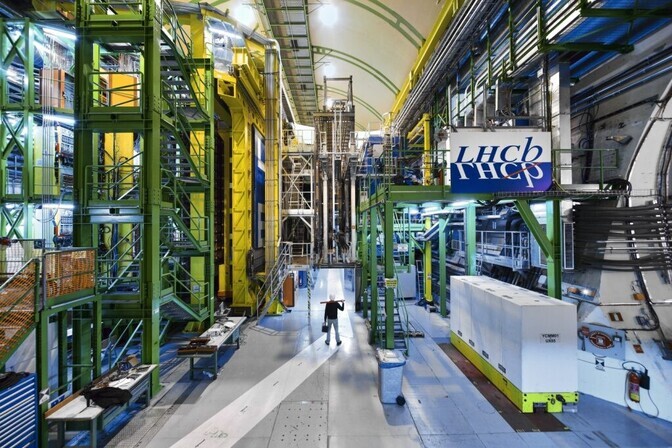
Physicists Detect Evidence of Rare Particle Decay at CERN
Photograph: Eesti Rahvusringhääling (embedded from source)
What this story says
- Physicists using the LHCb experiment at CERN have found evidence of a rare beauty particle decay into two muons.
- This decay is predicted to happen only once in every ten billion such particle decays.
- The result has a statistical significance of 3.2 sigma, which is below the five-sigma threshold required for a confirmed discovery in particle physics.
- The search for this specific particle decay has been ongoing for more than 40 years.
Who covered it
Percentages are shares of the 17 outlets carrying a published leaning rating. 20 of the 37 outlets we know ran this story carry no rating and are not counted in them. Coverage measured .
Trust
58/100
Craft
66/100
Hype
48/100
37 sources · methodology
Physicists at CERN's Large Hadron Collider have detected evidence of a rare decay of a beauty particle into two muons. The LHCb experiment's findings indicate this process, predicted to occur once in ten billion decays, has been observed with a statistical significance of 3.2 sigma. A five-sigma result is the standard for confirming a discovery in particle physics. This search has been underway for over 40 years.
Disagreement on statistical significance
While the majority of reports state the statistical significance of the finding is 3.2 sigma, EuropaWire.eu states the result is 3.2-sigma evidence. DiarioBitcoin reports evidence of a breakdown of beauty particles by ten billion, with a significance of 3.2 standard deviations. News Anyway also reports the upgraded LHCb experiment has found first evidence of the Bd to mu mu decay at 3.2 sigma.
What the coverage left out
None of the left-rated digests mention the specific statistical significance of 3.2 sigma. None of the right-rated digests mention the 40-year duration of the search for this particle decay. None of the centre-rated digests mention the 40-year duration of the search for this particle decay.
Still developing. We have re-checked which outlets are covering this 34 times, most recently on 4 Nov 2026, 04:15, and will add the sides that appear.
How each side covered it
Our own reading of the reporting listed below, written from the outlets’ articles rather than quoted from them. The reasoning is set out on our methodology page.
Left
2 rated outlets
- The left-rated reports highlighted the potential for this discovery to unravel secrets of the universe and trace dark matter. Metro News stated that humans are exploring the 'Zeptoverse,' a world 100 billion times smaller than an atom. Cumhuriyet's headline announced that the universe's lost secret is being unraveled, with scientists tracing dark matter through quark decay, suggesting a breakthrough that could rewrite theories about the universe's formation.
Centre
7 rated outlets
- Centre-rated reports focused on the rare decay process and its implications for understanding fundamental physics, often mentioning the 'Zeptoverse'. Eesti Rahvusringhääling's full report detailed the LHCb experiment's findings, quoting researchers who described the process as exceptional and a potential gateway to the 'Zeptouniverse'. The Times noted the breakthrough offers a first glimpse into this minuscule world. BBC News framed the story around the question of what the 'Zeptoverse' is and how it will transform physics, while Phys.org highlighted physicists stepping closer to the 'Zeptoverse' after a 42-year search. Science Daily's report focused on the Large Hadron Collider revealing evidence of Big Bang matter in small collisions.
Right
8 rated outlets
- Right-rated outlets largely focused on the discovery of the 'Zeptoverse' and its potential connection to new physics or dark matter. Anadolu Ajansı and anews.com.tr reported that physicists found evidence of the 'Zeptoverse' in the search for new physics, with Anadolu Ajansı adding that the decay could offer clues to dark matter. Die Presse reported researchers encountered a rare particle decay at CERN, suggesting it could provide new insights into unknown particles. Times of India and Reformatorisch Dagblad highlighted the scale of the discovery, stating scientists are exploring a world 100 billion times smaller than an atom. Dailymail.com reported British scientists peering inside the minuscule world of the 'zeptoverse'.
Questions about this coverage
- How did the left and right cover Physicists Detect Evidence of Rare Particle Decay at CERN?
- Of the 17 outlets on this story carrying a published leaning rating, 14% are rated left, 43% are rated centre, 43% are rated right. Those percentages are shares of the rated outlets, not of every outlet that ran it, which was 37. The sections above set out what each side emphasised, in its own terms.
- Is Physicists Detect Evidence of Rare Particle Decay at CERN left or right?
- Neither side dominates it. Of the 17 rated outlets on this story, 14% are rated left, 43% are rated centre, 43% are rated right, and no side holds the 70% this site would want before calling a field one-sided. A story is not left or right in any case; the outlets that carried it are what carry ratings.
- Is the coverage of Physicists Detect Evidence of Rare Particle Decay at CERN biased?
- Physicists Detect Evidence of Rare Particle Decay at CERN is one event reported by 37 outlets, and this page does not rate the story as biased or unbiased. What it publishes is the spread: which outlets ran it, where named rating organisations place each of them on the spectrum, and what each side chose to lead with. A leaning rating describes an outlet's record over time, not this article, and the two should not be run together.
- Which outlets covered Physicists Detect Evidence of Rare Particle Decay at CERN?
- 37 that we know of, every one of them listed further up this page with a link to its own report and to what we hold on the publisher. Nothing here is a summary of somebody else's summary: the outlets are named so the original reporting can be read.
- What is the significance of the new particle decay finding?
- Physicists have detected evidence of a rare beauty particle decay into two muons with a statistical significance of 3.2 sigma. This is a step towards confirming a process predicted to occur only once in ten billion decays, though it falls short of the five-sigma threshold required for a confirmed discovery in particle physics.
- How rare is this particle decay?
- The decay of a beauty particle into two muons is predicted to occur only once in every ten billion decays. This extreme rarity has made it a target for physicists for over 40 years.
- What is the 'Zeptoverse'?
- The 'Zeptoverse' refers to an extremely small scale of nature, described as being up to 100 billion times smaller than an atom. The detection of this rare particle decay offers a potential window into this minuscule world, where unknown particles and forces may exist.
Read it at the source
37 outlets, grouped by the leaning a published rating gives them. Every headline links to the original; an underlined outlet name opens our profile of that publisher.
Left
2- Humans are exploring the 'Zeptoverse' (opens Metro News in a new tab)
Metro News — is Metro News biased? Our profile of this outlet
- The Universe's Lost Secret Is Being Unraveled: Scientists Trace Dark Matter Through Quark Decay. (opens Cumhuriyet in a new tab)
Cumhuriyet — is Cumhuriyet biased? Our profile of this outlet
Centre
7- CERN Physicists Find Evidence of Ultra-Rare Particle Decay (opens sci.news in a new tab)
- Cern breakthrough offers first glimpse into the zeptoverse (opens The Times in a new tab)
- 'Zeptoverse': Scientists Have Discovered the Smallest Scale of Nature Ever Explored (opens Jornal Expresso in a new tab)
Jornal Expresso — is Jornal Expresso biased? Our profile of this outlet
- Physicists step closer to the 'Zeptoverse' after 42-year particle search (opens Phys.org in a new tab)
- Rare Decay Process Opens Window Into Zeptouniverse (opens Eesti Rahvusringhääling in a new tab)
Eesti Rahvusringhääling — is Eesti Rahvusringhääling biased? Our profile of this outlet
- Large Hadron Collider reveals evidence of Big Bang matter in surprisingly small collisions (opens Science Daily in a new tab)
Science Daily — is Science Daily biased? Our profile of this outlet
- The zeptoverse: what is it and how will it transform physics? (opens BBC News in a new tab)
Right
8- Scientists Explore the ‘Zeptoverse’ In Search For Nature’s Smallest Particles (opens tippinsights in a new tab)
tippinsights — is tippinsights biased? Our profile of this outlet
- Physicists Find Evidence of ‘Zeptoverse’ in Search for New Physics (opens Anadolu Ajansı in a new tab)
Anadolu Ajansı — is Anadolu Ajansı biased? Our profile of this outlet
- Physicists find evidence of ‘zeptoverse’ in search for new physics (opens anews.com.tr in a new tab)
anews.com.tr — is anews.com.tr biased? Our profile of this outlet
- Zeptoverse: Scientists Detect Signs of Rare Phenomenon in the World of Particles; Learn More (opens Globo in a new tab)
- Researchers Encountered Rare Particle Decay at the Cern (opens Die Presse in a new tab)
Die Presse — is Die Presse biased? Our profile of this outlet
- 100 billion times smaller than atom, scientists explore 'zeptoverse' (opens Times of India in a new tab)
Times of India — is Times of India biased? Our profile of this outlet
- Scientists Pick up Signals From Very Small Particles (opens Reformatorisch Dagblad in a new tab)
Reformatorisch Dagblad — is Reformatorisch Dagblad biased? Our profile of this outlet
- British scientists peer inside the minuscule world of the zeptoverse (opens dailymail.com in a new tab)
dailymail.com — is dailymail.com biased? Our profile of this outlet
Not rated
20- CERN Physicists Find Evidence of Rare B0 Meson Decay After 40 Years of Searches (opens Udaipur News in a new tab)
Udaipur News — is Udaipur News biased? Our profile of this outlet
- Physicists Approach "Zeptoverse" After 42 Years of Particle Research (opens Issuesfr in a new tab)
- Scientists Explore the ‘Zeptoverse’ In Search For Nature’s Smallest Particles (opens BizToc in a new tab)
- Zeptverse Explained: What Is It and How Will It Transform Physics? (opens themondonews.com in a new tab)
themondonews.com — is themondonews.com biased? Our profile of this outlet
- CERN’s LHCb Finds 3.2-Sigma Evidence for Extremely Rare Beauty-Particle Decay (opens EuropaWire.eu in a new tab)
EuropaWire.eu — is EuropaWire.eu biased? Our profile of this outlet
- CERN Finds Evidence of One-in-10-Billion Particle Event After 42-Year Search (opens abovethenormnews.com in a new tab)
abovethenormnews.com — is abovethenormnews.com biased? Our profile of this outlet
- Scientists Explore the Zeptouniverse, a World 100 Billion Times Smaller than an Atom (opens CNN Greece in a new tab)
CNN Greece — is CNN Greece biased? Our profile of this outlet
- Scientists Have Reached the "Door" of an Unknown World - What Are They Looking For? (opens ieidiseis.gr in a new tab)
ieidiseis.gr — is ieidiseis.gr biased? Our profile of this outlet
Show 12 more
- LHCb Finds Evidence of a Breakdown of Beauty Particles by Ten Billion (opens DiarioBitcoin in a new tab)
DiarioBitcoin — is DiarioBitcoin biased? Our profile of this outlet
- What Is the "Zeptoverse", the Smallest World of Nature Ever Detected, and Why It Is Key to Understanding the Universe (opens El Comercio in a new tab)
El Comercio — is El Comercio biased? Our profile of this outlet
- The Gateway to Dark Matter Has Been Opened! A Groundbreaking Discovery at CERN that Will Go Down in Scientific History. (opens Akşam in a new tab)
- Scientists at CERN Have Registered Signals on a Scale 100 Billion Times Smaller than an Atom (opens Telegraf in a new tab)
- At CERN, the Cambridge Team Detected a Signal on a Scale 100 Billion Times Smaller than an Atom. (opens Haberler in a new tab)
- Scientists Have Captured Signals From a Miniature World of Unknown Particles (opens dnevnik.bg in a new tab)
dnevnik.bg — is dnevnik.bg biased? Our profile of this outlet
- Scientists Close In on Mysterious Zeptoverse After 40-Year Hunt for Rare Particle (opens The European Magazine in a new tab)
The European Magazine — is The European Magazine biased? Our profile of this outlet
- A Thrilling Discovery in the World of Physics: We're Knocking on the Door of the Zepteuniverse. (opens Karar Gazetesi in a new tab)
Karar Gazetesi — is Karar Gazetesi biased? Our profile of this outlet
- LHCb finds first evidence of rare decay predicted once in 10 billion beauty particles (opens News Anyway in a new tab)
News Anyway
- CERN: 100 Billion Times Smaller than an Atom - Scientists Discovered Traces of an Invisible World (opens Unknown in a new tab)
Unknown
- The Physicists First Saw the Trace of Particles in the Matter of the First Moments of the Universe. (opens NEWSru.co.il in a new tab)
NEWSru.co.il — is NEWSru.co.il biased? Our profile of this outlet
- Manchester physicists step closer to the ‘Zeptoverse’ after 42-year particle search (opens manchester.ac.uk in a new tab)
manchester.ac.uk — is manchester.ac.uk biased? Our profile of this outlet
How did this read?
About the coverage, not about the story. We do not ask whether you agree with what happened — we have no honest use for that answer.
Elsewhere on the site
 Politics•2 min readBob Brooks unseats Ryan Mackenzie in Pennsylvania's 7th District
 Politics•2 min readDemocrat Zach Dembo wins Kentucky's 6th Congressional District
 Politics•2 min readPaul Pelosi gets 6-month driving ban for hit-and-run
 Politics•2 min readNed Lamont wins Connecticut governor reelection