US and Iran exchange defiant messages before new sanctions
Washington prepares to announce new economic measures that could affect Iran and its key trading partners, including China.
AI-assisted coverage comparison, editor-supervised · How this was made

US and Iran exchange defiant messages before new sanctions
Photograph: The Hindu (embedded from source)
What this story says
- The US is set to announce new economic sanctions against Iran on Monday, August 24, 2026.
- Both the US and Iran have exchanged defiant messages ahead of the sanctions announcement.
- The sanctions could affect Iran and its key trading partners, notably China, which imports over 80% of Iran's oil.
- Oil shipments through the Strait of Hormuz have reportedly halted, impacting global supply.
Who covered it
Percentages are shares of the 19 outlets carrying a published leaning rating. 4 of the 23 outlets we know ran this story carry no rating and are not counted in them. Coverage measured .
Trust
42/100
Craft
59/100
Hype
41/100
23 sources · methodology
The United States and Iran exchanged defiant messages in the lead-up to new U.S. economic sanctions planned for Monday, August 24, 2026. These sanctions are expected to impact Iran and its most significant trading partners, including China. Oil shipments through the Strait of Hormuz have reportedly come to a virtual halt. U.S. Treasury Secretary Scott Bessent is scheduled to announce the sanctions and call for China's cooperation. Data from Kpler indicates that China purchases more than 80% of Iran's shipped oil, based on 2025 figures.
Iran's response to sanctions
Iran's Foreign Ministry spokesperson, Esmaeil Baghaei, stated on Saturday, August 22, 2026, that the impending U.S. sanctions lack a basis in international law. He described the planned measures as an "assertion of extraterritorial sovereignty over every independent member state of the United Nations."
Omissions
None of the right-rated digests mention the specific figure that China buys more than 80% of Iran's shipped oil, according to 2025 data from Kpler. The left-rated reports and centre-rated reports carried this detail.
Still developing. We have re-checked which outlets are covering this 1 time, most recently on 22 Aug 2026, 14:00, and will add the sides that appear.
How other outlets pictured it
Which photograph to run is each newsroom’s own choice. The leaning beside a name is that outlet’s published rating, not a claim that the pictures divide along it. Every picture is shown from the outlet’s own server and links to the article it ran in.
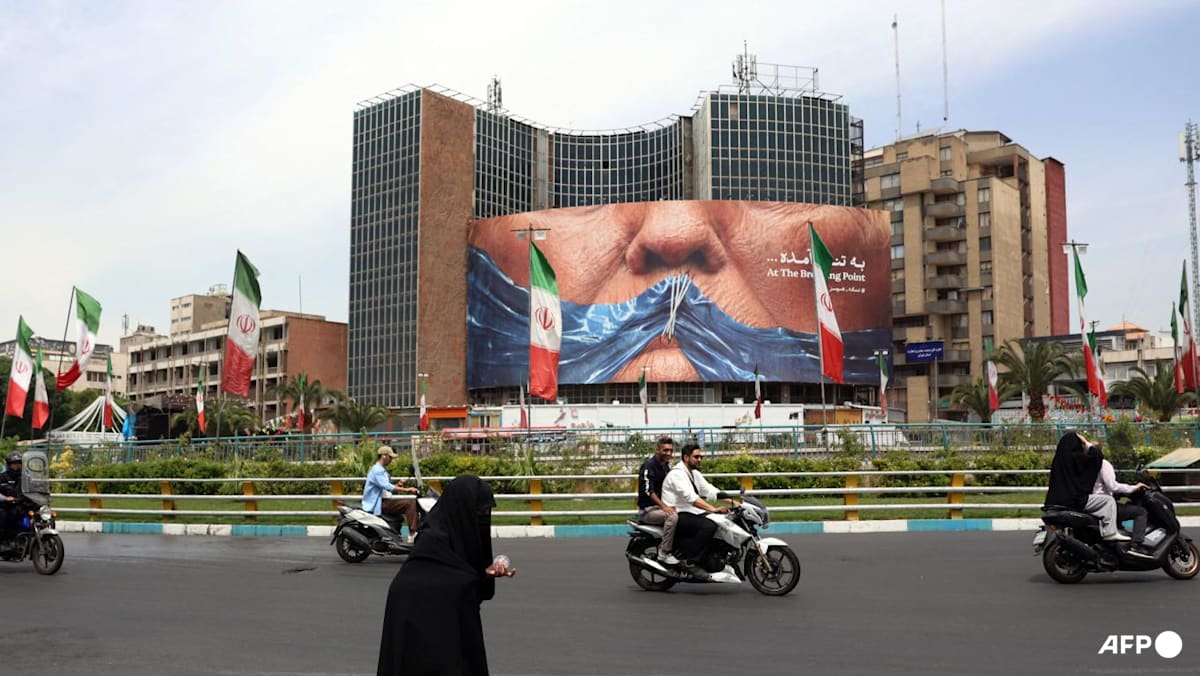
Iranians drive past a billboard featuring US President Donald Trump and the Strait of Hormuz, erected on Valiasr Square in Tehran, on May 28, 2026. (File photo: AFP)
Channel News Asia — embedded from source
How each side covered it
Our own reading of the reporting listed below, written from the outlets’ articles rather than quoted from them. The reasoning is set out on our methodology page.
Left
4 rated outlets
- Left-rated reports highlighted Iran's Foreign Ministry spokesperson Esmaeil Baghaei's statement that the new U.S. sanctions find no foundation in international law. These reports also noted that China buys more than 80% of Iran's shipped oil, according to 2025 data from Kpler. The Hindu's full report mentioned that as the war neared six months, the two sides were not exchanging fire but also not pursuing peace talks. It also included comments from Iran's parliament speaker, Mohammad Baqer Qalibaf, acknowledging the strain on Iran's economy and President Masoud Pezeshkian calling for a diplomatic solution.
Centre
8 rated outlets
- Centre-rated reports focused on the exchange of defiant messages between the U.S. and Iran ahead of the sanctions. They noted that the sanctions could impact Iran and its key trading partners, including China, and that oil shipments through the Strait of Hormuz have virtually halted. These reports also mentioned U.S. Treasury Secretary Scott Bessent's planned announcement and his call for China's cooperation. Several centre-rated digests referenced the statement from Iran's Foreign Ministry spokesperson that the sanctions find no foundation in international law.
Right
7 rated outlets
- Right-rated reports highlighted the exchange of defiant messages and warnings between the U.S. and Iran ahead of the new sanctions. They noted that the sanctions could affect Iran and its most important trading partners, such as China. Some reports mentioned disruptions in the Strait of Hormuz and rising oil prices. ARY News's digest stated that Tehran warns of retaliation, while disruptions continue in the Strait of Hormuz.
Questions about this coverage
- How did the left and right cover US and Iran exchange defiant messages before new sanctions?
- Of the 19 outlets on this story carrying a published leaning rating, 21% are rated left, 42% are rated centre, 37% are rated right. Those percentages are shares of the rated outlets, not of every outlet that ran it, which was 23. The sections above set out what each side emphasised, in its own terms.
- Is US and Iran exchange defiant messages before new sanctions left or right?
- Neither side dominates it. Of the 19 rated outlets on this story, 21% are rated left, 42% are rated centre, 37% are rated right, and no side holds the 70% this site would want before calling a field one-sided. A story is not left or right in any case; the outlets that carried it are what carry ratings.
- Is the coverage of US and Iran exchange defiant messages before new sanctions biased?
- US and Iran exchange defiant messages before new sanctions is one event reported by 23 outlets, and this page does not rate the story as biased or unbiased. What it publishes is the spread: which outlets ran it, where named rating organisations place each of them on the spectrum, and what each side chose to lead with. A leaning rating describes an outlet's record over time, not this article, and the two should not be run together.
- Which outlets covered US and Iran exchange defiant messages before new sanctions?
- 23 that we know of, every one of them listed further up this page with a link to its own report and to what we hold on the publisher. Nothing here is a summary of somebody else's summary: the outlets are named so the original reporting can be read.
- When are the new US sanctions against Iran scheduled to be announced?
- The new U.S. economic sanctions against Iran are scheduled to be announced on Monday, August 24, 2026. U.S. Treasury Secretary Scott Bessent is expected to make the announcement.
- Who could be impacted by the new US sanctions?
- The new U.S. economic sanctions are expected to impact Iran directly. They could also affect Iran's most important trading partners, with China being specifically mentioned as a key partner that imports a significant amount of Iranian oil.
- What is Iran's official response to the impending sanctions?
- Iran's Foreign Ministry spokesperson, Esmaeil Baghaei, has stated that the new U.S. sanctions find no foundation in international law. He described them as an "assertion of extraterritorial sovereignty over every independent member state of the United Nations."
- What is the status of oil shipments through the Strait of Hormuz?
- Reports indicate that oil shipments through the Strait of Hormuz have virtually halted. This disruption is a significant development, impacting global oil supply routes and potentially contributing to rising oil prices.
Read it at the source
23 outlets, grouped by the leaning a published rating gives them. Every headline links to the original; an underlined outlet name opens our profile of that publisher.
Left
4- U.S., Iran keep up hostile rhetoric ahead of new sanctions (opens The Hindu in a new tab)
- US and Iran Exchange Harsh Messages Ahead of Trump's Sanctions Announcement (opens in.gr in a new tab)
- US, Iran keep up hostile rhetoric ahead of new sanctions (opens Rappler in a new tab)
- US, Iran keep up hostile rhetoric ahead of new sanctions (opens Al-Monitor in a new tab)
Al-Monitor — is Al-Monitor biased? Our profile of this outlet
Centre
8- US and Iran Engage in War of Words Ahead of New Sanctions (opens Eesti Rahvusringhääling in a new tab)
Eesti Rahvusringhääling — is Eesti Rahvusringhääling biased? Our profile of this outlet
- Tensions Rise as U.S. Readies Toughest Sanctions on Iran (opens Devdiscourse in a new tab)
Devdiscourse — is Devdiscourse biased? Our profile of this outlet
- Iran, US keep up hostile rhetoric ahead of new sanctions (opens RTÉ in a new tab)
- U.S. and Iran keep up hostile rhetoric ahead of new sanctions (opens The Japan Times in a new tab)
The Japan Times — is The Japan Times biased? Our profile of this outlet
- US, Iran keep up hostile rhetoric ahead of new sanctions (opens Channel News Asia in a new tab)
Channel News Asia — is Channel News Asia biased? Our profile of this outlet
- Iran remains defiant as US keeps pressure, with both sides trading rhetoric ahead of new sanctions (opens TRT World in a new tab)
- US, Iran keep up hostile rhetoric ahead of new sanctions (opens WTVB in a new tab)
- US, Iran keep up hostile rhetoric ahead of new sanctions (opens Reuters in a new tab)
Right
7- US, Iran keep up hostile rhetoric ahead of new sanctions (opens Cyprus Mail in a new tab)
Cyprus Mail — is Cyprus Mail biased? Our profile of this outlet
- US, Iran trade threats as Washington prepares new sanctions (opens Daily Sabah in a new tab)
Daily Sabah — is Daily Sabah biased? Our profile of this outlet
- US, Iran Trade Warnings Ahead of New Sanctions (opens ARY News in a new tab)
- USA and Iran Exchange Statements Before Announcement About New Economic Sanctions (opens Globo in a new tab)
- US, Iran Keep Up Hostile Rhetoric Ahead of New Sanctions (opens Asharq AL-awsat in a new tab)
Asharq AL-awsat — is Asharq AL-awsat biased? Our profile of this outlet
- US, Iran keep up hostile rhetoric ahead of new sanctions - Regional Media News (opens regionalmedianews.com in a new tab)
regionalmedianews.com — is regionalmedianews.com biased? Our profile of this outlet
- US and Iran tensions rise ahead of new economic sanctions (opens The Straits Times in a new tab)
The Straits Times — is The Straits Times biased? Our profile of this outlet
Not rated
4- US and Iran Maintain Hostile Rhetoric Before New Sanctions (opens Digital Phablet in a new tab)
Digital Phablet — is Digital Phablet biased? Our profile of this outlet
- US, Iran Keep Up Hostile Rhetoric Ahead Of New Sanctions (opens Pakistan Live News in a new tab)
Pakistan Live News — is Pakistan Live News biased? Our profile of this outlet
- US, Iran keep up hostile rhetoric ahead of new sanctions (opens Egyptian Gazette in a new tab)
Egyptian Gazette — is Egyptian Gazette biased? Our profile of this outlet
- US and Iran Trade Sharp Rhetoric Ahead of New US Sanctions (opens The Times of Middle East in a new tab)
The Times of Middle East — is The Times of Middle East biased? Our profile of this outlet
How did this read?
About the coverage, not about the story. We do not ask whether you agree with what happened — we have no honest use for that answer.
More in Politics
All Politics →

Elsewhere on the site
 Business & Economy•5 min readUS military opens shipping corridor in Strait of Hormuz carrying 10 million barrels of oil daily
 Business & Economy•5 min readTrump announces new Iran sanctions plan as oil prices rise
 Conflict & Security•3 min readNATO Commander Discusses Strait of Hormuz Navigation Options
 Conflict & Security•3 min readPentagon: 757 US service members wounded in Iran conflict