Lake Powell and Lake Mead hit record lows as US unveils water cuts
The two reservoirs supply water and power to 40 million people across seven states amid a 25-year drought
AI-assisted coverage comparison, editor-supervised · How this was made
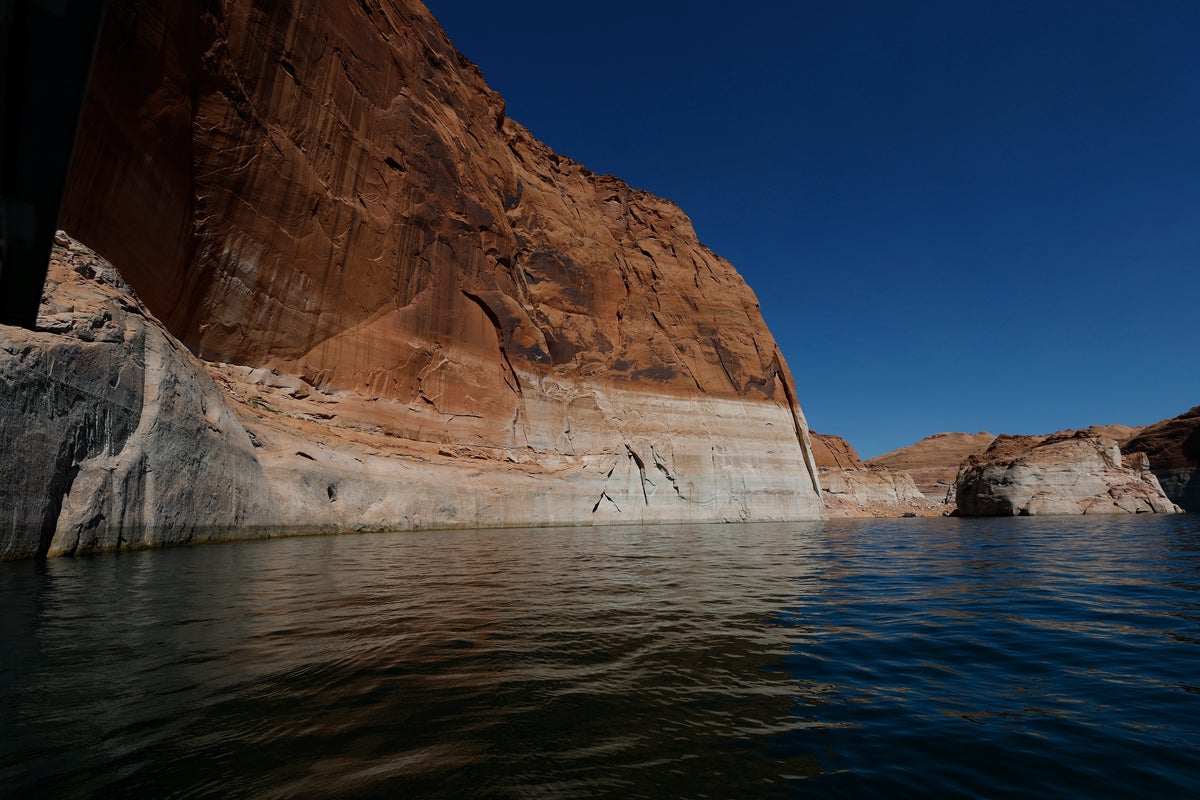
Water levels in Lake Powell, America’s second-largest reservoir, fell to historically low levels in August (Getty)
Photograph: The Independent (US) (embedded from source)
What this story says
- Lake Powell’s water level fell to 3,519.8 feet on 16 August 2026, the lowest since it was filled in the 1960s.
- Lake Mead’s elevation dropped to 1,039.83 feet on 17 August 2026, also a record low, according to the U.S. Bureau of Reclamation.
- The U.S. Department of the Interior released a framework requiring 3 million acre-feet of annual water cuts through 2036, which Arizona’s governor criticised as federally imposed.
- The reservoirs supply water and hydropower to 35 to 40 million people across seven western states.
Who covered it
Percentages are shares of the 7 outlets carrying a published leaning rating. 3 of the 10 outlets we know ran this story carry no rating and are not counted in them. Coverage measured .
Trust
86/100
Craft
95/100
Hype
15/100
10 sources · methodology
Lake Powell, the second-largest reservoir in the United States, reached its lowest recorded water level on 16 August 2026. Data from the U.S. Bureau of Reclamation showed the elevation at 3,519.8 feet, 3.8 feet below the level a month earlier. The reservoir, which spans northern Arizona and southern Utah, had previously set a record low in April 2023.
Lake Mead, the largest U.S. reservoir, also hit a record low on 17 August 2026. Its elevation fell to 1,039.83 feet, more than 23 feet below its level at the start of the year. The Bureau of Reclamation projected in July that Lake Mead’s water level would drop below 1,110 feet by July 2028, nearly 120 feet below the benchmark for a full pool.
The two reservoirs, both fed by the Colorado River, supply water to approximately 35 to 40 million people across seven states: Arizona, California, Colorado, Nevada, New Mexico, Utah, and Wyoming. They also generate hydropower and support agriculture, recreation, and wildlife. The Colorado River has been in drought for more than 25 years, a situation worsened by climate change and heavy water use.
On 15 July 2026, the U.S. Department of the Interior released a water management framework requiring a mandatory reduction of 3 million acre-feet annually through 2036. The plan replaces a 2007 framework set to expire this autumn. Arizona Governor Katie Hobbs criticised the framework as unacceptable, stating that federally imposed cuts would harm the state’s economy and national security priorities.
What the coverage left out
None of the right-rated or centre-rated digests mentioned the 3 million acre-feet annual water reduction required by the federal framework. The right-rated digest and two of the three centre-rated digests did not name Arizona Governor Katie Hobbs or quote her criticism of the plan. The full report in The Independent was the only source to include the Interior Secretary’s statement on flexibility for states.
Still developing. We have re-checked which outlets are covering this 1 time, most recently on 18 Aug 2026, 01:30, and will add the sides that appear.
How each side covered it
Our own reading of the reporting listed below, written from the outlets’ articles rather than quoted from them. The reasoning is set out on our methodology page.
Left
3 rated outlets
- The three left-rated digests and the full report in The Independent led on the record low water levels and the risks to water supply and hydropower for millions of people. The Independent’s full report quoted Arizona Governor Katie Hobbs calling the federal cuts "draconian" and "unacceptable", and linked the drought to human-driven climate change. It also noted that Lake Mead’s projected decline would bring it close to the threshold where electricity production would be affected.
- The Independent’s report described the reservoirs as "critical" for seven states and framed the drought as a long-term crisis exacerbated by climate change. It quoted Interior Secretary Doug Burgum stating that the new framework provided flexibility for states to reach consensus. None of the left-rated digests mentioned the 3 million acre-feet annual reduction figure.
Centre
3 rated outlets
- The three centre-rated digests led on the record lows and the threat to electricity production. France24 and TVN noted that water levels were just above the threshold at which hydropower would be affected. Audacy’s digest described the situation as a "critical Colorado River water crisis" and mentioned the impact on water security for millions. None of the centre-rated digests mentioned the 3 million acre-feet annual reduction or Arizona Governor Katie Hobbs’ criticism of the federal plan.
Right
1 rated outlet
- The single right-rated digest, from Free Malaysia Today, led on the record lows and described the Colorado River as a "crucial resource for 40 million people". It attributed the difficulties to climate change but did not mention the federal water management framework, the 3 million acre-feet reduction, or Arizona Governor Katie Hobbs’ statement.
Read it at the source
10 outlets, grouped by the leaning a published rating gives them. Every headline links to the original; an underlined outlet name opens our profile of that publisher.
Left
3- Drought in the US: Record Low in US Reservoirs Threatens to Supply Millions of People (opens Zeit Online in a new tab)
Zeit Online — is Zeit Online biased? Our profile of this outlet
- America’s second largest reservoir is at a record low (opens The Independent (US) in a new tab)
The Independent (US) — is The Independent (US) biased? Our profile of this outlet
- America’s second largest reservoir is at a record low (opens The Independent in a new tab)
The Independent — is The Independent biased? Our profile of this outlet
Centre
3Right
1Not rated
3- America's Two Largest Reservoirs in Trouble (opens Fréttir - mbl.is in a new tab)
Fréttir - mbl.is — is Fréttir - mbl.is biased? Our profile of this outlet
- The Largest Reservoirs in the Country Are Drying up, Threatening Life in the Southwest (opens eldiariodechihuahua.mx in a new tab)
eldiariodechihuahua.mx — is eldiariodechihuahua.mx biased? Our profile of this outlet
- Two Largest US Reservoirs Hit Record Lows Amid Western Drought (opens rtl.lu in a new tab)
Questions about this coverage
- How did the left and right cover Lake Powell and Lake Mead hit record lows as US unveils water cuts?
- Of the 7 outlets on this story carrying a published leaning rating, 43% are rated left, 43% are rated centre, 14% are rated right. Those percentages are shares of the rated outlets, not of every outlet that ran it, which was 10. The sections above set out what each side emphasised, in its own terms.
- Is Lake Powell and Lake Mead hit record lows as US unveils water cuts left or right?
- Too few of the outlets on this story carry a published leaning rating to say. 7 of them do, and this site does not characterise a field under 12: at that size one newsroom filing moves the share by ten points. The percentages above are the count as it stands.
- Is the coverage of Lake Powell and Lake Mead hit record lows as US unveils water cuts biased?
- Lake Powell and Lake Mead hit record lows as US unveils water cuts is one event reported by 10 outlets, and this page does not rate the story as biased or unbiased. What it publishes is the spread: which outlets ran it, where named rating organisations place each of them on the spectrum, and what each side chose to lead with. A leaning rating describes an outlet's record over time, not this article, and the two should not be run together.
- Which outlets covered Lake Powell and Lake Mead hit record lows as US unveils water cuts?
- 10 that we know of, every one of them listed further up this page with a link to its own report and to what we hold on the publisher. Nothing here is a summary of somebody else's summary: the outlets are named so the original reporting can be read.
- How low are Lake Powell and Lake Mead now?
- Lake Powell’s water level fell to 3,519.8 feet on 16 August 2026, the lowest since it was filled. Lake Mead’s elevation dropped to 1,039.83 feet on 17 August 2026, also a record low, according to the U.S. Bureau of Reclamation. Both levels threaten water supply and hydropower for millions.
- What is the federal government doing to address the water shortage?
- The U.S. Department of the Interior released a framework requiring a mandatory reduction of 3 million acre-feet of water use annually through 2036. The plan replaces a 2007 agreement and aims to manage the Colorado River’s dwindling supply, but Arizona’s governor called it unacceptable.
- Who relies on water from Lake Powell and Lake Mead?
- The two reservoirs supply water to approximately 35 to 40 million people across seven western states: Arizona, California, Colorado, Nevada, New Mexico, Utah, and Wyoming. They also generate hydropower and support agriculture, recreation, and wildlife in the region.
How did this read?
About the coverage, not about the story. We do not ask whether you agree with what happened — we have no honest use for that answer.
More in Science & Tech
All Science & Tech →
Elsewhere on the site
 Business & Economy•5 min read30-year US Treasury yield hits 5.31%, highest since 2007 on debt and AI issuance
 Politics•5 min readPentagon orders 30 US universities to audit foreign research ties by 31 August 2026