Mars cloud forms via rare process never before seen in planetary atmosphere
Scientists discover the Arsia Mons Elongated Cloud forms without dust particles through homogeneous nucleation.
AI-assisted coverage comparison, editor-supervised · How this was made
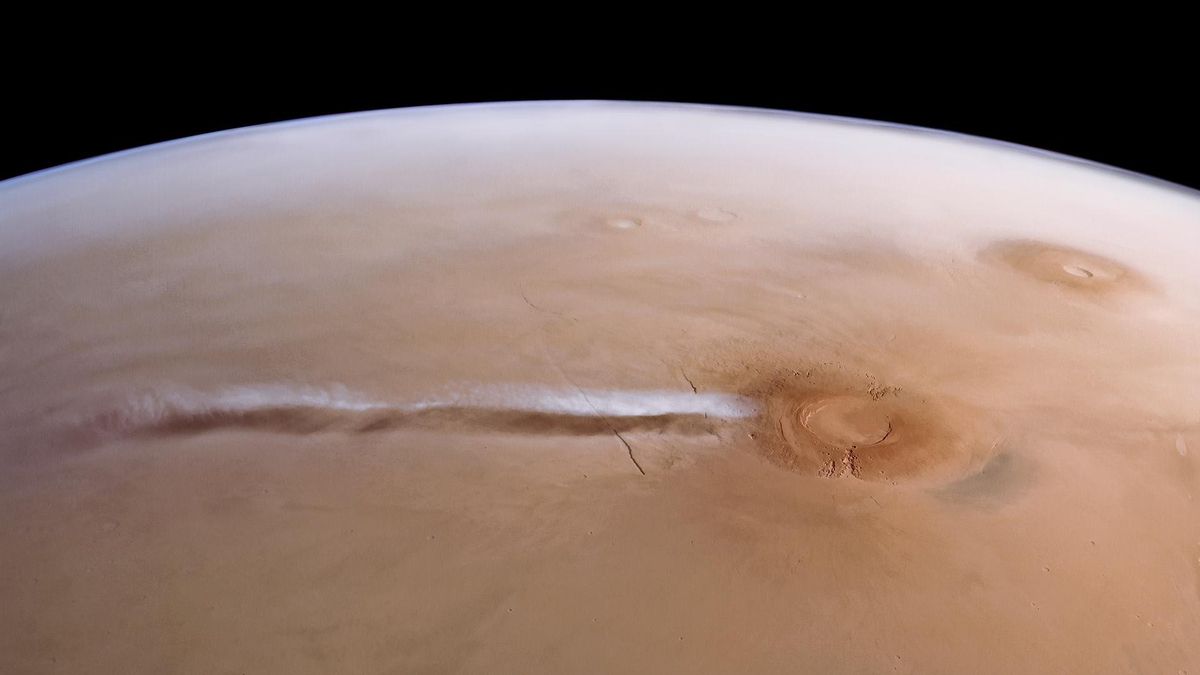
Imagen de la nube alargada de Arsia Mons tomada por la sonda Mars Express de la ESA. ESA/DLR/FU Berlin (acknowledgment: J. Cowart)
Photograph: Eldiario.es (embedded from source)
What this story says
- A giant cloud, the Arsia Mons Elongated Cloud (AMEC), forms daily near the Arsia Mons volcano on Mars during spring and summer.
- Scientists have discovered the AMEC forms through homogeneous nucleation, a process where water vapor turns directly into ice particles without needing dust.
- This is the first time homogeneous nucleation has been observed in a planetary atmosphere.
- The cloud can stretch up to 1,800 km (1,120 miles) long.
Who covered it
Percentages are shares of the 19 outlets carrying a published leaning rating. 17 of the 36 outlets we know ran this story carry no rating and are not counted in them. Coverage measured .
Trust
42/100
Craft
61/100
Hype
41/100
36 sources · methodology
A massive cloud, known as the Arsia Mons Elongated Cloud (AMEC), forms daily near the Arsia Mons volcano on Mars during the planet's spring and summer seasons. This orographic cloud is created by wind flowing past the volcano's topography and can extend up to 1,800 km (1,120 miles) in length.
New research indicates that the AMEC forms through a process called homogeneous nucleation. This involves water vapor transforming directly into ice particles without the need for dust or other impurities to act as a nucleus. This phenomenon has not been previously observed in any planetary atmosphere.
Disagreement on the novelty of the process
While the new study highlights the observation of homogeneous nucleation in a planetary atmosphere as unprecedented, Eldiario.es reports that Jorge Hernández Bernal, lead author of the study, stated that homogeneous nucleation of liquid to ice without passing through the liquid state had never been seen before. Phys.org also notes that scientists had suggested this process might take place in the upper atmospheres of Earth and Venus, but it had not been spotted.
What the coverage left out
None of the left-rated digests mention the specific dimensions of the cloud beyond its length, nor do they detail the specific temperature drop or humidity spike described in the full reports. None of the centre-rated digests mention the specific temperature drop or humidity spike described in the full reports.
Still developing. We have re-checked which outlets are covering this 4 times, most recently on 8 Oct 2026, 19:00, and will add the sides that appear.
How other outlets pictured it
Which photograph to run is each newsroom’s own choice. The leaning beside a name is that outlet’s published rating, not a claim that the pictures divide along it. Every picture is shown from the outlet’s own server and links to the article it ran in.

How each side covered it
Our own reading of the reporting listed below, written from the outlets’ articles rather than quoted from them. The reasoning is set out on our methodology page.
Left
5 rated outlets
- Left-rated reports focused on the novelty and unexpected nature of the cloud's formation process. Eldiario.es highlighted that the cloud was considered 'impossible' due to its formation via homogeneous nucleation, a process not requiring dust. The Independent and The Independent (US) also noted the 'exotic physics' involved. Mashable's report stated that Martian dust does not explain the cloud's formation, suggesting a 'wild reason' for its growth. Bdnews24.com's headline stated that scientists solved the mystery using 'exotic physics' once thought theoretical.
Centre
13 rated outlets
- Centre-rated reports frequently highlighted the unusual physics behind the cloud's formation. Phys.org stated that the AMEC may be 'even odder than previously thought' and requires 'exotic physics' not seen in action before. Multiple outlets, including ABC FOX Montana, KTEN, KAKE News, Idaho County Free Press, and iosconews.com, used similar headlines, noting the cloud was 'even more unusual than scientists thought' and mentioning its 1,800 km length. ZME Science reported that scientists 'finally think they know why' the giant cloud appears daily. The Debrief and Live Science focused on the cloud 'defying physics' and obeying 'exotic physics' never seen on Earth. Sci.news reported that the cloud may form through physics 'never before seen in planetary atmosphere'.
Right
1 rated outlet
- The single right-rated report from the New York Post used a headline stating that scientists explore the 'exotic physics' behind Mars' 'oddest cloud'.
Questions about this coverage
- How did the left and right cover Mars cloud forms via rare process never before seen in planetary…?
- Of the 19 outlets on this story carrying a published leaning rating, 26% are rated left, 69% are rated centre, 5% are rated right. Those percentages are shares of the rated outlets, not of every outlet that ran it, which was 36. The sections above set out what each side emphasised, in its own terms.
- Is Mars cloud forms via rare process never before seen in planetary… left or right?
- Neither side dominates it. Of the 19 rated outlets on this story, 26% are rated left, 69% are rated centre, 5% are rated right, and no side holds the 70% this site would want before calling a field one-sided. A story is not left or right in any case; the outlets that carried it are what carry ratings.
- Is the coverage of Mars cloud forms via rare process never before seen in planetary… biased?
- Mars cloud forms via rare process never before seen in planetary atmosphere is one event reported by 36 outlets, and this page does not rate the story as biased or unbiased. What it publishes is the spread: which outlets ran it, where named rating organisations place each of them on the spectrum, and what each side chose to lead with. A leaning rating describes an outlet's record over time, not this article, and the two should not be run together.
- Which outlets covered Mars cloud forms via rare process never before seen in planetary…?
- 36 that we know of, every one of them listed further up this page with a link to its own report and to what we hold on the publisher. Nothing here is a summary of somebody else's summary: the outlets are named so the original reporting can be read.
- What is the Arsia Mons Elongated Cloud?
- The Arsia Mons Elongated Cloud (AMEC) is a giant cloud that forms daily near the Arsia Mons volcano on Mars during its spring and summer seasons. It is an orographic cloud, meaning it forms as wind flows past the volcano's topography, and can stretch up to 1,800 km (1,120 miles) long.
- How does the AMEC cloud form?
- Scientists have discovered that the AMEC forms through a process called homogeneous nucleation. In this process, water vapor turns directly into ice particles without the need for dust or other impurities. This is a rare phenomenon that has not been observed before in a planetary atmosphere.
- Why is this cloud formation process considered unusual?
- The formation of the AMEC cloud through homogeneous nucleation is unusual because it does not require the presence of dust particles, which are typically necessary for cloud formation on Earth and were previously thought to be essential on Mars. This direct conversion of water vapor to ice has not been seen in a planetary atmosphere before.
Read it at the source
36 outlets, grouped by the leaning a published rating gives them. Every headline links to the original; an underlined outlet name opens our profile of that publisher.
Left
5- Scientists solve mystery of Mars' giant daily cloud using 'exotic physics' once thought theoretical (opens bdnews24.com in a new tab)
bdnews24.com — is bdnews24.com biased? Our profile of this outlet
- Mars’s strangest cloud is even weirder than we thought, scientists say (opens The Independent (US) in a new tab)
The Independent (US) — is The Independent (US) biased? Our profile of this outlet
- Mars’s strangest cloud is even weirder than we thought, scientists say (opens The Independent in a new tab)
The Independent — is The Independent biased? Our profile of this outlet
- The Gigantic Cloud that Forms on Mars Is Even Rarer than Expected: “Something Like This Was Considered Impossible” (opens Eldiario.es in a new tab)
Eldiario.es — is Eldiario.es biased? Our profile of this outlet
- Mars dust doesn't explain one of the solar system's weirdest clouds (opens Mashable in a new tab)
Centre
13- A Giant Cloud Appears on Mars Every Morning. Scientists Finally Think They Know Why. (opens ZME Science in a new tab)
ZME Science — is ZME Science biased? Our profile of this outlet
- Mars’ ‘oddest cloud’ may be even more unusual than scientists thought (opens iosconews.com in a new tab)
iosconews.com — is iosconews.com biased? Our profile of this outlet
- Mars’ ‘oddest cloud’ may be even more unusual than scientists thought (opens Idaho County Free Press in a new tab)
Idaho County Free Press — is Idaho County Free Press biased? Our profile of this outlet
- Mars’ ‘oddest cloud’ may be even more unusual than scientists thought (opens KAKE News in a new tab)
- Mars’ ‘oddest cloud’ may be even more unusual than scientists thought (opens KTEN in a new tab)
- Mars’ ‘oddest cloud’ may be even more unusual than scientists thought (opens ABC FOX Montana in a new tab)
ABC FOX Montana — is ABC FOX Montana biased? Our profile of this outlet
- A 1,100-Mile-Long Cloud on Mars is Defying Physics—This Unexpected Discovery May Reveal Why (opens The Debrief in a new tab)
The Debrief — is The Debrief biased? Our profile of this outlet
- Giant Martian Cloud May Form Through Physics Never Before Seen in Planetary Atmosphere (opens sci.news in a new tab)
Show 5 more
- 1,000-mile-long cloud that forms and vanishes on Mars every day obeys 'exotic physics' never seen on Earth (opens Live Science in a new tab)
Live Science — is Live Science biased? Our profile of this outlet
- The Most Curious Cloud on Mars Relies on Some Bizarre Physics (opens Nautilus in a new tab)
- They Discover a Phenomenon in the Strangest Cloud of Mars: "We Have Never Seen It Before in an Atmosphere" (opens 20minutos in a new tab)
- Mars' oddest cloud may be even odder than previously thought (opens Phys.org in a new tab)
- Scientists reveal the secret behind Mars' 'impossible' giant cloud (opens dailymail.com in a new tab)
dailymail.com — is dailymail.com biased? Our profile of this outlet
Right
1Not rated
17- Mars’ Oddest Cloud May Be Even Odder Than We Thought (opens astrobiology.com in a new tab)
astrobiology.com — is astrobiology.com biased? Our profile of this outlet
- Light Shed on the Secret of the Mysterious Martian Cloud (opens 24 HU in a new tab)
- Mars' oddest cloud is even odder than we thought, study finds (opens Knowridge Science Report in a new tab)
Knowridge Science Report — is Knowridge Science Report biased? Our profile of this outlet
- A Strange Cloud on Mars Turns Out to be... Even Weirder. (opens rmf24.pl in a new tab)
- Mars Express Suggests Exotic Physics Behind Mars' Strangest Cloud (opens Merca2.es in a new tab)
- Mars' Strangest Cloud Turned Out to Be Even More Unusual than Expected. (opens indyturk.com in a new tab)
indyturk.com — is indyturk.com biased? Our profile of this outlet
- A 1,800km Long Cloud on Mars Violates the Laws of Physics — What Could It Be (opens ТСН.ua in a new tab)
- The Gigantic Cloud that Forms on Mars Is Even Rarer than Expected: “Something Like This Was Considered Impossible” (opens elDiarioAR in a new tab)
elDiarioAR — is elDiarioAR biased? Our profile of this outlet
Show 9 more
- Unusual Giant Cloud on Mars Is Probably Created by "Exotic Physics" (opens Heise in a new tab)
- The Strangest Cloud on Mars Just Got Weirder. "Completely unexpected." (opens Spider's Web in a new tab)
Spider's Web — is Spider's Web biased? Our profile of this outlet
- Mars Ice Clouds Can Arise without Dust Particles (opens scinexx.de in a new tab)
scinexx.de — is scinexx.de biased? Our profile of this outlet
- A Cloud on Mars with a Length of 1800 Km Violates the Laws of Physics: It Should Not Exist (opens Unknown in a new tab)
UnknownOpinion
- A 1,800 km cloud on Mars points to ice born without dust, a first in nature (opens Martin Cid Magazine in a new tab)
Martin Cid Magazine — is Martin Cid Magazine biased? Our profile of this outlet
- Giant Martian Clouds Could Form Through Unique Atmospheric Phenomena (opens themondonews.com in a new tab)
themondonews.com — is themondonews.com biased? Our profile of this outlet
- Gravity Waves Over a Martian Volcano May Seed Ice Clouds Without Dust (opens Scienmag in a new tab)
- Exotic Physics on Mars: Cloud Is Created without Dust (opens nordisch.info in a new tab)
nordisch.info — is nordisch.info biased? Our profile of this outlet
- Mars’s oddest cloud may be even odder than we thought (opens The European Space Agency in a new tab)
The European Space Agency — is The European Space Agency biased? Our profile of this outlet
How did this read?
About the coverage, not about the story. We do not ask whether you agree with what happened — we have no honest use for that answer.
More in Science & Tech
All Science & Tech →
Elsewhere on the site
 Conflict & Security•3 min readArmy report cites systemic failures in deadly midair collision
 Politics•2 min readCanadian arrests in US up 60%, Global Affairs Canada reports
 Conflict & Security•3 min readUK Imposes 38 New Sanctions on Russia
 Politics•2 min readKen Paxton suggests support for federal spending cuts in leaked audio