New dinosaur Invictibellatrix amberina identified from Isle of Wight fossil
A long-clawed predator overlooked for nearly 100 years is the first megaraptoran found in Europe.
AI-assisted coverage comparison, editor-supervised · How this was made

The new species was identified from part of a fossilised skill acquired by the National History Museum in 1924
Photograph: Daily Mirror (embedded from source)
What this story says
- A new dinosaur species, Invictibellatrix amberina, has been identified from a fossil found on the Isle of Wight.
- The fossil, acquired by the Natural History Museum in 1924, had been overlooked for nearly a century.
- Invictibellatrix amberina was a long-clawed predator, three to four metres long, belonging to the megaraptoran group.
- This discovery marks the first evidence of megaraptorans in Europe.
Who covered it
Percentages are shares of the 25 outlets carrying a published leaning rating. 15 of the 40 outlets we know ran this story carry no rating and are not counted in them. Coverage measured .
Trust
60/100
Craft
67/100
Hype
45/100
40 sources · methodology
A new dinosaur species, Invictibellatrix amberina, has been identified from a fossil discovered on the Isle of Wight. The fossil, a partial skull, was acquired by the Natural History Museum in 1924 and remained unstudied for nearly 100 years. Scientists suggest that Invictibellatrix amberina was a long-clawed predator, approximately three to four metres in length, and belonged to the megaraptoran group of dinosaurs. This finding represents the first evidence of megaraptorans in Europe.
Researchers described Invictibellatrix amberina as an agile, two-legged carnivore that likely hunted smaller prey. Unlike larger predators such as Tyrannosaurus rex, which relied on powerful jaws, megaraptorans are thought to have used their long, strong arms and large claws to catch and disembowel their prey. Scientists have suggested that humans, due to their size, would have been considered suitable prey for this dinosaur.
Disagreement on dinosaur size
Reports differ on the estimated length of Invictibellatrix amberina. The Daily Mirror states the dinosaur measured between three and four metres long. Channel News Asia reports an estimate of about 16 feet (5 meters) long.
What the coverage left out
None of the left, centre, or right-rated reports mention the specific location on the Isle of Wight where the fossil was originally found by amateur palaeontologist Reginald Walter Tooley, as detailed in the Daily Mirror's full report.
Still developing. We have re-checked which outlets are covering this 5 times, most recently on 14 Oct 2026, 13:00, and will add the sides that appear.
How other outlets pictured it
Which photograph to run is each newsroom’s own choice. The leaning beside a name is that outlet’s published rating, not a claim that the pictures divide along it. Every picture is shown from the outlet’s own server and links to the article it ran in.
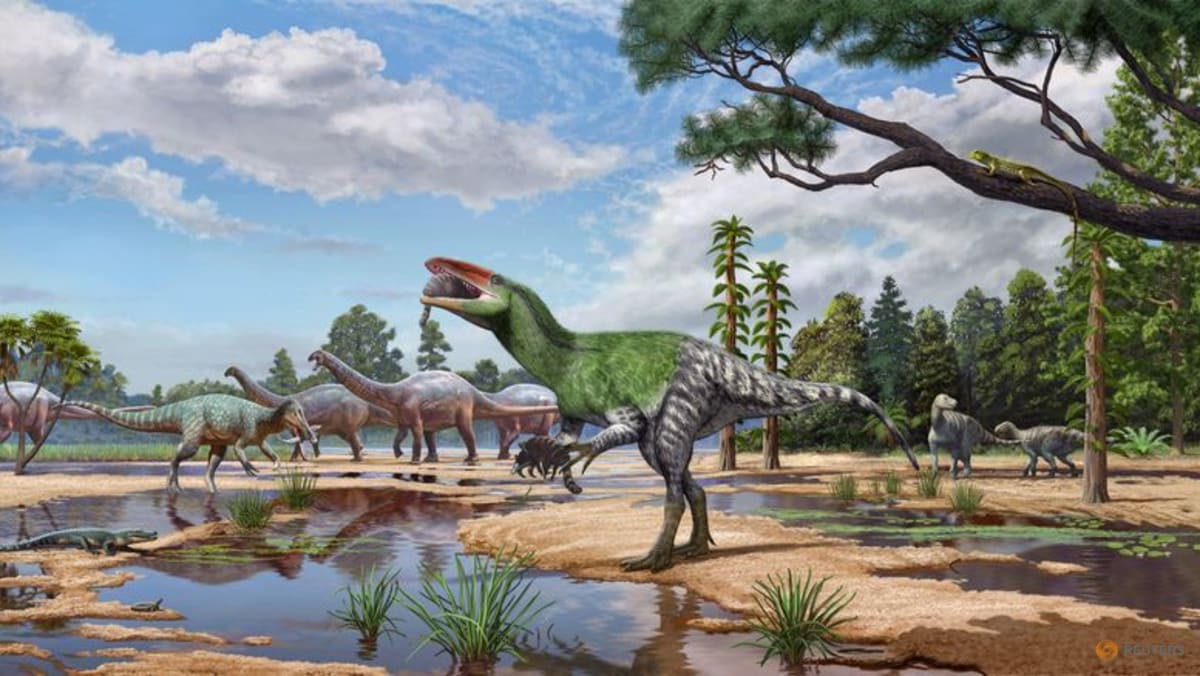
The meat-eating dinosaur Invictibellatrix amberina feeds on a mammal while grasping another in its ecosystem alongside other dinosaurs and other kinds of animals on the Isle of Wight, United Kingdom, in the Cretaceous Period around 120 million years ago, in this illustration released on October 13, 2026. Sergey Krasovskiy and Pedro Salas/Handout via REUTERS
Channel News Asia — embedded from source
How each side covered it
Our own reading of the reporting listed below, written from the outlets’ articles rather than quoted from them. The reasoning is set out on our methodology page.
Left
4 rated outlets
- The Daily Mirror's report led with the discovery of a new dinosaur species from an Isle of Wight fossil that had been overlooked for 100 years. It highlighted that scientists say humans would have been the perfect size for the tiger-sized predator to hunt. The report quoted Dr Cassius Morrison, who led the research, stating that for humans, this dinosaur would have been more dangerous than a T.rex. It also noted the dinosaur's name, Invictibellatrix, translates as 'unconquered female warrior', chosen to give hope to those who are bullied or oppressed.
Centre
17 rated outlets
- Central reports focused on the identification of Invictibellatrix amberina from a fossil acquired by the Natural History Museum in 1924. Many digests noted that the fossil had been in a drawer for a century. Several reports, including BBC News and The Echo UK, mentioned the dinosaur's length and claws, with BBC News stating it would have been up to four metres long with 20cm claws. The IW County Press highlighted that the new species was found on the Isle of Wight and described it as potentially 'more dangerous to humans than a T-Rex'.
Right
4 rated outlets
- The right-rated reports led with the discovery of a new dinosaur species from a fossil that had been overlooked for over 100 years at the Natural History Museum. GB News stated the creature, formally named Invictibellatrix amberina, represents the first megaraptoran, a group of two-legged predators renowned for their enormous claws. Business Times also noted the fossil sheds light on enigmatic meat-eating dinosaurs.
Questions about this coverage
- How did the left and right cover New dinosaur Invictibellatrix amberina identified from Isle of Wight…?
- Of the 25 outlets on this story carrying a published leaning rating, 16% are rated left, 68% are rated centre, 16% are rated right. Those percentages are shares of the rated outlets, not of every outlet that ran it, which was 40. The sections above set out what each side emphasised, in its own terms.
- Is New dinosaur Invictibellatrix amberina identified from Isle of Wight… left or right?
- Neither side dominates it. Of the 25 rated outlets on this story, 16% are rated left, 68% are rated centre, 16% are rated right, and no side holds the 70% this site would want before calling a field one-sided. A story is not left or right in any case; the outlets that carried it are what carry ratings.
- Is the coverage of New dinosaur Invictibellatrix amberina identified from Isle of Wight… biased?
- New dinosaur Invictibellatrix amberina identified from Isle of Wight fossil is one event reported by 40 outlets, and this page does not rate the story as biased or unbiased. What it publishes is the spread: which outlets ran it, where named rating organisations place each of them on the spectrum, and what each side chose to lead with. A leaning rating describes an outlet's record over time, not this article, and the two should not be run together.
- Which outlets covered New dinosaur Invictibellatrix amberina identified from Isle of Wight…?
- 40 that we know of, every one of them listed further up this page with a link to its own report and to what we hold on the publisher. Nothing here is a summary of somebody else's summary: the outlets are named so the original reporting can be read.
- What is the new dinosaur species called?
- The new dinosaur species has been named Invictibellatrix amberina. The name translates to 'unconquered female warrior' and is a reference to the amber found in the rocks where the fossil was uncovered.
- Where was the fossil found and how long was it overlooked?
- The fossil was found on the Isle of Wight and acquired by the Natural History Museum in 1924. It was overlooked for nearly 100 years before its significance was recognised by scientists.
- What kind of dinosaur was Invictibellatrix amberina?
- Invictibellatrix amberina is described as a long-clawed predator, approximately three to four metres long, belonging to the megaraptoran group. Scientists suggest it was an agile hunter that may have viewed humans as prey.
- What is the significance of this discovery for Europe?
- This discovery is significant because it is the first evidence of megaraptorans living in Europe. It helps scientists understand how this group of dinosaurs spread across the prehistoric world.
Read it at the source
40 outlets, grouped by the leaning a published rating gives them. Every headline links to the original; an underlined outlet name opens our profile of that publisher.
Left
4- New dinosaur discovered from Isle of Wight fossil 'overlooked' for 100 years (opens Daily Mirror in a new tab)
Daily Mirror — is Daily Mirror biased? Our profile of this outlet
- New species of dinosaur discovered from fossil ‘overlooked’ for over 100 years (opens The Scotsman in a new tab)
The Scotsman — is The Scotsman biased? Our profile of this outlet
- Dinosaur fossil ‘sitting in a drawer’ for 100 years identified as new T rex relative (opens The Independent (US) in a new tab)
The Independent (US) — is The Independent (US) biased? Our profile of this outlet
- Century-old UK museum specimen identified as new T rex relative species (opens The Independent in a new tab)
The Independent — is The Independent biased? Our profile of this outlet
Centre
17- Tiny Relative of the T-Rex Discovered: Fossil Lay in a Drawer for a Century (opens hna.de in a new tab)
- Tiny Relative of the T-Rex Discovered: Fossil Lay in a Drawer for a Century (opens mannheim24.de in a new tab)
mannheim24.de — is mannheim24.de biased? Our profile of this outlet
- Tiny Relative of the T-Rex Discovered: Fossil Lay in a Drawer for a Century (opens tz.de in a new tab)
- Tiny Relative of the T-Rex Discovered: Fossil Lay in a Drawer for a Century (opens merkur.de in a new tab)
- Tiny Relative of the T-Rex Discovered: Fossil Lay in a Drawer for a Century (opens Kreiszeitung in a new tab)
Kreiszeitung — is Kreiszeitung biased? Our profile of this outlet
- New species of dinosaur discovered from fossil ‘overlooked’ for over 100 years (opens The Echo UK in a new tab)
The Echo UK — is The Echo UK biased? Our profile of this outlet
- New dinosaur species 'more dangerous to humans than a T-Rex' found on Isle of Wight (opens IW County Press in a new tab)
IW County Press — is IW County Press biased? Our profile of this outlet
- Isle of Wight fossil identified as new dinosaur species (opens BBC News in a new tab)
Show 9 more
- New Dinosaur Species Which Preyed on Humans Discovered From Isle of Wight Fossil 'Overlooked' for 100 Years (opens INTELLINEWS in a new tab)
INTELLINEWS — is INTELLINEWS biased? Our profile of this outlet
- Isle of Wight fossil Europe's first known long-clawed megaraptoran dinosaur (opens Phys.org in a new tab)
- Isle of Wight fossil sheds light on enigmatic meat-eating dinosaurs (opens WTVB in a new tab)
- Isle of Wight fossil sheds light on enigmatic meat-eating dinosaurs (opens Channel News Asia in a new tab)
Channel News Asia — is Channel News Asia biased? Our profile of this outlet
- New dinosaur species found on Isle of Wight after fossil 'overlooked' for over a century (opens The News in a new tab)
- New dinosaur species discovered from fossil ‘overlooked’ for over 100 years (opens Evening Standard in a new tab)
Evening Standard — is Evening Standard biased? Our profile of this outlet
- Dinosaur with huge claws prowled Isle of Wight 120 million years ago (opens dailymail.com in a new tab)
dailymail.com — is dailymail.com biased? Our profile of this outlet
- They Identify a New Dinosaur From a Fossil that Was in a Drawer 100 Years (opens Hola News in a new tab)
- Isle of Wight fossil sheds light on enigmatic meat-eating dinosaurs ... (opens Reuters in a new tab)
Right
4- A Fossil Skull Was Hidden 100 Years in a Drawer and Now They Discover It's From a New Kind of Dinosaur. (opens Clarin in a new tab)
- Isle of Wight fossil sheds light on enigmatic meat-eating dinosaurs (opens Business Times in a new tab)
Business Times — is Business Times biased? Our profile of this outlet
- New species of dinosaur discovered from fossil 'overlooked' in Natural History Museum drawer for over 100 years (opens GB News in a new tab)
- New dinosaur species identified from Isle of Wight fossil 'overlooked ... (opens The Telegraph in a new tab)
The Telegraph — is The Telegraph biased? Our profile of this outlet
Not rated
15- After a Hundred Years, It Was Revealed that a New Species of Dinosaur Was Hidden in the Bones Gathering Dust in a Drawer (opens Heti Világgazdaság in a new tab)
Heti Világgazdaság — is Heti Világgazdaság biased? Our profile of this outlet
- New Dinosaur Species Found After Isle Of Wight Fossil 'overlooked' For A Century (opens Great Yorkshire Radio in a new tab)
Great Yorkshire Radio — is Great Yorkshire Radio biased? Our profile of this outlet
- A New Dinosaur Type, Discovered on the Basis of a 100-Year-Old Fossil. Megaraptoran, Relative to Tyrannosaurus • Newsweek Romania (opens newsweek.ro in a new tab)
newsweek.ro — is newsweek.ro biased? Our profile of this outlet
- Tiny Relative of the T-Rex Discovered: Fossil Lay in a Drawer for a Century (opens op-online.de in a new tab)
op-online.de — is op-online.de biased? Our profile of this outlet
- Researchers Identify New Dinosaur Species From Forgotten Skull Remains (opens Index in a new tab)
- New Dinosaur Species Discovered From Fossil That Was' Neglected 'For Over 100 Years (opens republika.mk in a new tab)
republika.mk — is republika.mk biased? Our profile of this outlet
- The Undefeated Warrior Lay Unnoticed for a Hundred Years. The European Megaraptor Was Worse for Humans than the T-Rex (opens TA3.com in a new tab)
TA3.com — is TA3.com biased? Our profile of this outletOpinion
- The Remains of the Mysterious Dinosaur - Onlíner Technology Have Been Found. (opens onliner.by in a new tab)
onliner.by — is onliner.by biased? Our profile of this outlet
Show 7 more
- They Identify a New Dinosaur From a Fossil that Was in a Drawer 100 Years (opens Telemundo de Puerto Rico in a new tab)
Telemundo de Puerto Rico — is Telemundo de Puerto Rico biased? Our profile of this outlet
- UK dinosaur fossil identified as new long-clawed predator (opens nhm.ac.uk in a new tab)
- Long-clawed dinosaur from Isle of Wight fossil is first megaraptoran found (opens Scienmag in a new tab)
- Invictibellatrix Amberina: New Dinosaur Found in Europe (opens lavozdemichoacan.com.mx in a new tab)
lavozdemichoacan.com.mx — is lavozdemichoacan.com.mx biased? Our profile of this outlet
- Isle of Wight fossil sheds light on enigmatic meat-eating dinosaurs (opens PressNewsAgency in a new tab)
PressNewsAgency — is PressNewsAgency biased? Our profile of this outlet
- Nearly 100 Years in a Drawer: Fossil Turns Out to Be a New Species of Dinosaur (opens bluewin.ch in a new tab)
bluewin.ch — is bluewin.ch biased? Our profile of this outlet
- Dinosaur fossil ‘sitting in a drawer’ for 100 years identified as new T-rex relative (opens Western Morning News in a new tab)
Western Morning News — is Western Morning News biased? Our profile of this outlet
How did this read?
About the coverage, not about the story. We do not ask whether you agree with what happened — we have no honest use for that answer.