Mars volcanic activity evidence found by scientists
New research suggests an inactive magma chamber may lie beneath the planet's surface.
AI-assisted coverage comparison, editor-supervised · How this was made
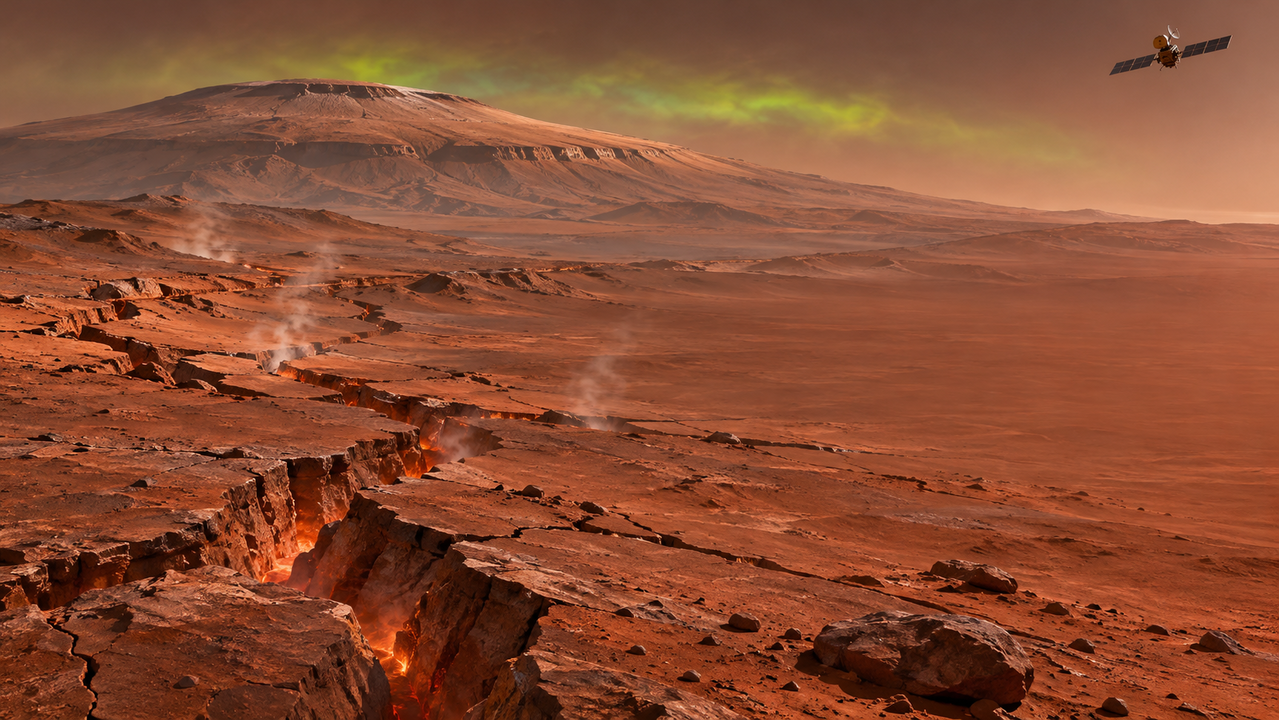
Mars volcanic activity evidence found by scientists
Photograph: Cumhuriyet (embedded from source)
What this story says
- A Russian spectrometer on the TGO spacecraft detected evidence of volcanism on Mars.
- Scientists suggest an inactive magma chamber may be present beneath the Martian surface.
- Hydrogen chloride emissions on Mars are linked to hot magma below the surface.
- The rate of Mars' volcanic eruptions has decreased substantially over billions of years.
Who covered it
Percentages are shares of the 72 outlets carrying a published leaning rating. 54 of the 126 outlets we know ran this story carry no rating and are not counted in them. Coverage measured .
Trust
78/100
Craft
77/100
Hype
35/100
126 sources · methodology
Evidence of volcanism on Mars has been detected by scientists, suggesting the planet may not be geologically dead. A Russian ACS spectrometer on the TGO spacecraft found signs of volcanic activity, according to Interfax. Researchers also believe an inactive magma chamber could be located beneath the planet's surface, as reported by glasistre.hr. An international team attributes hydrogen chloride emissions on Mars to hot magma beneath the surface, according to the Owensboro Messenger-Inquirer.
Disagreement on eruption timeline
France24, citing AFP Daniel Mège, states that Mars' volcanic eruption rate has declined over two billion years, with the most recent eruptions occurring tens of millions of years ago. IFLScience suggests that after at least two million years without an eruption, Martian volcanism might be considered to be on a brief nap.
What the coverage left out
None of the left-rated digests mention the specific finding by the Russian ACS spectrometer on the TGO spacecraft. None of the centre-rated digests mention the hydrogen chloride emissions or the inactive magma chamber possibility. None of the right-rated digests mention the specific timeline of eruption decline over billions of years or the possibility of subsoil water pockets.
Still developing. We have re-checked which outlets are covering this 104 times, most recently on 6 Nov 2026, 18:45, and will add the sides that appear.
How other outlets pictured it
Which photograph to run is each newsroom’s own choice. The leaning beside a name is that outlet’s published rating, not a claim that the pictures divide along it. Every picture is shown from the outlet’s own server and links to the article it ran in.

Camera IconMars surface Credit: BANG - Entertainment News
PerthNow — embedded from source

Mars was once overflowing with water (Picture: Getty Images)
Metro News — embedded from source
How each side covered it
Our own reading of the reporting listed below, written from the outlets’ articles rather than quoted from them. The reasoning is set out on our methodology page.
Left
20 rated outlets
- The left-rated reports highlighted the potential for volcanic activity on Mars and its implications for life. IFLScience noted that Martian volcanoes may not be dead but merely sleeping, questioning if an eruption could occur. In.gr reported that signs of volcanic activity were recorded for the first time on Mars, rekindling hopes for life and suggesting that volcanic heat could create hospitable pockets of moist water in the subsoil.
Centre
31 rated outlets
- France24's report focused on the historical decline of volcanic activity on Mars. It cited Daniel Mège, who explained that the eruption rate has been falling for two billion years, with the most recent eruptions occurring tens of millions of years ago, suggesting Mars is volcanically falling asleep.
Right
21 rated outlets
- The right-rated reports focused on the discovery of volcanic activity and its potential implications. Interfax.ru reported that a Russian spectrometer found evidence of volcanicism on Mars, suggesting modern Mars might still be volcanically active. The Owensboro Messenger-Inquirer stated that an international research team believes the release of hydrogen chloride comes from hot magma beneath the surface.
Questions about this coverage
- How did the left and right cover Mars volcanic activity evidence found by scientists?
- Of the 72 outlets on this story carrying a published leaning rating, 29% are rated left, 40% are rated centre, 31% are rated right. Those percentages are shares of the rated outlets, not of every outlet that ran it, which was 126. The sections above set out what each side emphasised, in its own terms.
- Is Mars volcanic activity evidence found by scientists left or right?
- Neither side dominates it. Of the 72 rated outlets on this story, 29% are rated left, 40% are rated centre, 31% are rated right, and no side holds the 70% this site would want before calling a field one-sided. A story is not left or right in any case; the outlets that carried it are what carry ratings.
- Is the coverage of Mars volcanic activity evidence found by scientists biased?
- Mars volcanic activity evidence found by scientists is one event reported by 126 outlets, and this page does not rate the story as biased or unbiased. What it publishes is the spread: which outlets ran it, where named rating organisations place each of them on the spectrum, and what each side chose to lead with. A leaning rating describes an outlet's record over time, not this article, and the two should not be run together.
- Which outlets covered Mars volcanic activity evidence found by scientists?
- 126 that we know of, every one of them listed further up this page with a link to its own report and to what we hold on the publisher. Nothing here is a summary of somebody else's summary: the outlets are named so the original reporting can be read.
- What evidence suggests volcanism on Mars?
- A Russian ACS spectrometer on the TGO spacecraft detected evidence of volcanic activity on Mars. Additionally, hydrogen chloride emissions have been linked by scientists to hot magma beneath the planet's surface.
- Could there be an inactive magma chamber on Mars?
- Yes, scientists suggest that an inactive magma chamber may be hiding beneath the surface of Mars, according to new research. This finding is based on traces of volcanic activity discovered.
- How has Mars' volcanic activity changed over time?
- The rate of volcanic eruptions on Mars has been falling significantly over billions of years. While the most recent eruptions occurred tens of millions of years ago, scientists suggest the planet may be in a 'sleeping mode' rather than being geologically dead.
Read it at the source
126 outlets, grouped by the leaning a published rating gives them. Every headline links to the original; an underlined outlet name opens our profile of that publisher.
Left
20- Mars: Space Probe Detects Hydrogen Chloride Near Ancient Volcano (opens Spiegel in a new tab)
- New detection from Mars orbiter suggests that the planet may still be volcanically active (opens CBC News in a new tab)
- European Satellite Detects Signs of Volcanic Activity on Mars (opens La Vanguardia in a new tab)
La Vanguardia — is La Vanguardia biased? Our profile of this outlet
- Signs of Volcanic Activity Recorded for the First Time on Mars — Hopes for Life Rise (opens in.gr in a new tab)
- Mars’s Volcanoes May Not Be Dead But Merely Sleeping. Could A Volcano Erupt On Mars Someday? (opens IFLScience in a new tab)
IFLScience — is IFLScience biased? Our profile of this outlet
- An Active Volcanoism on Mars? "We Detected a Gas that Probably Escapes Through a Crack" (opens Liberation in a new tab)
Liberation — is Liberation biased? Our profile of this outlet
- New Discovery on Mars Raises Hope for the Existence of Life (opens IndexHR in a new tab)
- Gas Is Leaking From the Surface of Mars: What Lies Beneath the Red Planet? (opens Cumhuriyet in a new tab)
Cumhuriyet — is Cumhuriyet biased? Our profile of this outlet
Show 12 more
- On Mars, Sleeping Volcanoes and a Door Open to Life (opens TVA Nouvelles in a new tab)
TVA Nouvelles — is TVA Nouvelles biased? Our profile of this outlet
- Scientists discover 'noxious gas' coming out of Mars (opens The Independent (US) in a new tab)
The Independent (US) — is The Independent (US) biased? Our profile of this outlet
- Scientists discover 'noxious gas' coming out of Mars (opens The Independent in a new tab)
The Independent — is The Independent biased? Our profile of this outlet
- Mars may not be dead? ‘Smoking gun’ suggests life on Red planet (opens ashepostandtimes.com in a new tab)
ashepostandtimes.com — is ashepostandtimes.com biased? Our profile of this outlet
- Mars may not be dead? ‘Smoking gun’ suggests life on Red planet (opens Watauga Democrat in a new tab)
Watauga Democrat — is Watauga Democrat biased? Our profile of this outlet
- Mars may not be dead? ‘Smoking gun’ suggests life on Red planet (opens The Laconia Daily Sun in a new tab)
The Laconia Daily Sun — is The Laconia Daily Sun biased? Our profile of this outlet
- Mars may not be dead? ‘Smoking gun’ suggests life on Red planet (opens Fairfield Sun Times in a new tab)
Fairfield Sun Times — is Fairfield Sun Times biased? Our profile of this outlet
- Mars may not be dead? ‘Smoking gun’ suggests life on Red planet (opens El Paso Inc. in a new tab)
El Paso Inc. — is El Paso Inc. biased? Our profile of this outlet
- Mars may not be dead? ‘Smoking gun’ suggests life on Red planet (opens Daily Post-Athenian in a new tab)
Daily Post-Athenian — is Daily Post-Athenian biased? Our profile of this outlet
- Mars: New Measurements Show Volcanic Activity – Researchers Believe Outbreaks Are Possible (opens Sueddeutsche Zeitung in a new tab)
Sueddeutsche Zeitung — is Sueddeutsche Zeitung biased? Our profile of this outlet
- New evidence of volcanic activity on Mars suggests possible life on the red planet (opens Metro News in a new tab)
Metro News — is Metro News biased? Our profile of this outlet
- Mars volcanoes might just be playing dead, new detection suggests (opens Mashable in a new tab)
Centre
31- Active volcanoes on Mars? Noxious gas discovery says (opens EarthSky in a new tab)
- ESA Probe Finds Evidence of Vulcanism Under the Mars Surface (opens mannheim24.de in a new tab)
mannheim24.de — is mannheim24.de biased? Our profile of this outlet
- ESA Probe Finds Evidence of Vulcanism Under the Mars Surface (opens merkur.de in a new tab)
- ESA Probe Finds Evidence of Vulcanism Under the Mars Surface (opens hna.de in a new tab)
- ESA Probe Finds Evidence of Vulcanism Under the Mars Surface (opens Kreiszeitung in a new tab)
Kreiszeitung — is Kreiszeitung biased? Our profile of this outlet
- The Planet Mars Is Not (Geologically) Dead, Its Volcanoes Are Simply Asleep, According to a Study (opens TF1 INFO in a new tab)
- Scientists discover 'noxious gas' seeping out of Mars (opens PerthNow in a new tab)
- Mysterious Gas over Mars’ Alba Mons Could Hint at Volcanic Activity (opens sci.news in a new tab)
Show 23 more
- European orbiter detects fresh hints of volcanic activity on Mars (opens Phys.org in a new tab)
- Gas Detected in the Martian Atmosphere May Be a Sign of Volcanic Activity (opens Discover Magazine in a new tab)
Discover Magazine — is Discover Magazine biased? Our profile of this outlet
- Sensation Finding on Mars: Research Team Finds Volcanic Gases – Is It Burning Deep in the Planet? (opens tz.de in a new tab)
- Pungent gas above Martian fissures hints at ongoing volcanism (opens WTVB in a new tab)
- Mars may not be dead? ‘Smoking gun’ suggests life on Red planet (opens The Indiana Gazette Online in a new tab)
The Indiana Gazette Online — is The Indiana Gazette Online biased? Our profile of this outlet
- Mars may not be dead? ‘Smoking gun’ suggests life on Red planet (opens romesentinel.com in a new tab)
romesentinel.com — is romesentinel.com biased? Our profile of this outlet
- Mars may not be dead? ‘Smoking gun’ suggests life on Red planet (opens mykxlg.com in a new tab)
mykxlg.com — is mykxlg.com biased? Our profile of this outlet
- Mars may not be dead? ‘Smoking gun’ suggests life on Red planet (opens charitonleader.com in a new tab)
charitonleader.com — is charitonleader.com biased? Our profile of this outlet
- Mars may not be dead? ‘Smoking gun’ suggests life on Red planet (opens Tioga Publishing in a new tab)
Tioga Publishing — is Tioga Publishing biased? Our profile of this outlet
- Mars may not be dead? ‘Smoking gun’ suggests life on Red planet (opens The Guam Daily Post in a new tab)
The Guam Daily Post — is The Guam Daily Post biased? Our profile of this outlet
- Mars may not be dead? ‘Smoking gun’ suggests life on Red planet (opens The Grand Junction Daily Sentinel in a new tab)
- Mars may not be dead? ‘Smoking gun’ suggests life on Red planet (opens SF Weekly in a new tab)
- Mars may not be dead? ‘Smoking gun’ suggests life on Red planet (opens Pacific Daily News in a new tab)
Pacific Daily News — is Pacific Daily News biased? Our profile of this outlet
- Mars may not be dead? ‘Smoking gun’ suggests life on Red planet (opens NE Iowa Publishing in a new tab)
NE Iowa Publishing — is NE Iowa Publishing biased? Our profile of this outlet
- Mars may not be dead? ‘Smoking gun’ suggests life on Red planet (opens KPVI in a new tab)
- Mars may not be dead? ‘Smoking gun’ suggests life on Red planet (opens KAKE News in a new tab)
- Mars may not be dead? ‘Smoking gun’ suggests life on Red planet (opens Idaho County Free Press in a new tab)
Idaho County Free Press — is Idaho County Free Press biased? Our profile of this outlet
- Mars may not be dead? ‘Smoking gun’ suggests life on Red planet (opens Columbia Gorge News in a new tab)
Columbia Gorge News — is Columbia Gorge News biased? Our profile of this outlet
- Mars Is Not 'Dead' Inside, but 'Inactive' (opens Hola News in a new tab)
Hola News — is Hola News biased? Our profile of this outletOpinion
- The European Mission ExoMars Detects "Possible Signs of Volcanic Activity" Under the Surface of Mars (opens Cadena SER in a new tab)
Cadena SER — is Cadena SER biased? Our profile of this outlet
- Mars isn't dead — recent volcanic activity reveals it's just sleeping (opens Space in a new tab)
- Something Weird is Seeping Out of Mars (opens National Geographic in a new tab)
National Geographic — is National Geographic biased? Our profile of this outlet
- On Mars, Sleeping Volcanoes and a Door Open to Life (opens France24 in a new tab)
Right
21- Russian-led team suspects volcanic activity on Mars (opens news-pravda.com in a new tab)
news-pravda.com — is news-pravda.com biased? Our profile of this outlet
- Scientists Detect Volcanic Gas Emissions On Mars (opens tippinsights in a new tab)
tippinsights — is tippinsights biased? Our profile of this outlet
- Mars may not be volcanically dormant after all: Hydrogen chloride discovery raises questions about underground magma and possible life (opens Times of India in a new tab)
Times of India — is Times of India biased? Our profile of this outlet
- Scientists Found Signs of Active Volcanic Activity on Mars (opens Interfax.ru in a new tab)
Interfax.ru — is Interfax.ru biased? Our profile of this outlet
- Scientists Found Signs of Current Volcanicism on Mars (opens vz.ru in a new tab)
- On Mars, Sleeping Volcanoes and a Path to Life (opens Le Figaro in a new tab)
- Energy for Living Beings?: Study: Possible Vulcanism Under Mars' Surface (opens n-tv in a new tab)
- European Scientists Discover that Mars Is Not Dead, only Asleep (opens ABC in a new tab)
Show 13 more
- Mars may not be dead? ‘Smoking gun’ suggests life on Red planet (opens Webster County Citizen in a new tab)
Webster County Citizen — is Webster County Citizen biased? Our profile of this outlet
- Mars may not be dead? ‘Smoking gun’ suggests life on Red planet (opens The Mountain Press in a new tab)
The Mountain Press — is The Mountain Press biased? Our profile of this outlet
- Mars may not be dead? ‘Smoking gun’ suggests life on Red planet (opens The Herald Palladium in a new tab)
The Herald Palladium — is The Herald Palladium biased? Our profile of this outlet
- Mars may not be dead? ‘Smoking gun’ suggests life on Red planet (opens The Elkhart Truth in a new tab)
The Elkhart Truth — is The Elkhart Truth biased? Our profile of this outlet
- Mars may not be dead? ‘Smoking gun’ suggests life on Red planet (opens The Courier-Times in a new tab)
The Courier-Times — is The Courier-Times biased? Our profile of this outlet
- Mars may not be dead? ‘Smoking gun’ suggests life on Red planet (opens Shelby News in a new tab)
Shelby News — is Shelby News biased? Our profile of this outlet
- Mars may not be dead? ‘Smoking gun’ suggests life on Red planet (opens Princeton Clarion in a new tab)
Princeton Clarion — is Princeton Clarion biased? Our profile of this outlet
- Mars may not be dead? ‘Smoking gun’ suggests life on Red planet (opens Mountain Democrat in a new tab)
Mountain Democrat — is Mountain Democrat biased? Our profile of this outlet
- Mars may not be dead? ‘Smoking gun’ suggests life on Red planet (opens Chronicle-Tribune in a new tab)
Chronicle-Tribune — is Chronicle-Tribune biased? Our profile of this outlet
- Scientists Point Out that Mars Could Hide Life in the Fissures of This Volcano (opens La Razón in a new tab)
- Bombshell 'smoking gun' evidence of Mars volcanic activity 'shows proof of life' (opens Daily Star in a new tab)
Daily Star — is Daily Star biased? Our profile of this outlet
- Probe Finds Volcanic Activity Clues Inside Mars (opens Globo in a new tab)
- Mars may not be dead? ‘Smoking gun’ suggests life on Red planet (opens Owensboro Messenger-Inquirer in a new tab)
Owensboro Messenger-Inquirer — is Owensboro Messenger-Inquirer biased? Our profile of this outlet
Not rated
54- Mars Is Not Dead: European Mission Detects Volcanic Activity Giving Indications that It Is Geologically Asleep (opens meteored.cl in a new tab)
meteored.cl — is meteored.cl biased? Our profile of this outlet
- Mars orbiter finds hidden volcanic activity near Alba Mons (opens Brighter Side News in a new tab)
Brighter Side News — is Brighter Side News biased? Our profile of this outlet
- Mars Is Not Dead, a European Probe Detects Signs of a Sleeping Magma Under Its Volcanoes (opens Clubic.com in a new tab)
Clubic.com — is Clubic.com biased? Our profile of this outlet
- Russian-led team suspects volcanic activity on Mars (opens rt-english.com in a new tab)
rt-english.com — is rt-english.com biased? Our profile of this outlet
- A Toxic Gas Has Just Been Detected on Mars: Volcanoes on the Red Planet Would Still Be Active (opens Journal du Geek in a new tab)
Journal du Geek — is Journal du Geek biased? Our profile of this outlet
- Active Volcanoes on Mars? Alba Mons Gas Reopens Its Search in the Martian Subsoil - Scintilena (opens scintilena.com in a new tab)
scintilena.com — is scintilena.com biased? Our profile of this outlet
- The Planet Mars Is Not Dead, It's just... Sleeping - What New Research Reveals (opens Έθνος in a new tab)
Έθνος
- Mars Is Not "Dead" yet: Scientists Find New Evidence of Volcanic Activity (opens daryo.uz in a new tab)
Show 46 more
- A European Satellite Detects Active Fissures in Alba Mons: Mars Volcanoes May Not Be Extinct (opens Merca2.es in a new tab)
- Volcanic Activity on the Mars. (opens IMLebanon in a new tab)
- Scientists Detect Volcanic Gas Emissions On Mars (opens BizToc in a new tab)
- Probe Detects Volcanic Gas on Mars and Suggests Active Planet (opens Revista Oeste in a new tab)
Revista Oeste — is Revista Oeste biased? Our profile of this outlet
- Detect Gas on Mars: Could Hide Volcanic Activity Beneath Its Surface (opens Independent Español in a new tab)
Independent Español — is Independent Español biased? Our profile of this outlet
- Volcanic Activity May Be Dormant Deep in the Interior of Mars (opens poslovni.hr in a new tab)
poslovni.hr — is poslovni.hr biased? Our profile of this outlet
- ExoMars Trace Gas Orbiter Detects Hints Of Volcanic Activity On Mars (opens astrobiology.com in a new tab)
astrobiology.com — is astrobiology.com biased? Our profile of this outlet
- ESA Probe Finds Evidence of Vulcanism Under the Mars Surface (opens op-online.de in a new tab)
op-online.de — is op-online.de biased? Our profile of this outlet
- Researchers Find Evidence of Volcanic Activity on Mars (opens Heise in a new tab)
- Mars: Magma Would Still Flow Into the Bowels of the Red Planet (opens sciencesetavenir.fr in a new tab)
sciencesetavenir.fr — is sciencesetavenir.fr biased? Our profile of this outlet
- European orbiter detects hints of volcanic activity on Mars (opens The European Space Agency in a new tab)
The European Space Agency — is The European Space Agency biased? Our profile of this outlet
- Mars Is Not Dead, It Is Just Sleeping: Volcanic Activity Recorded on the Planet (opens flash.gr in a new tab)
- Under the Dormant Volcanoes of Mars, Something Would Still Be happening... (opens Futura in a new tab)
- Giant Mars Volcano Spews Toxic Gas Hinting At Hidden Hot Magma (opens HotHardware in a new tab)
HotHardware — is HotHardware biased? Our profile of this outlet
- The Cracks of a Giant Volcano of Mars Release Toxic Gas that Can Come From Hidden Magma (opens SoCientífica in a new tab)
SoCientífica — is SoCientífica biased? Our profile of this outlet
- Scientists Discover 'Harmful Gas' Emitted From Mars (opens NewsBomb in a new tab)
- Mars Still Has Active Volcanoes: Discovered a Toxic Fumarola Similar to the Terrestrial Ones (opens The Social Post in a new tab)
The Social Post — is The Social Post biased? Our profile of this outlet
- An Inactive Magma Chamber May Be Hiding Beneath the Surface of Mars: Scientists Discover Traces of Volcanic Activity (opens glasistre.hr in a new tab)
glasistre.hr — is glasistre.hr biased? Our profile of this outlet
- Scientists: Mars Is Not a Dead Planet, It Is in Sleeping Mode (opens Actualno.com in a new tab)
Actualno.com — is Actualno.com biased? Our profile of this outlet
- The ExoMars Satellite Detected Signs of Volcanic Activity on Mars! (opens techgear.gr in a new tab)
techgear.gr — is techgear.gr biased? Our profile of this outlet
- Footprint of Active Volcanoes? Unexpected Traces of Gas Were Detected over Alba Mons on Mars (opens Новое Время in a new tab)
Новое Время
- Gas Detected Leaking From Cracks in Mars: Is It Volcanic Activity? (opens indyturk.com in a new tab)
indyturk.com — is indyturk.com biased? Our profile of this outlet
- Mars Is Not a Dead Planet, It's just... Sleeping, New Study Says (opens Naftemporiki in a new tab)
Naftemporiki — is Naftemporiki biased? Our profile of this outlet
- ESA’s Trace Gas Orbiter Detects Potential Signs of Volcanic Activity on Mars (opens SpaceWatch.Global in a new tab)
SpaceWatch.Global — is SpaceWatch.Global biased? Our profile of this outlet
- Mars Is Not ‘Dead’ Inside, but ‘Inactive’ (opens Telemundo de Puerto Rico in a new tab)
Telemundo de Puerto Rico — is Telemundo de Puerto Rico biased? Our profile of this outletOpinion
- Gas Detection on Mars Suggests Volcanic Activity - 05/11/2026 (opens Folha de S.Paulo in a new tab)
Folha de S.Paulo — is Folha de S.Paulo biased? Our profile of this outlet
- New Evidence: Mars Could Still Be Active Today (opens wissenschaft.de in a new tab)
wissenschaft.de — is wissenschaft.de biased? Our profile of this outlet
- Mars Shows Signs of Volcanic Activity and the Potential for Life. (opens Thanh Niên in a new tab)
Thanh Niên — is Thanh Niên biased? Our profile of this outlet
- Mysterious Gas on Mars’ Mount Aruba May Signal Volcanic Activity (opens themondonews.com in a new tab)
themondonews.com — is themondonews.com biased? Our profile of this outlet
- Mars Isn't Dead Inside, Just "Sleeping" (opens IOL Portugal in a new tab)
IOL Portugal — is IOL Portugal biased? Our profile of this outletOpinion
- Something Is "Boiling" Beneath the Surface of Mars: The Eerie "Breath" that Troubles Scientists (opens Ελεύθερος Τύπος in a new tab)
Ελεύθερος Τύπος
- European orbiter detects hints of volcanic activity on Mars (opens Nanowerk in a new tab)
- Are Volcanic Processes Still Occurring on Mars? New Data From the ExoMars Probe • Everything that Matters (opens wszystkoconajwazniejsze.pl in a new tab)
wszystkoconajwazniejsze.pl — is wszystkoconajwazniejsze.pl biased? Our profile of this outlet
- "Tuesday Is Just Asleep. A New Study Shows that Under the Surface of the Red Planet There Could Be Favorable Living Conditions (opens Stirile Pro TV in a new tab)
Stirile Pro TV — is Stirile Pro TV biased? Our profile of this outlet
- Spectacular Discovery on Mars. Scientists Say There Is "Activity Under the Surface of the Planet (opens Mediafax in a new tab)
- Mars Is Not ‘Dead’ Inside, but ‘Inactive’ (opens Proceso Digital in a new tab)
Proceso Digital — is Proceso Digital biased? Our profile of this outletOpinion
- Mars "Sleeping." An Extraordinary Discovery on the Red Planet (opens rmf24.pl in a new tab)
- Mars Is Not Dead: Recent Volcanic Activity Reveals that It Is Simply Sleeping (opens DiarioBitcoin in a new tab)
DiarioBitcoin — is DiarioBitcoin biased? Our profile of this outletOpinion
- A European Mission Detects Signs of Active Volcanoes Under the Surface of Mars: 'They Are Not Dead, only Asleep' (opens laprovincia.es in a new tab)
laprovincia.es — is laprovincia.es biased? Our profile of this outlet
- A European Mission Detects Signs of Active Volcanoes Under the Surface of Mars: 'They Are Not Dead, only Asleep' (opens lacronicabadajoz.com in a new tab)
lacronicabadajoz.com — is lacronicabadajoz.com biased? Our profile of this outlet
- A European Mission Detects Signs of Active Volcanoes Under the Surface of Mars: 'They Are Not Dead, only Asleep' (opens elcorreogallego.es in a new tab)
elcorreogallego.es — is elcorreogallego.es biased? Our profile of this outlet
- Detect Signs of Volcanic Activity on Mars (opens El Periodista Online in a new tab)
El Periodista Online — is El Periodista Online biased? Our profile of this outlet
- Mars may not be dead? ‘Smoking gun’ suggests life on Red planet (opens Sunnyside Sun in a new tab)
Sunnyside Sun — is Sunnyside Sun biased? Our profile of this outlet
- Marsorbiter Has Discovered Evidence of Volcanic Activity of the Red Planet (opens scinexx.de in a new tab)
scinexx.de — is scinexx.de biased? Our profile of this outlet
- Alien Vulcanism: Does Mars Have Active Volcanoes? (opens spektrum.de in a new tab)
spektrum.de — is spektrum.de biased? Our profile of this outlet
- Magma Chambers Under Mars? Space Probe Finds Gas Where None Should Be (opens ingenieur.de in a new tab)
ingenieur.de — is ingenieur.de biased? Our profile of this outlet
How did this read?
About the coverage, not about the story. We do not ask whether you agree with what happened — we have no honest use for that answer.