Most Distant Quasar Discovered 630 Million Years After Big Bang
The quasar, nicknamed Dun Aonghasa, is powered by a black hole 360 million times the mass of the sun.
AI-assisted coverage comparison, editor-supervised · How this was made
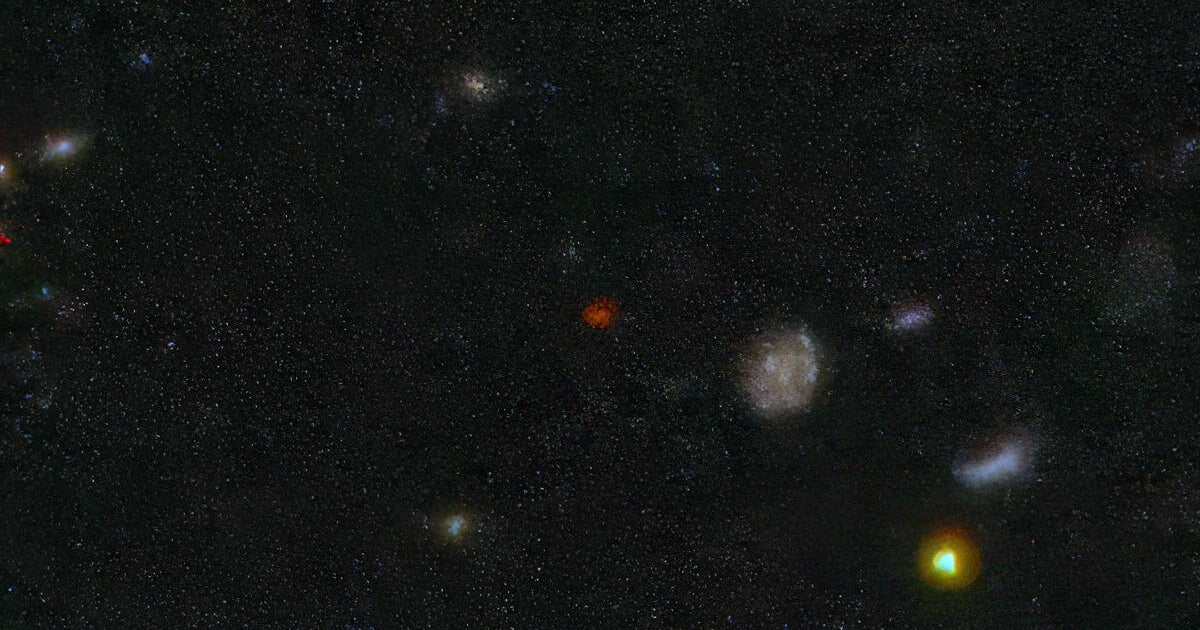
This European Space Agency's Euclid telescope image, released on Nov. 24, 2026, shows the farthest quasar known to man, visible as the red dot at the center. ESA / Euclid / Euclid Consortium / NASA, Wolf et al. 2026 via AP
Photograph: CBS News (embedded from source)
What this story says
- The most distant quasar yet has been discovered, existing 630 million years after the Big Bang.
- The quasar is powered by a black hole with a mass equivalent to 360 million suns.
- The discovery was made using data from the European Space Agency's Euclid telescope.
- The quasar has been nicknamed Dun Aonghasa by lead scientist Julien Wolf.
Scientists have discovered the most distant quasar known, dating from 630 million years after the Big Bang. This finding represents a significant leap in observing the early universe. The quasar is powered by a black hole with a mass 360 million times that of the sun. The discovery was made using data from the European Space Agency's Euclid telescope, and its findings were corroborated by the Hubble and Webb space telescopes.
The lead scientist on the study, Julien Wolf, nicknamed the quasar Dun Aonghasa. He described the discovery as a "huge leap in cosmic time," noting it pushes back the record by nearly 40 million years. The quasar's existence so early in the universe's 13.8-billion-year history, along with the immense size of its black hole, presents a new area for scientific inquiry. Scientists are observing the quasar as it was 13.1 billion years ago, when the universe was less than 5% of its current age.
Disagreement on the origin of the black hole's mass
While CBS News reports that scientists are questioning "how" the black hole had already grown to such a mass so early in time, other reports suggest potential explanations. Digests from op-online.de, mannheim24.de, kreiszeitung.de, tz.de, and La Razón mention that "huge gas clouds could explain its origin" or present "alternative explanations for the formation of Dun Aonghasa (J1504+6252)."
What the coverage left out
None of the right-rated digests mention the specific nickname "Dun Aonghasa" given to the quasar by lead scientist Julien Wolf. Similarly, none of the right-rated digests include the corroboration of the findings by the Hubble and Webb space telescopes.
How each side covered it
Our own reading of the reporting listed below, written from the outlets’ articles rather than quoted from them. The reasoning is set out on our methodology page.
Left
- Seven left-rated reports led on the discovery of the most distant quasar, with many using headlines that highlighted the record-breaking nature of the find. Associated Press News, The Independent, and The Independent (US) all stated that scientists discovered the most distant quasar yet. Stuff and The Seattle Times also reported this, with Stuff adding that the discovery "smashes previous records." Charter97.org's headline focused on the quasar revealing "one of the riddles."
Centre
- Eight centre-rated reports focused on the discovery of the distant quasar, with many using headlines that described it as a record-breaking event. CBS News, which provided a full report, highlighted that the quasar is the "farthest quasar yet" and a "record-setting oldest." Washington Top News and The Northern Virginia Daily reported that scientists discovered the quasar formed within 630 million years of the Big Bang, setting a record. Mannheimer24.de, Kreiszeitung, and TZ.de used headlines stating that "630 Million Years After Big Bang: Black Hole Devours Gas and Grows Into Cosmic Giants," suggesting a focus on the black hole's growth. Popular Science noted that the Euclid telescope "broke a record it previously set."
Right
- All five right-rated reports focused on the discovery of the distant quasar, with headlines consistently stating it was found 630 million years after the Big Bang. The Hindu Business Line reported the discovery and mentioned the black hole weighing "360 million suns." New York Post and Plaindealerin.com stated it was the "most distant quasar yet" with a black hole dating back to "nearly the dawn of the universe." La Razón's headline noted that the quasar existed when the universe was "a newborn" and questioned "how it's possible."
Questions about this coverage
- Is the coverage of Most Distant Quasar Discovered 630 Million Years After Big Bang biased?
- Most Distant Quasar Discovered 630 Million Years After Big Bang is one event reported by several outlets, and this page does not rate the story as biased or unbiased. What it publishes is the spread: which outlets ran it, where named rating organisations place each of them on the spectrum, and what each side chose to lead with. A leaning rating describes an outlet's record over time, not this article, and the two should not be run together.
- When did the newly discovered quasar form?
- The newly discovered quasar formed approximately 630 million years after the Big Bang. This makes it the most distant quasar identified to date and a significant find for understanding the early universe.
- What powers the quasar Dun Aonghasa?
- The quasar, nicknamed Dun Aonghasa, is powered by a supermassive black hole. This black hole has a mass equivalent to 360 million suns, which is an astounding size for such an early period in the universe's history.
- Which telescopes were used to discover the quasar?
- The primary discovery was made using data from the European Space Agency's Euclid telescope. The findings were subsequently corroborated by observations from the Hubble and Webb space telescopes.
Read it at the source
42 outlets, grouped by the leaning a published rating gives them. Every headline links to the original; an underlined outlet name opens our profile of that publisher.
Left
11- 13.1 Billion-Year-Old Mystery Revealed, Universe's Farthest Quasar Discovered (opens Cumhuriyet in a new tab)
Cumhuriyet — is Cumhuriyet biased? Our profile of this outlet
- The Brightest Object in the Universe Reveals One of the Riddles. (opens charter97.org in a new tab)
charter97.org — is charter97.org biased? Our profile of this outlet
- Scientists discover quasar formed within a mere 630 million years of the Big Bang, setting a record (opens Stuff in a new tab)
- Scientists discover quasar formed within a mere 630 million years of the Big Bang, setting a record (opens The Seattle Times in a new tab)
The Seattle Times — is The Seattle Times biased? Our profile of this outlet
- Scientists discover quasar formed within a mere 630 million years of the Big Bang, setting a record (opens Oskaloosa Herald in a new tab)
Oskaloosa Herald — is Oskaloosa Herald biased? Our profile of this outlet
- Scientists discover quasar formed within a mere 630 million years of the Big Bang, setting a record (opens Enid News & Eagle in a new tab)
Enid News & Eagle — is Enid News & Eagle biased? Our profile of this outlet
- Scientists discover quasar formed within a mere 630 million years of the Big Bang, setting a record (opens The Independent (US) in a new tab)
The Independent (US) — is The Independent (US) biased? Our profile of this outlet
- Scientists discover quasar formed within a mere 630 million years of the Big Bang, setting a record (opens Associated Press News in a new tab)
Associated Press News — is Associated Press News biased? Our profile of this outlet
Show 3 more
- Scientists discover quasar formed within a mere 630 million years of the Big Bang, setting a record (opens The Independent in a new tab)
The Independent — is The Independent biased? Our profile of this outlet
- Scientists discover quasar formed within 630 million years of the Big Bang (opens ABC News in a new tab)
- Scientists discover quasar formed within a mere 630 million years of the Big Bang, setting a record (opens The Record in a new tab)
The Record — is The Record biased? Our profile of this outlet
Centre
16- 630 Million Years After Big Bang: Black Hole Devours Gas and Grows Into Cosmic Giants (opens mannheim24.de in a new tab)
mannheim24.de — is mannheim24.de biased? Our profile of this outlet
- 630 Million Years After Big Bang: Black Hole Devours Gas and Grows Into Cosmic Giants (opens Kreiszeitung in a new tab)
Kreiszeitung — is Kreiszeitung biased? Our profile of this outlet
- 630 Million Years After Big Bang: Black Hole Devours Gas and Grows Into Cosmic Giants (opens tz.de in a new tab)
- Newly found farthest quasar from Earth is also record-setting oldest, scientists say (opens CBS News in a new tab)
- Oldest known quasar formed 630 million years after the big bang (opens Popular Science in a new tab)
Popular Science — is Popular Science biased? Our profile of this outlet
- Scientists discover quasar formed within a mere 630 million years of the Big Bang, setting a record (opens union-bulletin.com in a new tab)
union-bulletin.com — is union-bulletin.com biased? Our profile of this outlet
- Scientists discover quasar formed within a mere 630 million years of the Big Bang, setting a record (opens Herald Bulletin in a new tab)
Herald Bulletin — is Herald Bulletin biased? Our profile of this outlet
- Scientists discover quasar formed within a mere 630 million years of the Big Bang, setting a record (opens The Northern Virginia Daily in a new tab)
The Northern Virginia Daily — is The Northern Virginia Daily biased? Our profile of this outlet
Show 8 more
- Scientists discover quasar formed within a mere 630 million years of the Big Bang, setting a record – WTOP News (opens Washington Top News in a new tab)
Washington Top News — is Washington Top News biased? Our profile of this outlet
- The 'Euclid' Telescope Discovers a Gigantic Black Hole at the Dawn of the Universe (opens Hola News in a new tab)
- Scientists discover quasar formed within a mere 630 million years of t (opens WBAL in a new tab)
- Scientists discover quasar formed within a mere 630 million years of the Big Bang, setting a record (opens City News in a new tab)
- Scientists discover quasar formed within a mere 630 million years of the Big Bang, setting a record (opens Rutland Herald in a new tab)
Rutland Herald — is Rutland Herald biased? Our profile of this outlet
- Scientists discover quasar formed within a mere 630 million years of the Big Bang, setting a record (opens Cecil Daily in a new tab)
Cecil Daily — is Cecil Daily biased? Our profile of this outlet
- Scientists discover quasar formed within a mere 630 million years of the Big Bang, setting a record (opens WKMG in a new tab)
- Scientists discover quasar formed within a mere 630 million years of the Big Bang, setting a record (opens Winnipeg Free Press in a new tab)
Winnipeg Free Press — is Winnipeg Free Press biased? Our profile of this outlet
Right
5- Scientists discover most distant quasar yet, dating back 630 million years after Big Bang (opens The Hindu Business Line in a new tab)
The Hindu Business Line — is The Hindu Business Line biased? Our profile of this outlet
- Scientists discover quasar formed within a mere 630 million years of the Big Bang, setting a record (opens New York Post in a new tab)
New York Post — is New York Post biased? Our profile of this outlet
- They Discover a Quasar that Already Existed when the Universe Was a newborn... and We Don't Understand How It's Possible. (opens La Razón in a new tab)
- Scientists discover quasar formed within a mere 630 million years of the Big Bang, setting a record (opens plaindealerin.com in a new tab)
plaindealerin.com — is plaindealerin.com biased? Our profile of this outlet
- Scientists discover quasar formed within a mere 630 million years of the Big Bang, setting a record (opens Owensboro Messenger-Inquirer in a new tab)
Owensboro Messenger-Inquirer — is Owensboro Messenger-Inquirer biased? Our profile of this outlet
Not rated
10- 630 Million Years After Big Bang: Black Hole Devours Gas and Grows Into Cosmic Giants (opens op-online.de in a new tab)
op-online.de — is op-online.de biased? Our profile of this outlet
- An Interesting Discovery Approximately 630 Million Years After the Big Bang: The Most Distant Quasar Has Been Revealed. (opens tgrthaber.com in a new tab)
tgrthaber.com — is tgrthaber.com biased? Our profile of this outlet
- A Record-Breaking Distant Quasar Will Help Unravel the Mysteries of Black Holes (opens rmf24.pl in a new tab)
- Oldest Quasar Ever Found Detected by ESA's Euclid Telescope (opens Newsit.gr in a new tab)
- Euclid Space Telescope Discovers Oldest Quasar Ever Detected (opens ΑΘΗΝΑ 9,84 in a new tab)
ΑΘΗΝΑ 9,84 — is ΑΘΗΝΑ 9,84 biased? Our profile of this outlet
- Record. Scientists Discovered a Quasar that Formed Just 630 Million Years After the Big Bang (opens Stirile Pro TV in a new tab)
Stirile Pro TV — is Stirile Pro TV biased? Our profile of this outlet
- ESA's Euclid Space Telescope Discovers Oldest Quasar Detected to Date (opens ertnews.gr in a new tab)
ertnews.gr — is ertnews.gr biased? Our profile of this outlet
- Esa: Euclid Beats Its Record on 40 Million Year Quasars (opens Askanews in a new tab)
Show 2 more
- Scientists discover quasar formed within mere 630 mln years of the Big Bang, setting a record (opens arabtimesonline.com in a new tab)
arabtimesonline.com — is arabtimesonline.com biased? Our profile of this outlet
- Newly discovered quasar dates back to universe's early days (opens BizToc in a new tab)
How did this read?
About the coverage, not about the story. We do not ask whether you agree with what happened — we have no honest use for that answer.
More in Science & Tech
All Science & Tech →

Elsewhere on the site
 Politics•3 min readUN Report: 47,000 Women Killed by Partners or Relatives in 2025
 Politics•3 min readNY Court: Social Media Firms Not Liable for Buffalo Massacre
 Conflict & Security•5 min readEurope Security Architecture Overhaul Pushed by US, Russia
 Politics•3 min readUS envoy doubts end to Israel military aid by year's end